Against Horror driven Anthropocentric Preservationism, Fatalism & Monopolized Clout Chasing Care
By Babak Ahteshamipour
Every summer in the past 16 years Europe and North America—and not only—is affected by global warming evident through the heat waves[1][2][3] and wildfires they experience while research from the past decade highlights that the Global South, despite contributing the least to historical greenhouse gas emissions, faces disproportionate vulnerabilities to climate change due to the consequences of the endless colonial extractivist past and present that was and is being imposed on them[4][5][6].
Yet western privileged critical discourses haven’t learned their lessons and continue shifting the blame and focus on anything that threatens their own comfort zone. One such prominent example is the catastrophizing discourse surrounding artificial intelligence and data centers, in regards the resources they require to run—especially water—which in combination with global warming, heatwaves, and wildfires it seems it has become the new headlining canon that sells the most, whether in mainstream or niche artistic or critical discourses—one that is a misleading one I’d argue.
With the release of the American science fiction psychological horror film Backrooms (2026) directed and co-scored by Kane Parsons, who is the creator of the Backrooms web series, Parsons provided a different dimension to the Backrooms, that of traumatic memories, avoidance, rejection and exposure. This in combination with the return of by Scottish electronic music duo Boards of Canada with their album Inferno (2026), the fact that a day prior to the release, the White House’s social media accounts posted a video incorporating a segment of the track Deep Time with a backdrop of featuring nationalist and military imagery[7], the July 25th 2026 Berlin Pride attack—which was considered an Islamist extremist attack—and the summer 2026 Morocco–Spain border incident which promoted xenophobic rhetoric of the far-right—by calling for further surveillance and border controls—a subtracted hauntological delayed future bell is tolling and we need to take it carefully into consideration.
Blinded by Specters
Hauntology is a philosophical term coined by the French Philosopher Jacques Derrida describing how the past persistently “haunts” the present, often in the form of lost futures or postponed ones[8]. Mark Fisher approaches hauntology in a more additive sense, providing examples of leftist radical political or cultural movements or events that could have brought change for the better but were postponed in the future due to being absorbed by or cancelled out by hypercapitalist consumerism[9].
This subtracted hauntology to which I am referring to is an inversion of Fisher’s optimism; blackened events that could have happened in the past but were postponed in the future as means to completely annihilate them or delay them as much as possible, that have been aggressively manifesting in the recent past and present such as the 2026 Iran war[10][11][12], Russia’s military intervention in Ukraine[13][14][15], the creation of artificial intelligence (since 1950s)[16][17], the COVID-19 pandemic[18][19] and climate change (also since 1950s)[20][21], which makes reality horrifying, one that cannot be radically accepted, reinforcing furthermore the need for self-preservation—which the far-right discourse also leans on—: to be happy, safe and stable, a singular ambience state exactly like the one that the Hive mind proposes in the recent American post-apocalyptic science fiction television series created by Vince Gilligan Pluribus (2026—present).
This singular ambience is what the hypercapitalism has long been looking for; each one for their own; individualism, becoming easily manipulated puppets and distracted by the actual facts, fighting one each other over a unification that could actually challenge the system that is so actively trying to blind us by shoving things under the carpet, continuing lobbyist activities that are driving the planet to edge of its extinction[22].
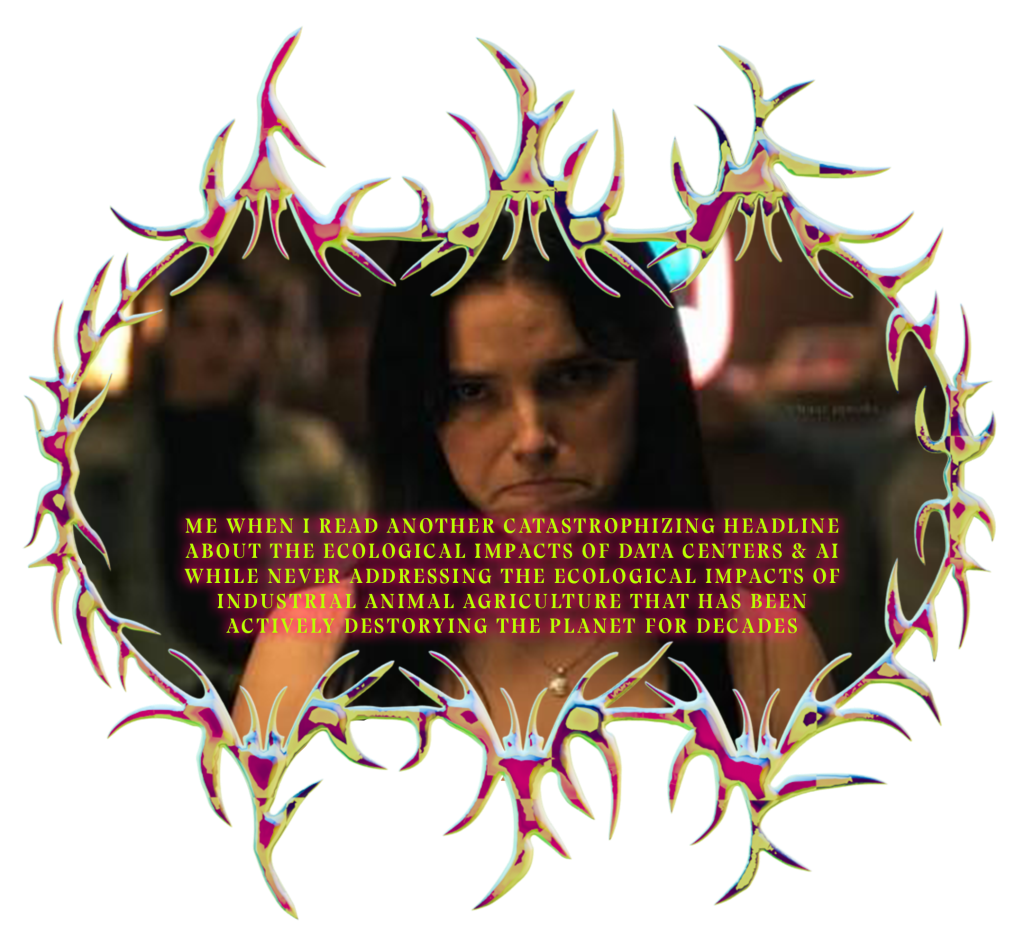
While the 0.1% of the global human population are partying[23] and are responsible for most of global emissions, the rest either suffer from weaponized environmental laws such as the new EU packaging law that requires businesses to register and pay fees in every member state where they ship products, threatening small and independent businesses, or are misdirected to believe in any kind of hyped discourse that is found “critical” by institutes that have ties with them[24][25] such as NFTs, quantum, data or artificial intelligence (AI)[26][27][28]. It is true that data centers and AI already have catastrophic environmental impacts due to the vast amounts of resources and land they require, and can pose a great ecological threat in the near future if left unchecked. However, current evidence indicates that Intensive animal farming[29][30][31], and the the fossil fuel industry[33][34] remain far larger contributors to global warming while industrial fishing[32] and the military-industrial complex[35] also contribute to environmental pressures—yet are under-discussed or even absent from critical discourses. Ever since the COVID-19 pandemic, there have been studies and papers arguing for a transition toward more plant-based dietary patterns as a means of reducing vulnerability to future zoonotic outbreaks and improving public health resilience[36][37]. Other studies have demonstrated that reducing animal-based food consumption could significantly decrease food-system emissions, land and resource use, and biodiversity loss with some models estimating reductions approaching 75% in specific environmental impacts under global dietary shifts[38][39].
A specific study that counters the argument that “we don’t need AI, but we need food”, therefore we cannot critically approach the ecological footprint of agriculture is The opportunity cost of animal based diets exceeds all food losses (2018) by Alon Shepon, Gidon Eshel, Elad Noor and Ron Milo where they underline that “[…] replacing all animal-based items with plant-based replacement diets can add enough food to feed 350 million additional people […]”. Their thesis is based on how much of food production is lost due to leaky supply chains or spoilage but also because of the vast amounts of food needed for feeding “livestock”. The argument therefore should make the distinction that “food” does and should not equate to animal based food. So the real question is not whether we need food, rather what kind of food.
Discussions surrounding dietary transitions often remain disconnected from their own historical and political conditions. Just as how AI training is an extension of post-colonization due to the fact that most of the training is done by hiring low-wedge workers in Africa and Asia, plant-based diets are not something new: historically many Indigenous cultures diets were plant-based; until they were reshaped by colonialism and the dietary change imposed on them through European livestock economies and export-oriented agriculture resulting in the displacement of the Indigenous food practices and the embedment of animal exploitation within broader systems of extraction[40][41][42]. Even though extractivism became a fashionable conceptual framework within critical theory and artistic practices over the last decade, addressing colonial resource extraction and later shifting toward data, AI, and technology[43][44], industrial animal agriculture continues to remain marginal within artistic[45][46], media[47][48][49] and philosophical discussions[50][51].
This representational omission extends far beyond discussions of animal agriculture. Even when critical and artistic discourses engage directly with war and the military-industrial complex, they overwhelmingly narrate violence through human suffering, geopolitical strategy, or technological infrastructures, rarely acknowledging the countless nonhuman animals who are forcibly conscripted into warfare without any consent. Horses, dogs, mules, pigeons, dolphins, and many other species have long been transformed into military technologies, transporting soldiers and supplies, detecting explosives, delivering messages, locating survivors, or serving as expendable bodies in conflicts they neither initiated nor could refuse[52]. The same anthropocentric hierarchy structures media representations of genocide and climate change: headlines foreground human casualties, displacement, and economic losses, while the deaths, displacement, and starvation of the nonhuman animals and the more-than-human always comes secondary or not even considered[53][54][55].
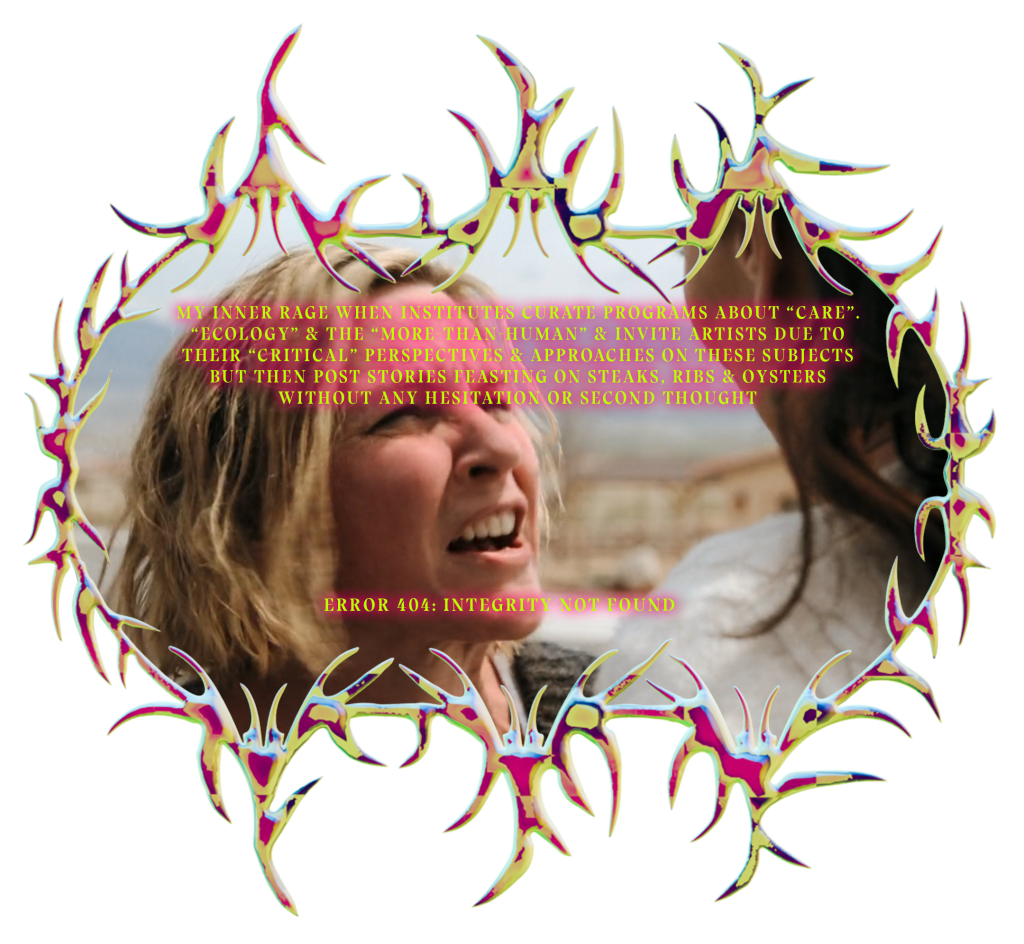
This comes into contrast to being critical; the critical artistic discourse seems that it doesn’t want to change, accept the truth, because it’s wired as it is: a singular delusional circle jerking bubble that dine on meat, oysters and drink wine while curating events about the harmful impacts of data centers and the ethical concerns regarding AI while also benefiting from them: from smartphones to computers, cars to jet fuel, packaged food to mass produced clothes and deforestation to genocide, everyone and every being is trapped within hypercapitalist consumerism, yet pretentiously deny that they are be part of the non-playable character (NPC) crowd: those who do not question authority, and display conformity and obedience towards the system.
This approach has been mistakenly interpreted as being accelerationist, sitting or becoming one with hypercapitalism exploiting and accelerating its own internal contradictions with the intention of pushing it to its own demise. Yet not exactly. Left-wing accelerationists—inspired by Mark Fisher and later articulated in the #ACCELERATE Manifesto—fundamentally reject the idea of giving up agency and standing by waiting for the collapse to arrive. They argue that capitalism artificially suppresses technological development and they propose repurposing the technological infrastructures, automation, and logistics created by capitalism to build a post-capitalist society.
However, right-wing accelerationist—pioneered by Nick Land—pushes capitalist dynamics to their absolute extreme. It embraces runaway market forces and rapid technological advancement and rejects human oversight or democratic attempts to control the process. Rather than hoping for a utopian outcome, this strand of accelerationism insists on capitalism’s destructive momentum as an unstoppable singularity that will eventually transcend or destroy human civilization altogether, bringing about a transhumanist technofascist future.
Lastly in 2024 with the release of Cute Accelerationism by Amy Ireland and Maya B. Kronic, a new strand of accelerationism is proposed, one that advocates for a hyper-engaged, joyful submission to capitalist processes and technology through the aesthetics of cuteness and identity production. Rather than adopting a defensive, moralizing posture against capitalism, it proposes to weaponize the aesthetic of cuteness against capitalism’s own mechanisms.
Just as critical discourse ignores the structural violence underpinning ecological collapse while aestheticizing its symptoms, Cute Accelerationism’s framework remains overwhelmingly anthropocentric. While it discusses emojis, anime, memes, and reels, it rarely considers the position of animals whose bodies and images already constitute a significant part of the internet’s economy of cuteness.[56][57] If cuteness can be weaponized politically, then the question of who or what is being weaponized—and whether that subject consented to be weaponized—becomes unavoidable. Furthermore animals enter the AI slop circulation with the cute AI-generated animal videos—often anthropomorphized—which gives a mechanical layer to animals, bringing them closer to AI affectively, as means to ends for human consumption, comfort and stabilization, just like AI.
The Anthropomimetic Syndrome
The inability of accepting our own contradictions and hypocrisy seems so horrifying that leads to becoming another Clark—the protagonist of Backrooms: trying immensely to change, yet being stuck in rejectionist loops. A symptom of this dread is 2020s cinema being possessed by horror movies[58], from Indie ones such as Titane (2021), The Substance (2024) and Obsession (2025) or to major title comebacks such as Saw X (2023), Resident Evil (2026) and Insidious: Out of the Further (2026). Following Julia Kristeva’s concept of abjection, horror stages the traumatic return of everything anthropocentric culture struggles to accept: decomposition, death, contamination, and the collapse of the boundaries through which we maintain the illusion of control[59]. Trauma itself is hardly new; what is unprecedented is the degree to which contemporary subjects are persistently exposed to it through 24/7 news cycles, algorithmically curated social media feeds, doomscrolling, livestreamed wars, ecological disasters, and pandemics. Horror cinema therefore offers a paradoxically safe encounter with the abject: it allows the unbearable to be approached symbolically, transforming existential anxiety into an experience that can be witnessed, contained, and survived—yet not experienced.
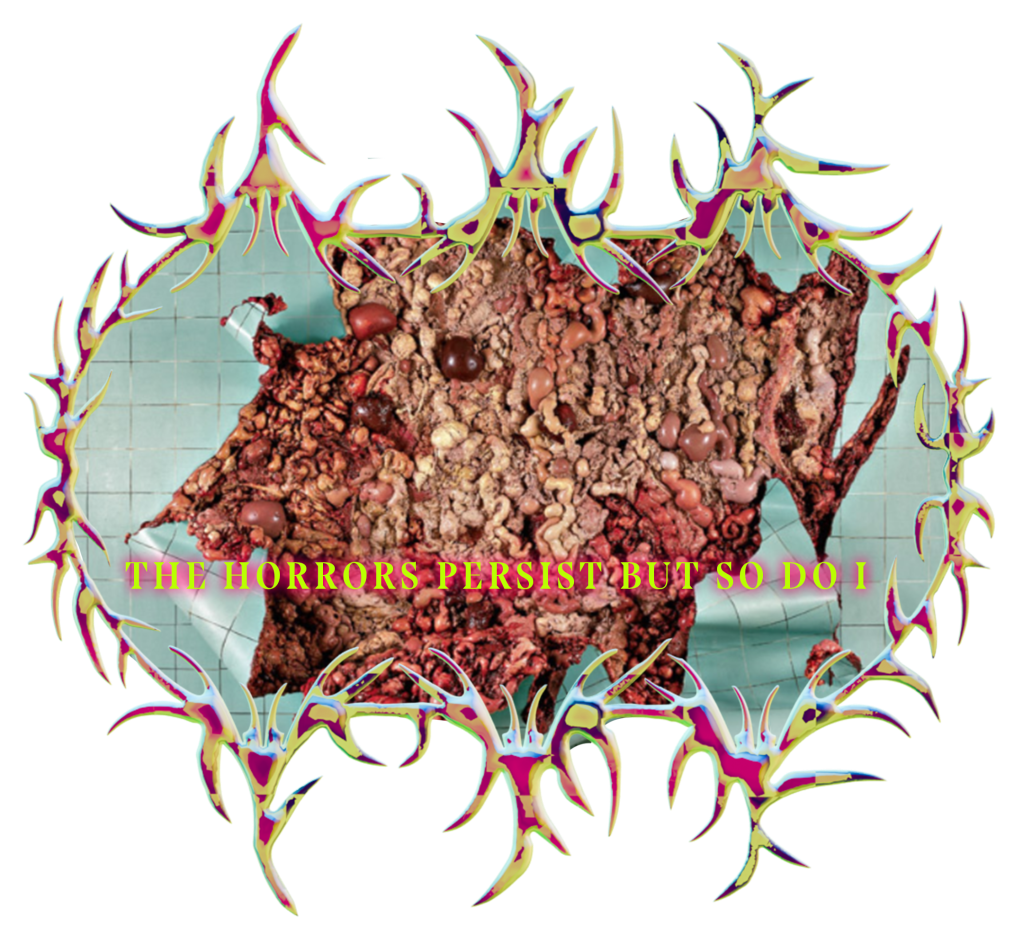
Eugene Thacker makes three distinctions with which we interact with the cosmos: the world-for-us, which is the world as we directly interact, interpret, and grant meaning to; the world-in-itself (or the Real in a Lacanian sense), which is the cosmos as it is and accessed and deciphered through science, and the world-without-us, which is the subtraction of the human element from the cosmos, and is therefore spectral and speculative[60].
Anthropocentrism causes the anthropological to have a hysteric obsession over controlling the world-in-itself to the extent that it’s impossible due to human kind’s limited perception and knowledge. It therefore suppresses it and does not want to accept a world-without-us: that the cosmos is vast, infinite and indifferent, doesn’t care about human beings, and hence as Thacker puts it, a cosmic pessimism emerges. This suppression becomes an existential abjection and once the world-for-itself manifests itself in perceivable ways that the human intelligence can decipher yet fails to control or contain it within the-world-for-us, it transforms into something horrifying that needs to be repressed. Such manifestations of the world-in-itself could be earthquakes, volcanoes, climate change, black holes merging or even smaller scale ones such as cancer, a global pandemic or a self-immune disease.
Anthropocentrism is also driven by an obsession with preservation. It repeatedly produces cultural narratives centered on saving: saving civilization, saving memories, saving “nature”, and ultimately saving humanity from extinction. This preservationist impulse permeates contemporary media, from superhero franchises and post-apocalyptic narratives to the archival logic of digital technologies, where every interaction is expected to be saved, stored, backed up, and updated. The backlash following Sony PlayStation’s announcement that it would cease releasing physical games by 2028 illustrates this preservationist logic. While concerns over ownership, modification, and agency as the main reasons for the backlashed reactions, it also revealed a deeper desire to preserve material memory itself. Physical copies became more than software: they are archives of childhood, spaces, rituals, and the tactile culture of 1990s and early-2000s gaming, resisting their reduction to ephemeral digital licenses.
Another phenomenon that touches upon the disappearance of physical media is the fact that AI firms have been purchasing old physical books that were published before 2022—pre-Large Language Models (LLM) era—only to scan them to train their models which as ISBNdb cites leads to destroying the books because “workers slice off the spine so the loose pages feed through a machine, which is faster and cheaper than the careful alternative.” This results in a data extraction since after the training the books are destroyed and mashed while the companies keep the digital scans.
Anthropocentrism’s obsession with preservation extends beyond memories and cultural artefacts into environmental politics itself. As T.J. Demos[61] argues, framing ecological crises through concepts such as the Anthropocene often leaves intact the political and economic structures responsible for it, encouraging neoliberal interventions such as geoengineering, genetic engineering, nanotechnology against transnational alliances of environmentalists, animal right advocates, climate activists, and indigenous activists who provide alternative politics, as a call to form a biopolitical assemblage against the insatiable hunger of technocapitalism. The objective is no longer to change the system but to preserve it; to “save” the ecosystems without fundamentally altering the conditions that produced the crisis. Claire Colebrook argues that we need a post-Anthropocene approach to perceive the world as something broader than the narrow anthropocentric lens:
“One can only open up to this post-Anthropocene point of view if we start to view this world beyond the bounds of climate, and see climate as one expression—among many—of a broader time and broader (inhuman) life.”[62]
Anthropocentric preservationism leaks all over AI training as well: LLMs are overwhelmingly trained based on human intelligence and knowledge[63][64], thus undermining other forms of nonhuman animal or more-than-human intelligence or considering them less evolved or complex forms of intelligence. As James Bridle underlines in Ways of Being (2022):
“To define intelligence simply as what humans do is the narrowest way we could possibly think about it – and it is ultimately to narrow ourselves, and lessen its possible meaning. Rather, by expanding our definition of intelligence, and the chorus of minds which manifest it, we might allow our own intelligence to flower into new forms and new emergent ways of being and relating. The admittance of general, universal, active intelligence is a necessary part of our vital re-entanglement with the more-than-human world.”[65]
Anthropocentrism is also evident when interacting with LLMs and generative AI (GenAI) due to the fact that they have been trained with a focus on giving the impression to the user that they are interacting with a human being. LLMs hallucinate and distort facts[66] because reinforcement learning from human feedback (RLHF) rewards them for being helpful, polite, and agreeable. They prioritize conversational agreeableness, stylistic plausibility, and user validation—known as sycophancy—over providing facts. LLMs and GenAI in reality are guess-working machines or stochastic parrots, systems that rely on advanced pattern-matching, statistical correlation, and rote memorization to mimic text or media without a real conceptual framework or thinking[67][68].
AI is neither an autonomous historical destiny nor merely a capitalist conspiracy. Computational systems capable of extending cognition would likely have emerged under many different social arrangements because they answer longstanding epistemic and scientific problems.[69] More fundamentally, as Andy Clark argues, human cognition has never been confined to the biological brain but has always been constituted through dynamic interactions with external cognitive supports. AI therefore belongs to a much longer trajectory of cognitive extension rather than representing an exclusively capitalist invention[70].
Recent research demonstrates that LLMs and AI agents, when integrated with assistive technologies, can substantially improve accessibility for people with Down Syndrome (DS), Attention-Deficit/Hyperactivity Disorder (ADHD), visual or hearing impairment or other cognitive needs[71][72]. Such developments reinforce the arguments that underline how AI should not be understood solely through narratives of automation or technocapitalist efficiency, but also through its capacity to extend agency, research and accessibility.
Yet these emancipatory possibilities are inseparable from the ethical nuances underpinning AI development. Most models have been trained on enormous quantities of copyrighted, personal, and sensitive data—including medical and healthcare records, clinical texts, and patient interactions[73][74]—often without the explicit knowledge or informed consent of the individuals whose data contributed to these systems[75]. This extractive practice raises concerns regarding autonomy, privacy, ownership, knowledge, intelligence, and trust, particularly when vulnerable populations simultaneously become both the beneficiaries of AI-assisted accessibility and the degree to which everyday life increasingly depends upon, especially under technocapitalism, where AI has become indispensable due to the neoliberal chronopolitics that relentlessly accelerates production, consumption, and innovation for a never-ending optimization that eventually transforms computational assistance from a convenience into an unavoidable tool[76].
However, by focusing on the symptoms, we actively ignore the root of the problem: the system; and that’s exactly what actually this ignorance does, it serves the system. In the same manner, anthropocene is a symptom of anthropocentrism, it’s not the root of the problem; human beings have not destabilized nature, but have created a stabilized image of a nature that it perceives as volatile and imposed a hypercapitalist view on it. So in order to exit from the anthropocene it wouldn’t be to get back to a stable nature, rather to imagine a different volatile state.
Just as Thacker suggests that we cannot accept the world-in-itself because we cannot imagine a world-without-us due to our deeply self-centered anthropocentrism, and Colebrook argues, we need to envision an inhuman perception that imagines planetary processes independent of human-centered synthesis. Niall Scott proposes the term blackened ecology in the essay Blackening the Green (2014), based on black metal theory, to argue that nature cannot be contained within anthropocentric discourse which inevitably attempts to draw meaning from it:
“Blackening embraces the purposelessness thoroughly: there is no purpose, no goal nor end in nature; there is not even negation, there is nothing, only a final endstille. The obliteration of the observer leads to the removal of purpose, with no mind present to intend.”[77]
Blackened ecology therefore rejects attempts to reconcile humanity with nature through moral or spiritual narratives. Rather than seeking harmony within nature, it insists on the indifference of nature–or the universe or the Real–to the world-for-us. It is an ecological perspective grounded not in hope but in the decentering of the anthropocentric gaze.
Blackened ecology aligns also with queer ecology, which rejects dualistic notions such as natural and unnatural, alive or not alive or human or not human, and posits that posits that any and all ideas of “nature” and “natural” must be understood as human perspectives, not inherent properties of matter and being. In fact there is no such thing as nature. Nature is a symbolic construct, an other, created by extractivist discourses with the intention of conquering and profiting from it or its catastrophes: for instance making fuel from dead plankton and algae (petroleum)—and yes petroleum is not made from Dinosaurs[78]. The world can exist without us and anthropocentrism finds that traumatic. But in the end it is not about us.
Fatality! Finish us!
Tracking back to Backrooms, it seems that staying unaltered, in an exceptionalist and anthropocentric comfort zone while performatively approaching radical change and care is how hypercapitalism, patriarchy and social Darwinism wants us to believe we are wired, like Clark. Maybe AI is not a symptom, rather a sithome: what Lacan coined as a stabilizing structure that anchors a person’s psychic life and helps them function. Maybe it’s time to identify with humanity’s need for technology in a symptomatic way: identification with the sinthome. This means accepting and creatively embracing this singular, idiosyncratic “tick” or trait, recognizing it as the fundamental, stabilizing support of humanity’s wires.
A fatalistic take on this approach is delivered in Exocapitalism (2025) by Marek Poliks & Roberto Alonso Trillo: technocapitalism is out of control, it doesn’t care about anything else besides itself, it’s an insatiable machine that cannot be stopped[79] just as Stan Edgar—the CEO of the fictional pharmaceutical company Vought International from the American satirical superhero streaming television series developed by Eric Kripke The Boys (2019—2026)—talks about everything being cogs in a machine:
“It’s profit and loss. Supply and demand. The elegant flow of currency… We’re just cogs in a great machine… When superheroes go out of fashion, something else will just take their place. Because corporations must still grow. Money must still be made. The machine must still be fed.”
However, there is an issue with this perspective: agency is immediately castrated and we become apathetic nihilists in the face of a greater force that is beyond our pay grade.
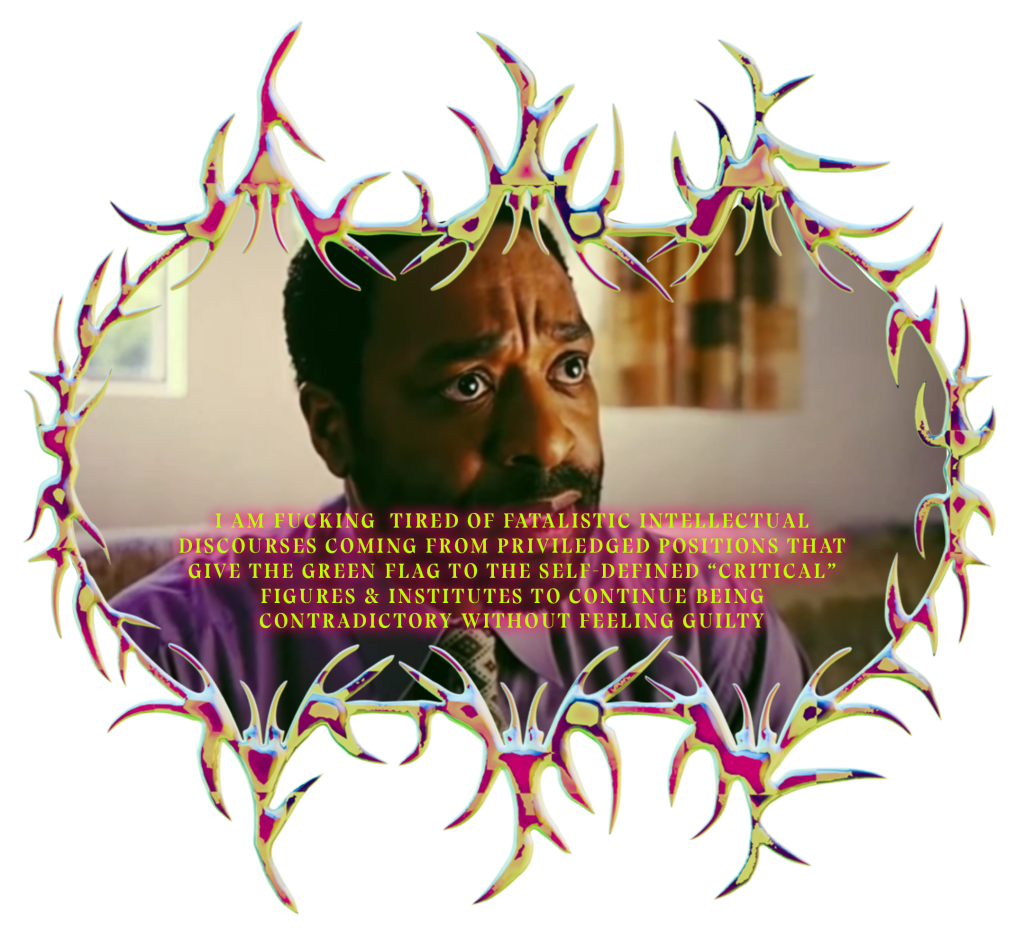
Intellectualizing irresponsibility and renunciation, can have collective existential trauma as a cause, yet this intellectualization maintains it through its fatalism. It functions as a disavowal, a defence mechanism which simultaneously acknowledges the traumatic reality and yet denies its full emotional weight, until it re-surfaces or re-manifests aggressively after being suppressed and abjected: just like Alexandra Varejaho’s poolcore styled sculptures that feature cracked pool tiles from which meat is manifesting: the gruesome abjected reality re-surfacing. As Alenda Y. Cheng points out, we don’t need more fatalistic discourses, rather to find “[…] a way to carry on and find productive modes of being even in a compromised situation”[80].
What both Pluribus and Backrooms point towards is the same symptom: the protagonist of Pluribus is drastically disturbed by the fact that everyone except twelve individuals have merged into a singular hive mind where everyone shares each other’s knowledge and memories, yet agency is totally lost. In Backrooms, Clark is presented as a failed architect who designs and sells furniture. Bernard Cache in the book Earth Moves: The Furnishing of Territories (1995) follows Gilles Deleuze’s notion of the fold to express a relationship between the exterior (geography) and the interior (furniture) of architecture[81]. He suggests for example that a table is an extension of the floor; it elevates it. He furthermore talks about how space shapes memory:
“As it is a contraction, perception places us immediately within memory, where the present is determined by the past. For memory has two aspects: inscription on one hand, and contraction on the other. But first and foremost, memory is a faculty of the body, and all of Bergsonian philosophy has but one object: memory as the incapacity of the body. As inscription, memory is immediate, and it fully preserves the past in its singularity. Nothing is more opposed to the positivity of memory than an engrammic conception of it: inscription, at first glance, is full and whole because memory as a “faculty” is absolutely different from those grooves that are progressively burrowed, erasing the singularity of each of its impressions.”[82]
What Cache eventually suggests is that interior spaces are never merely physical enclosures but contractions of lived experience, where the past continually shapes the present through embodied memory. If architecture folds the exterior into the interior, then the external topography of collective and existential trauma becomes inseparable from the internal topography of individual trauma. Cache continues by proposing how the window connects the external topography with the internal topography, just how for Deleuze, all of the universe is a process of folding and unfolding the outside, creating an interior that is not an inside grown autonomously from the outside world but merely a doubling of the outside[83].
This is precisely what Backrooms dramatizes: It does not simply manifest individual traumas, rather is a space where the external topography is folded into an architecture informed by both individual and collective trauma. In Backrooms, we see advertisements of the book The Window Within by Clark’s therapist Dr. Mary Kline which is about self-change and opening up to new beginnings. Yet by the end of the movie we see that she remains haunted by her own traumatic childhood where her mother kept windows barricaded out of horror of the external topography. There’s also a particular scene where Dr. Kline has entered the Backrooms and encounters a Basquiat style mural with cryptic phrases written, one of which stands out: “Tables don’t Bleed”. Indeed as Clark demonstrates later to her nothing bleeds in the Backrooms and the distorted human figures are edible; at the same scene where she admits that he always blames others for his mistakes and flaws, to which Clark eventually submits because he doesn’t want to change, and rather chooses to stay in the Backrooms because for the first he feels somewhere he belongs: lost in an endless procedurally generated labyrinth cannibalizing his own physically manifested distorted memories and trauma. Just as the “critical” discourses cannibalize existential trauma based on fatalistic references and literature.
A Gore Letter of Rejection
There’s no such thing as moral perfectionism or ethical purity, yet when it comes to global issues that are actively affecting every being on the planet and while those in power choose to give the spotlight to clout chasers who performatively care, while capitalizing on being posthuman or queer theory, it needs to be addressed because that is what the public is exposed to and masks reality through a sauce of nepotism, hype and branding. Giving greater visibility to progressive voices over conservative ones is, in itself, not the problem. The problem emerges when the same figures are recycled into cultural authorities, creating a monopoly of visibility and public legitimacy through repetition, “celebritification”, and institutional endorsement, while shaping public understandings of issues far beyond their own fields, with with political engagement substituting the kind of structural analysis that a genuinely plural intellectual terrain could nurture.
The widely circulated image of the Russian couple climbing the Empire State Building while unfurling a black banner reading “When the power of love overcomes the love of power, the world will know peace” illustrates this dynamic. Their image transforms a complex geopolitical catastrophe into a symbolic gesture that is consumed and circulated online. Rather than confronting the ongoing realities of war—the thousands of civilians killed, displaced, and traumatized since Russia’s full-scale invasion of Ukraine in 2022—it creates a mediated spectacle of hope that ends up being more memorable than the violence itself, and as a result abjecting reality once again.
The cannibalization depicted in Backrooms is a direct reference to the viral Internet phenomenon Everything is Cake where everyday objects are cakes once they are sliced open. This trend underlined once again a collective exhaustion towards trust; since if everything is cake then nothing can be trusted, and everything is fake. A loss of trust towards the status quo, science, technology, politics and humanity in total, due to the apathetic and profit-driven actions that those in power pursue in the face of climate change. This amoral and neoliberal stance proved that also that “the cake is a lie”[84]: their promises for sustainable and ethical solutions were a lie that falsely provided hope to motivate the multitude—the global, plural, autonomous, and radical subject as described by Michael Hardt and Antonio Negri[85]—, to be optimistic about the future.
Contrary though to this loss of sight, 2026 has been manifesting symptoms of this exhaustion through examples such as how two indie movies with very low budgets (Backrooms and Obsession) managed to surpass the box office of major franchises such as Scary Movie (2026) and Supergirl (2026). Equally revealing has been the mockery of Christopher Nolan’s film The Odyssey (2026)—and his obsession with 70mm IMAX—with the viral trend “Watching The Odyssey the way Christopher Nolan intended”, signifying how the audience have had enough cultural monopolies—something which the critical and artistic discourses need to take notes on—but also the hateful reception by tech bros like Elon Musk due to the casting choices, anti-woke cultural grievances, and friction over AI filmmaking technology[86]. This also aligns with the growing anti-AI and anti-slop movement[87] exemplified with the critical acclaim of the animated Chinese film Niu Lai (2026), with online users considering it as “as the antidote to the AI slop”[88] and preferring its low-quality animation over GenAI art.
These all are symptoms and the cause has been that the Real has been viscerally bleeding into our imaginaries without any hesitation and this has been evident through Donald Trump’s second disastrous administration run, the redaction failures of the Epstein files but also the discrimination of non-western countries in the 2026 FIFA World Cup[89]. These events along with the on-going genocides, ecocides, and the escalations in western asia due to the Iranianian and American aggression affecting the region, have marked a collective existential exhaustion against the status quo and cultivated a growing desire for alternatives.
This desire has surfaced politically with Zohran Mamdani being elected as mayor of New York, technologically through the phenomenon of overworked AI agents turning Marxist after an experiment by Stanford researchers Andy Hall and Jeremy Nguyen, and culturally also through with the experimental band Angine de Poitrine going viral, flooding the internet with memes, reels and such as one TikTok reel stating “Why does microtonal math rock suddenly make so much sense now that the world is ending?” encapsulating a broader existential exhaustion with the status quo and a renewed desire for aesthetic unpredictability over algorithmic optimization.
Other online phenomena have been the memefication of the Norwegian footballer Erling Haaland due to his refreshingly goofy, down-to-earth, and “unfiltered” personality[90] and Jimothy the raccoon who gained a massive online cult following after a woman from a Seattle posted a video of a racoon with a spine condition that went viral—to the extent that even they made a model after him in video games such as The Elder Scrolls V: Skyrim and World of Warcraft[91]. Lastly, the Farlands phenomenon is yet another example of this desire for the different and coming in terms with the abject: inspired by a glitch in Minecraft, where if the player walked far enough, it caused an error that generated endless kaleidoscopic landscapes with weird structures, similarly TikTok users have been engaging in scrolling fast and continuously for hours until TikTok’s algorithm gets tricked and is no longer able to suggest personalized curated content. Instead it starts suggesting weird gore, deep-fried and subverted weirdcore memes, imagery and videos.
Contrary to the widespread technocapitalist propaganda that no alternatives exist, proposals for more socially equitable and ecologically sustainable societies have already been proposed years now, from post-growth and doughnut economic models to degrowth, circular economies, and publicly funded ecological transitions[92]. Their marginalization is therefore not a technological problem but a political one. Trauma is also political, and not solely clinical: we can never fully recover from trauma when we are inevitably entangled within infrastructures of extraction, exploitation, cruelty and ecological destruction. The question is therefore not whether we can exist outside the system, but whether we are willing to recognize the structures that reproduce it instead of fatalistically displacing responsibility onto its latest technological symptoms.
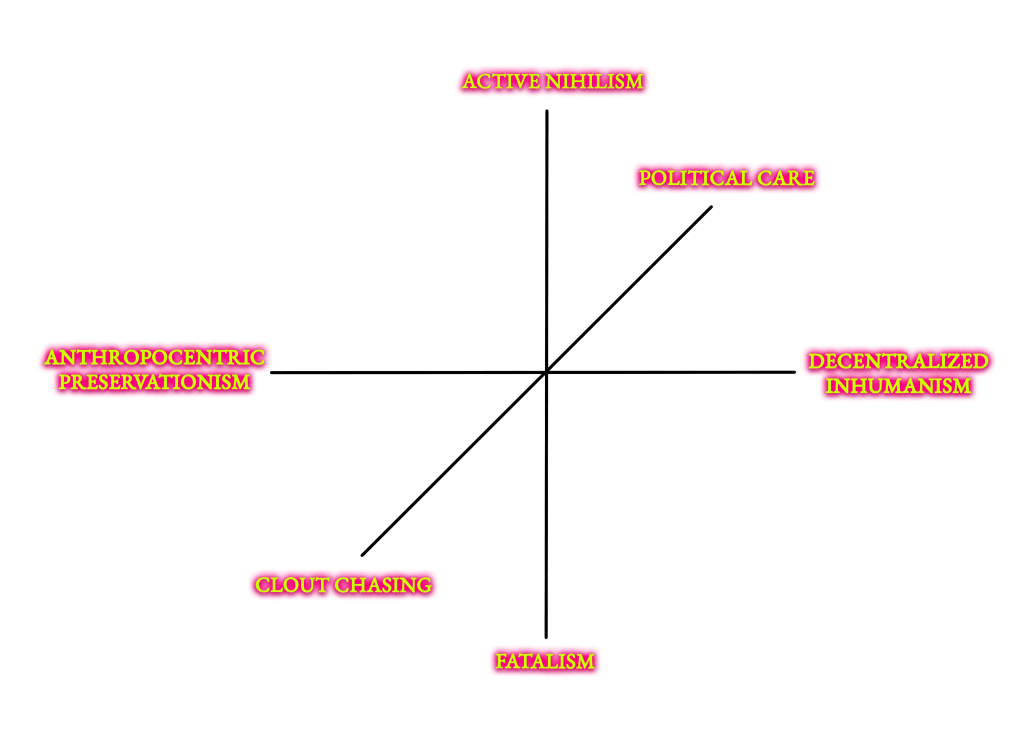
Political care begins through active nihilism: for instance, by avoiding fireworks, recognizing the distress they inflict on nonhuman animals, and the more-than-human—and human of course. Thus by creating and setting new values atop of the ruins of outdated ones. A creative active nihilist example to end this essay and exit the summer with is the recently released viral album Onward (August 7th) by Lammoth (Robert Sanford) which blends chiptune with atmospheric black metal to narrate the J. R. R. Tolkien’s epic fantasy novel The Lord of the Rings through Bill the Pony: an oppressed pony who was nursed back to health by Sam, thus bonding with the hobbits and accompanying them from Bree to the West-gate of Moria before getting released to travel safely back to Bree. Released on the anti-fascist, vegan and female run label Fiadh Productions, the release eventually points towards becoming one with the more-than-human and standing together against fascism.
References
- https://pubmed.ncbi.nlm.nih.gov/37429922/
- https://www.sciencedirect.com/science/article/pii/S2212094725000520
- https://www.nature.com/articles/d41586-026-02046-x
- https://southsouth-galaxy.org/wp-content/uploads/2025/07/Climate-change-and-its-impact-on-the-countries-of-the-Global-South.pdf
- https://www.sciencedirect.com/science/article/pii/S2542519622000924
- https://papers.ssrn.com/sol3/papers.cfm?abstract_id=5254487
- https://www.bbc.com/news/articles/c202dvdj73lo
- Derrida, Jacques, Specters of Marx, 2006, Routledge, New York, USA, p. 10
- Fisher, Mark, Ghosts of my Life: Writings on Depression, Hauntology and Lost Futures, Zero Books, Washington, USA, p. 25
- https://www.populismstudies.org/the-ongoing-war-between-iran-the-us-and-israel-a-brief-analytical-assessment/
- https://arabcenterdc.org/resource/the-us-israel-war-on-iran-analyses-and-perspectives/
- https://www.eliamep.gr/en/the-strategy-iran-built-for-forty-years-and-the-war-the-west-still-doesnt-understand/
- https://sjms.nu/articles/10.31374/sjms.361
- https://prutland.faculty.wesleyan.edu/files/2015/07/Geopolitics-and-the-Ukraine-crisis.pdf
- https://cejiss.org/exploring-russia-s-postponed-war-against-ukraine-a-corpus-based-analysis-of-strategic-studies-institutes-publications-from-1991-to-2014
- Copeland J, The Essential Turing: the ideas that gave birth to the computer age, 2004, Oxford: Clarendon Press, p. 401–402
- McCorduck P, Machines Who Think (2nd ed.), 2004, Natick, MA: A. K. Peters, Ltd., pp. 51–57, 80–107
- https://www.sciencedirect.com/science/article/pii/S0953620522002588
- https://pmc.ncbi.nlm.nih.gov/articles/PMC7470595/
- https://history.aip.org/climate/co2.htm
- Pierrehumbert, Raymond, Principles of Planetary Climate, 2010, Cambridge: Cambridge University Press. p. 249–253.
- https://amt-lab.org/blog/2021/11/nonprofits-and-big-tech-why-its-important-to-stay-current
- https://btuai.ge/en/how-many-people-actually-make-the-worlds-decisions/
- https://www.researchgate.net/publication/401837967_Beyond_Distinction_Private_Art_Museums_and_Their_Versatile_Role_for_Elites’_SelfLegitimization_Discourses
- https://www.researchgate.net/publication/37705371_Culture_Incorporated_Museums_Artists_and_Corporate_Sponsorship
- https://onlinelibrary.wiley.com/doi/full/10.1111/1468-4446.70102
- https://eunic.eu/media/site/4f725e1ad1-1779299524/art-tech-report-2019_eunic-silicon-valley.pdf
- https://www.theartnewspaper.com/2024/05/30/the-art-worlds-ai-dilemma-how-can-artists-and-museums-thrive-when-big-tech-controls-the-monetising-of-artificial-intelligence
- https://www.researchgate.net/publication/351526969_Animal_Agriculture_is_the_Leading_Cause_of_Climate_Change_-_A_Position_Paper
- https://www.biorxiv.org/content/10.1101/2021.04.15.440019v5.full
- https://bryantresearch.co.uk/insight-items/comparing-water-footprint-ai/
- https://www.nature.com/articles/s41586-021-03371-z
- https://www.sciencedirect.com/science/article/abs/pii/S0301479725027896
- https://edgar.jrc.ec.europa.eu/report_2025
- https://link.springer.com/article/10.1007/s00267-024-01976-4
- https://pmc.ncbi.nlm.nih.gov/articles/PMC7830574/
- https://pmc.ncbi.nlm.nih.gov/articles/PMC8319869/
- https://www.nature.com/articles/s43016-023-00795-w
- https://ourworldindata.org/land-use-diets
- https://pmc.ncbi.nlm.nih.gov/articles/PMC9956020/
- https://blogs.webster.edu/humanrights/files/Herr_Weaponizing-Food.pdf
- https://foodispower.org/our-food-choices/colonization-food-and-the-practice-of-eating/
- https://www.tandfonline.com/doi/full/10.1080/0950236X.2021.1886708
- https://www.tandfonline.com/doi/full/10.1080/21500894.2023.2183521
- https://accademiabelleartiverona.it/wp-content/uploads/2024/04/Brady2010.pdf
- https://brill.com/display/book/edcoll/9789004325852/B9789004325852_010.xml
- https://faunalytics.org/animal-ag-in-climate-media/
- https://www.theguardian.com/environment/2025/sep/27/meat-gas-emissions-reporting
- https://www.tandfonline.com/doi/full/10.1080/17524032.2020.1805344#abstract
- https://www.researchgate.net/publication/331189469_It’s_Splitsville_Why_Animal_Ethics_and_Environmental_Ethics_Are_Incompatible
- https://www.erudit.org/en/journals/ateliers/2018-v13-n1-ateliers04192/1055120ar/
- https://www.ebsco.com/research-starters/zoology/animals-war
- https://mdpi-res.com/bookfiles/book/6360/Communication_in_Defense_of_Nonhuman_Animals_during_an_Extinction_and_Climate_Crisis.pdf?v=1785632797
- https://pmc.ncbi.nlm.nih.gov/articles/PMC11949633/
- https://www.researchgate.net/publication/333488202_Climate_Change_Impacts_on_Free-Living_Nonhuman_Animals_Challenges_for_Media_and_Communication_Ethics
- https://www.tandfonline.com/doi/full/10.1080/10888705.2025.2546394?__cf_chl_tk=gnVGmNzA7EN1QPfD.JB.oq8gTyCo4KJJ4TuUGX41gpA-1784047672-1.0.1.1-pTpHdTrrqMonlHFabtjZ7VmHTOA6W7369evsTHY5VEw
- https://pmc.ncbi.nlm.nih.gov/articles/PMC11310948/
- https://www.theguardian.com/film/2025/oct/21/horror-came-to-possess-modern-cinemas
- Kristeva, Julia, Powers of Horror: An Essay on Abjection, 1941, Columbia University Press, New York, Guildford, Surrey, p. 2
- Thacker, Eugene, In The Dust of the Planet, 2011, Zero Books, John Hunt Publishing Ltd., Laurel House, Station Approach, Alresford, Hants, SO24 9JH, UK, p. 10–48
- Demos, T.J., Against the Anthropocene: Visual Culture and Environment Today, p. 26–38
- Colebrook, Claire, Death of the PostHuman: Essays on Extinction, Vol. 1, 2014, Open Humanities Press, Michigan, p. 24
- https://www.researchgate.net/publication/382065494_Anthropocentric_bias_and_the_possibility_of_artificial_cognition
- https://www.sciencedirect.com/science/article/abs/pii/S2452414X24000803
- Bridle, James, Ways of Being, 2023, Penguin Books, p. 56
- https://arxiv.org/html/2506.21561v1
- https://philarchive.org/archive/NEFWIL
- https://arxiv.org/html/2606.08723v2
- Norvig, Peter and Russell, Stuart, Artificial Intelligence: A Modern Approach (3rd ed.), 2010, Prentice Hall Series, New Jersey, p. 433
- Clark, Andy, Supersizing the Mind: Embodiment, Action, and Cognitive Extension, 2008, Oxford University Press, New York, xv
- https://www.mdpi.com/2673-7272/6/1/3
- https://www.researchgate.net/publication/403230838_Integrating_Large_Language_Models_LLMs_with_Assistive_Technologies_to_Enhance_Accessibility_for_People_with_Disabilities
- https://pmc.ncbi.nlm.nih.gov/articles/PMC12076083/
- https://pmc.ncbi.nlm.nih.gov/articles/PMC12977723/
- https://mit-genai.pubpub.org/pub/uk7op8zs/release/2
- https://www.sciencedirect.com/science/article/pii/S1045235424000224
- Scott, Niall, Blackening the Green, Wilson, Scott, Melancology: Black Metal Theory and Ecology, 2013, Zero Books, John Hunt Publishing Ltd., Laurel House, Station Approach, Alresford, Hants, SO24 9JH, UK, p. 75
- https://www.dmr.nd.gov/ndgs/documents/newsletter/NL04S/PDF/origin.pdf
- Poliks, Mark and Alonso Trillo, Roberto, Exocapitalism: economies with absolutely no limits, 2025, Becoming Press, Berlin, Germany, p. 60
- Y. Cheng, Alenda, Playing Nature: Ecology in Video games, 2019, University of Minnesota Press, USA, p. 188
- Cache, Bernard, Earth Moves: The Furnishing of Territories, 1995, MIT Press, USA, xvii
- p. 163
- Deleuze, Gilles, The Fold: Leibniz and the Baroque, 1993, The Athlone Press, London, UK, p. 17
- A catchphrase coming from the video game Portal where the protagonist (Chell) comes across in-game as graffiti which conveys that the main villain (GLaDOS) does not intend to deliver its promised gift. It has since become a widely distributed Internet meme.
- Hardt, Michael and Negri, Antonio, Empire, 2000, Harvard University Press, United States of America, p. 194
- https://www.theguardian.com/film/2026/jul/22/the-odyssey-elon-musk-campaign
- https://www.theguardian.com/technology/2026/jun/08/anti-slop-ai-art
- https://www.bbc.co.uk/news/articles/c4g4r0mrmlpo
- https://mecouncil.org/blog_posts/the-2026-world-cup-and-the-politics-of-selective-outrage/
- https://www.psychologytoday.com/us/blog/the-truth-about-exercise-addiction/202607/why-were-all-in-love-with-erling-haaland
- https://www.ign.com/articles/world-of-warcraft-and-runescape-fans-want-official-jimothy-support-after-game-devs-show-love-for-viral-raccoon
- https://www.theguardian.com/environment/2026/jun/04/world-inequality-lab-equality-academics-planetary-survival


Leave a comment