A Situated Philosophical Approach to the Putrefied Logic of the Capitalist Structural Interregnum
By Unai Estatuet Sanchez
“la folie se distingue des maladies du corps, en ceci qu’elle manifeste une vérité qui n’apparaît pas en celles-ci : elle fait surgir un monde intérieur de mauvais instincts, de perversité, de souffrances et de violence, qui était resté jusqu’alors en sommeil.[1] ” – Michel Foucault, “Histoire de la folie à l’âge classique” (Foucault, 1972, p. 539).
Contemporary capitalism has reached a stage in which it cannot properly hide its illusions, its false and cruelly constructed syntheses that transfigured and then edified its own terms to respond to questions that the market doesn’t have the authority to respond to. The result: the market sets itself up as the arbiter of not merely economic questions but of metaphysical ones, for example, “what is worthwhile” (a question that pertains to an ethical dimension), “what is honorable” (a moral dimension), and even “what is real” (a pure ontological dimension). In that way—and with that process of ontological assimilation—this capitalism does not produce interregnums as transitory phases between two stable orders; it produces the interregnum as a structural condition of its own reproduction. Gramsci diagnosed that in moments of crisis (when) “the old is dying and the new cannot be born,” and in this interval “a great variety of monstrosities and morbid symptoms appear.” Berman’s reading of Marx allows us to add that bourgeois nihilism[2]—the systematic dissolution of all values into exchange-value—is precisely the mechanism that makes this interregnum permanent: every possible (and true / pure) synthesis is absorbed and falsely resolved; every negation becomes a piece of the market itself. And it is inside this putrefied system where we can find the marginalization of everyone who thinks and acts outside the normative framework shaped by institutions. We can argue that these marginalized ones are institutionally designated as lunatics.
Section I. The Schlechte Aufhebung as the Central Operation
This permanent interregnum operates—and it finds its reason to exist—through what Hegel would call a “Schlechte Aufhebung,” a false synthesis, or a deficient ascendent dialectical practice. As Hegel argues in the “Phenomenology of the Spirit,” a consciousness can achieve a moment of internal tension, and, rather than recognizing the “negativity” within, it flees towards a form of false stability. For this synthesis to be pure, to be true, in Hegel’s words, to achieve a “new unit of superior order,” it needs to simultaneously negate but also conserve itself, and then it can reach its elevation. If we extrapolate this dialectical process from: the consciousness of a subject to the consciousness of the system[3], we can argue that this (permanent interregnum) is not a failure of capitalism nor an intrinsic value; it is its most refined operation that became an active ossification[4]. Berman’s reading of Marx makes everything clearer in presenting its concrete form: on the part on which he talks about the “paradoxical dialectic between the capitalists and their enemies,” Berman states that even the most radical movements, even the most critical thinkers, melt into the air in a putrefied process of assimilation. In other words, these movements are transformed into a mere object that follows the market logic, and their radical ideas must attract buyers: Marx’s manifesto itself was transformed into a market-driven object. We can say, then, that the system has learned to assimilate these movements, presenting every false resolution as a true synthesis and every absorption as transcendence. The monsters Gramsci announced do not visit the interregnum — they constitute it.
Section I.2: The “monsters” that this false synthesis invokes (creates)
To understand the real implications that this “Schlechte Aufhebung” provokes, I must present—very briefly—three types of monstrosities created by it:
- Type A is what I already talked about: the cooptation and assimilation of the resistance.
- Type B has to be related to the hole that bourgeois nihilism creates: if the “generalized nudity” (the construction of false aureoles by the professionals, of the “Mann der Wissenschaft” in Marx’s terms) doesn’t find any new [genuine] form of collective values, it leads to substantive forms of representation. Basically, what Berlin comprehends as the “monstrous impersonation”, that in our time have been the basis for real authoritarianisms.[5]
- Type C is what Berman defines as “institutionalized mediocrity”: the functional norms with minimum acceptance and mutual imposition that perpetuate the interregnum. This phenomenon, this monster, was already identified by Max Weber decades ago. Weber argued that the legal-rational bureaucracy is extraordinarily efficient for perpetuating itself and extraordinarily deficient for transforming itself. Also, unlike other tyrannies, mediocrity does not generate the antagonist force that would overcome it. It does not oppress; it exhausts, it discourages, keeping us trapped in Gramsci’s interregnum.
Section II. The Institutional Lunatic: Between Systematic Exclusion and Epistemic Privilege
It’s behind this structural conjucture of reality, where Foucault’s genealogy of madness becomes indispensable. As he states, the act of locking someone or something, as we are objects in a transcendental/illusory realm of reality—in this case, it is a soft lock, which involves an automatic and apathetic[6] assimilation of the object isn’t a simple one; it has strong political, social, religious, economic, and moral implications. “Et qui concernent probablement certaines structures essentielles au monde classique dans son ensemble[7]“ (Foucault, 1972, p. 60). In that way, bourgeois society draws its borders by imprisoning those who fall outside them by designating what is “non-reason”.
This mechanism has not disappeared in liquid modernity (in terms of Zygmunt Bauman); it has been structurally transformed. As Bauman argues in a dialogue with Haugaard, the shift from solid to liquid modernity implied a fundamental and rotten change in the logic of power: where solid modernity operated through confinement, surveillance, and the imposition of a routine, liquid modernity dominates the subject through uncertainty and precarisation. “In other words, we move from cutting down the options to multiplying them, from making the setting of actions more ‘transparent’ and predictable to making it, on the contrary, more opaque and less calculable.” (Zygmunt Bauman & Mark Haugaard, p. 3. 2008). In this context, the institutional lunatic is not physically confined or chained but simply denied the ontological security that the system’s subjects constantly seek; his ideas circulate—although in these contemporary times, for a very short period of time—as disruptive content, generating momentary impressions and momentary reactions, and then he and his ideas dissolve in the permanent flow without leaving any institutional mark. The lunatic designation doesn’t oppress; it precarizes and confuses. Finally, as Bauman argues in the conversation with Haugaard, taking into account Max Horkheimer & Theodor Adorno’s Dialectic of Enlightenment, we think because we can’t not think, and that aloofness (described there as the “perfect/splendid isolation”) is the best and perhaps the only way to shape radical ideas, protests, dissidence, and opposition in order to protect the critical thoughts from oblivion, “from oblivion the values which the world neglects/pushes aside/destroys.” (Zygmunt Bauman & Mark Haugaard, 2008, p. 5). For those who are inside and assimilated by the system, those who don’t have the ability to think critically to embrace that aloofness, they must “mold themselves to the technical apparatus, body and soul.” (Horkheimer & Theodor W. Adorno, 2002, p. 23).
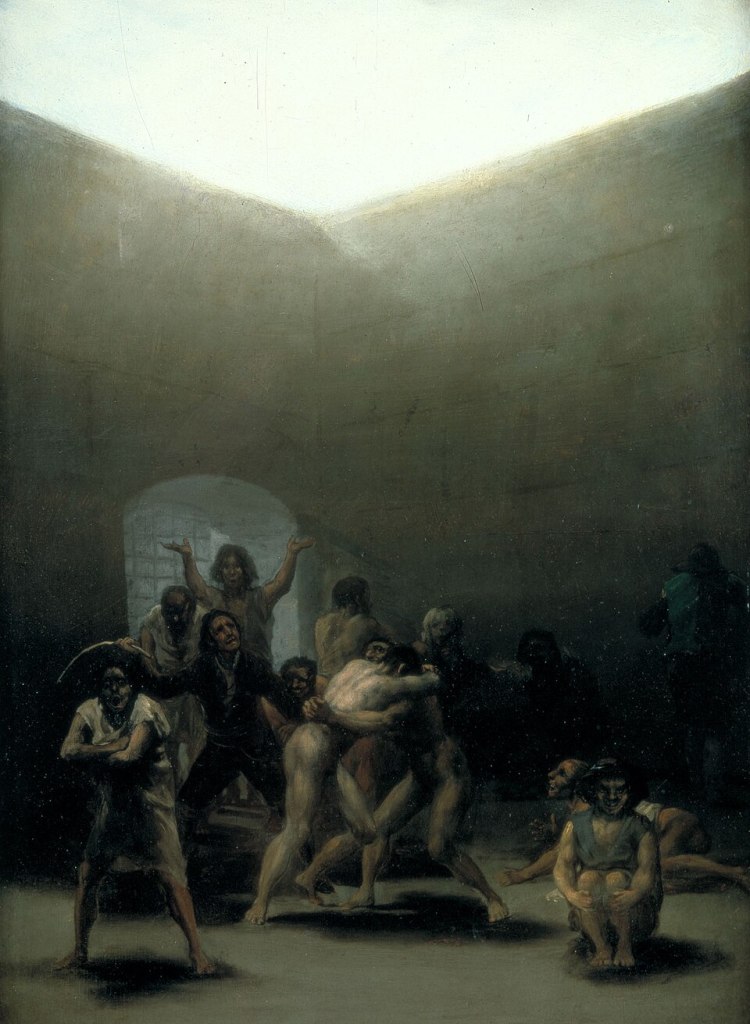
Section II.1: The possibility of the epistemic privilege of lunacy
And yet—with all that has been said above—this exclusion can generate an unexpected epistemic privilege. Žižek argues that the lunatic is not the one who confuses fiction with reality but one that sees the fiction of what reality is surrounded by; it isn’t just a clinical condition but a structural necessity in our human existence, theology, and politics. Within his view, we must risk having a fundamental “madness” (lunacy) in order to embrace a full negation of the system itself (in other words, to embrace the pure void of meaning). With all, the lunatic is, inside this view that I’m presenting, a subject that has an ability to think and articulate that thinking in ways that the system cannot pronounce itself; he can discern the so well-hidden illusion of capitalism (and its Schlechte Aufhebung).
Section III. The situated case: The Catalan independence movement, a situated case of institutional designation
For this practical section, I wanted to apply all that has been said above and all the prior arguments I constructed. In this way, this section presents itself as a theoretical-application case. In addition, this case presents both as a situated case and as a case of personal involvement in which I, as the subject, participated.
The Catalan independence process and movement can offer us a paradigmatic example of how this logic that I’ve presented above operates; in other words, it can offer us a structural radiography of the structural logic developed above. Since the Constitutional Court’s partial annulment of the 2006 Statute of Autonomy—democratically approved by both parliaments—Catalonia has inhabited a political interregnum in a strictly Gramscian form: the old constitutional order has lost its capacity to generate true democratic consensus, while the new order has been systematically prevented from being born. While in this interregnum, the new order had shaped itself as an independence movement.[8]
The constitutional rules of the Spanish state defined its boundaries of “rational conduct.” Within this constructed framework, the Catalan demand for self-determination wasn’t simply illegal: it was designated as irrational, as lunacy. The 2017 referendum leaders—Carles Puigdemont, Oriol Junqueras, and many others[9]—were not simply prosecuted or abused directly by power; they were also institutionally designated as lunatics: their democratic mandate was recast as sedition and their political rationality pathologized as a collective delirium/delusion. The system performed, in Foucault’s terms, this onto-political operation, which is explained by the delimitation of what counts as reason and what counts as non-reason in concrete judicial terms (working rules). Thus, in that way, expelling all those designated as non-rational (lunatics).
In the way of all that I said above (please, especially take into account Section II and the continuation in Section II.1), the Catalan referendum leaders and the “many others” (check note 9), those who were excluded and institutionally designated, take part in (occupy) the epistemological privilege argument, described and developed all along in Sections II & II.1: basically, they could articulate what the constitutional system couldn’t pronounce itself (something that is basically about itself). In the same terms, from the outside, from that aloofness, is where these political actors and civil society had perceived and conceived the Schlechte Aufhebung that contaminates all the system and the dialectic relations inside it (both of the individual subjects interacting with each other and of the collectives).
With all, we can argue that both sides of this dialectical relationship have not only failed to resolve the contradiction, but they have also developed a relationship of mutual dependence that has resulted in the construction of a structural and permanent interregnum. In other words, they’ve constructed what we can call, in Hegelian terms, a master-slave dialectic between the Spanish constitutional bloc and the Catalan independentist movement. Deeply arguing in that way, the constitutional order (the master) needs the designated lunatics to define the borders of all that they consider non-reason; to put it another way, the constitutional court needed the lunatics to define the borders of its own rationality. On the other side (the slave side), the independence movement needs the designation to sustain their narrative of resistance and emancipation. In this dialectic relation, the thing is that it is the slave who ends up developing a self-awareness (a consciousness of itself) through work, and in this case, their work consisted of weaving a movement (having become self-aware) that was entirely critical of the status quo[10], constructing their own self-awareness. In that sense, we can say that the two consciousnesses (the two actors) had constructed/developed a structural dependency on their perpetuation.
Ultimately, these two interregnums do not simply coexist; they mutually produce each other, generating a structural interregnum where there is no escape. No genuine Aufhebung (synthesis) is possible in this domain, not because the contradiction is irresolvable, but because both of the actors have woven a logic in which the two of them have an interest in the continuation of the interregnum. To end, I want to remark that the monsters that this interregnum can create are the common product of the two consciousnesses, which stem from an empty dialectic that neither side is willing to conclude.
Bibliography
Adorno, T. W., & Horkheimer, M. (2002). Dialectic of Enlightenment (G. S. Noerr, Ed.). Stanford University Press.
Bauman, Z., & Haugaard, M. (2008). Liquid modernity and power: A dialogue with Zygmunt Bauman. Journal of Power, 1(2), 111–130. https://doi.org/10.1080/17540290802227536
Berman, M. (1988). All that is solid melts into air. (Selection of the II chapter: Marx, Modernism, and Modernization) https://langurbansociology.wordpress.com/wp-content/uploads/2013/01/berman_marshall_all_that_is_solid_melts_into_air_the_experience_of_modernity.pdf
Burroughs, W. S. (1959). Naked Lunch. Olympia Press.
Commons, J. R. (2012). Legal foundations of capitalism. Literary Licensing. (Selection of the first three chapters).
Cronenberg, D. (Director). (1991). Naked Lunch [Film]. Recorded Picture Company. Available online on YouTube: https://www.youtube.com/watch?v=NfpcLAsK6LA
Foucault, M. (1972). Histoire de la folie à l’âge classique[11]. Éditions Gallimard. Available online at: https://monoskop.org/images/2/29/Foucault_Michel_Histoire_de_la_folie_a_l_age_classique.pdf
Heidegger, M. (2006). La fenomenología del Espíritu de Hegel. Alianza Editorial.
Marx, K. (2000). Karl Marx: Selected Writings (D. McLellan, Ed.; 2a ed.). Oxford University Press. (Selection of Economic and Philosophical Manuscripts)
Pulver, A. (2004, July 30). Interzone revisited. The Guardian. https://www.theguardian.com/books/2004/jul/31/featuresreviews.guardianreview14
Sánchez Piñol, A. (2016). Victus, Barcelona (1714). Edicions La Campana.
Appendix: Burroughs’ Naked Lunch as a literary and cinematographic instance of counter-bourgeois nihilism.
Rather than being a strange book and movie, Naked Lunch is a pure critique, not of the capitalist system itself nor an explicit critique, but of the structural and perverse logic that the capitalist machinery has. For the next analysis, I’m going to treat the novel and the movie together, as I think the rebel spirit is the same for the two works, and also, the two of them have comprehended, in the same way, how capitalist machinery works and how to try to counteract it.
In this way, Naked Lunch is a piece of art, a piece outside the capitalist puzzle, but it has to fight to gain visibility, as all commodities do. Precisely for being outside, we can talk (as I did arguing in Section II) of an epistemological privilege in talking, describing, and, above all, comprehending the system in a way that the system itself can’t. The paradox here is clearer than it seems: both the movie and the book were financed by the “Burroughs Corporation,” a company funded by the father of William Burroughs, so, in that way, it was all along the capital and the corporation that put the resources in order to finance something that is strongly criticizing it. In that way, this paradox enlightens us to understand how blind the capitalist logic is when it prioritizes the (maximum) gains and efficiency without having any time to think about the many[12] other things. And that’s what a system constructed on false synthesis (Schlechte Aufhebung) creates: an ontological blindness.
In my view, Naked Lunch reminds me of a smashed and then reassembled mirror, but every shard now reflects a different place. Wonderful imagery, but very disjointed (as it tries to be). In terms of Berman, this literary unpredictable work is the operation Marx makes with the aureoles: the moment where all the ideological covers and all the false value(s) that capitalism created are destroyed, and the lunacy imposes its reign: the “Interzone[13]”. But the main difference between Burroughs’s work and Marx’s theories is that Burroughs’s doesn’t wait for his nihilism to create a revolutionary consciousness: the “nudity” (as the destruction of ideological covers) is simply a permanent condition of his reality.
Finally, I want to illustrate a very short clip from the film itself that I think serves as a fully vibrant representation of what Burroughs’s work means for those who can see the destructive and lunatic beauty in it. The scene in question is as follows: from the minute 4:21 to minute 5:15: https://youtu.be/NfpcLAsK6LA?si=Mzbe6aDVap4XtoNR&t=261 (the link will start the video at minute 4:21).
[1] “Madness differs from physical illnesses in that it reveals a truth that does not appear in the latter: it brings to the surface an inner world of base instincts, perversity, suffering, and violence, which had hitherto remained dormant.”
[2] We are talking about an “active nihilism” (what Nietzsche would call a nihilism of strength: one that has the capability to destroy in order to construct, one that feeds on his proper destructions).
[3] And with this term, I refer, for example, to John R. Commons’ working rules principles as a set of norms and rules that construct the system itself and that determine the functionality of the whole (economic) system. With a proper set of rules with the capacity of creating healthy and true synthesis, the system gains consciousness of itself; the capitalist system, unfortunately, cannot reach that stage.
[4] Please note that I have used this term in the sense of formulating an analogy between a biological process and a dialectical, economical, political, and societal process. In technical terms, ossification is understood as the biological process that involves the creation of new bone tissue by specialized cells. In this sense, capitalism groups and conglomerates act like these cells in order to create new tissue in an uninterrupted way (the same process that defines bourgeois nihilism).
[5] Taking into account some of the 20th century’s monstrous impersonations, we can mention Nazism’s “volkgeist” (the spirit of the people) or Stalinism’s proletariat as a collective subject.
[6] By “apathetic,” I want to refer to a process that even one’s own (the subject) doesn’t perceive this assimilation. So I use this term in order to define how the assimilation (alienation) process itself is an illusion.
[7] “And these likely concern certain structures that are fundamental to the classical world as a whole.”
[8] An independence movement with everything that entails: support from (the majority) of the syndicates, a necessarily organized civil society, and the Catalanist political parties’ working in orbit around the movement, with all actors merging into a substantive representation of Catalan citizens.
[9] In this “many others,” I include participants in manifestations, visible leaders of associations (and syndicates), and many others who were labeled as lunatics.
[10] A sharp-eyed reader might ask, however, at what exact moment did the independence movement become self-aware? And I respond to that question, saying that the answer can be found in the history. Personally, I recommend reading Albert Sánchez Piñol’s work, Victus, Barcelona (1714): a masterpiece, in historical terms, on Catalan history, which, when applied to the text’s philosophical content and framework, can help the reader understand the historical-concrete moment when the slave becomes self-aware of its own condition.
[11] Just to note that, in this case, the DeepL AI (a text translation tool) was used to translate parts of the book that I found interesting and appropriate for the matter at hand.
[12] And by many other things, I’m referring to, for example, the case of not having time to think about the process—which involves the human beings—because the capitalist machinery only works and prays for the results. With this being said, I consider these many other things as the important ones for humanity, for the well-being of the subjects themselves. Unfortunately, capitalist logic is situated on the antipodes of that way of thinking.
[13] The “Interzone” is designed in Burroughs’s work as the metropoly of dreams, of a vigil state of mind: “With little in the way of coherent narrative, Naked Lunch takes the form of disconnected episodes describing the activities of bizarrely imagined figures—junkies, agents, ‘faggots’—who inhabit Interzone, a fantastical urban melting pot. (for further information on the “Interzone,” please read
Andrew Pulver’s article published on The Guardian. Find it on the bibliography.) I also strongly recommend the curious reader to watch the movie and read the book.


Leave a Reply