By Stefan Paulus
Non-becoming confronts the one verb contemporary philosophy of the subject has left unquestioned. The critical critics have learned to dissolve every fixed identity and to celebrate every flux, every line of flight – and in doing so have made becoming the single concept immune to critique, an unquestioned standstill. This essay treats the imperative of becoming itself as a form of capture: not its content but its form, which installs lack as the affect on which an entire economy of optimization, therapy, and acceleration feeds. Against this it lays bare a non-becoming – not a return to static being, but the vanishing point at which Deleuze and Guattari’s becoming-imperceptible turns into its fractals. The argument echoes through five hyperspeculations in Laruelle’s sense: it proves nothing and depicts nothing; it models: exhausted emptiness (burnout, depression as product of the compression machine) and saturated emptiness (the non-onto-photo-logical erasure of the code).
The Wrong Question
Almost every contemporary philosophy of the subject begins with the question of what the subject must become. It must become free, become reconciled, become productive, become enlightened, become intelligent, become other than it is. Even the philosophies that proclaim the death of the subject preserve this narrative unchanged: they merely displace the becoming, transferring it from the human to biology, to neurons, to oxidation chemistry, or outward onto the action of God, onto fate and karma, or onto matter itself. Sometimes it is also the product of structures or of a last instance. The philosophy of the subject swaps out the noun, never the verb. “Becoming” – the imperative that one must become anything at all, must develop in the name of a superstructure or perfect oneself epigenetically – is never called into question. Moreover, the critical critics have learned to question every fixed identity and to celebrate every flux, every apparent line of flight and deterritorialization – and with that, becoming has been made the one concept that withdraws from critique. Becoming has become an unquestioned standstill.
This essay proceeds from a different intuition, easy to formulate but hard to internalize: that the imperative of becoming is itself a form of capture. Not its content – its form. At the level of structure, it makes no difference what one is told one is supposed to become. The interpellation to become anything at all already produces a deficit in the subject: it says that you are not yet it, that you are incomplete, that your true self lies ahead of you, that you are a stranger in your present self, that your true nature hovers in a future you must work toward. Lack is the affect the imperative produces, and lack is the affect on which an entire economy of self-improvement, of therapy, of optimization, and of acceleration feeds. The subject that lacks something is a subject to whom identities and means to its completion can be sold eternally, because completion never comes.
What is to be propagated here is not another becoming but its suspension. No return to static being – that is merely the mirror image of becoming, the reactionary nostalgia for an essence. What is at stake here is laying something bare: a non-becoming that is not a return but a becoming-empty, in which the subject ceases to make itself identical with what it is supposed to become, because there is nothing to become that it would not already be.
Two meanings of “becoming” must be kept apart here, and their confusion would be fatal. The becoming criticized here is the imperative: the interpellation, the address to the subject to develop toward a goal, to perfect itself, to fill a deficit (Paulus 2025a). To be strictly distinguished from this is the devenir in the sense of Deleuze and Guattari – becoming-animal, becoming-molecular, becoming-intense – which is precisely not a progression toward a goal but a desubjectivation, a leaving of one’s own form. The non-becoming developed in this essay does not stand against this devenir but is its vanishing point. For Deleuze and Guattari lead every becoming toward a final one: becoming-imperceptible, the immanent end of becoming (Deleuze/Guattari 1987, 374), in which becoming grows so complete that there is nothing left that would still become – no form left to leave, and no subjectivation that would still need to be surpassed. At this limit point becoming turns into its other: where nothing is left to become, non-becoming begins. The imperative is discarded; the devenir fractalizes into infinite echoes.
At the center of Laruelle’s non-philosophy lies the search for this “psychocosmism” and a “fractalized Identity” (Laruelle 2013, 59). The central assumption here is not to assign an identity or a phenomenon to the Real by means of ready-made conceptions, thereby letting it become a clone of reality, a fetishistic realism, but rather to reverse this order: in the contemplation of and experimentation with the phenomenon, its reality is grounded, and it develops a life of its own (Laruelle 2014, 22f). The turn away from interpretation is at once a turn away from the grounding of the perceived, because cognition is not to be traced back to existing codings, “whose dominion makes us deaf to the thing speaking in the tradition” [deren Herrschaft uns gegen die in der Überlieferung sprechende Sache taub macht] (Gadamer 1999, 274). Experimenting with philo-fictions neither verifies nor falsifies the phenomenon but exceeds it: it does not intervene in a scientific theory but models it in favor of the inner self-similarity in which nested structures of fractalization generate an open universe of fractal knowledge. The goal of philo-fiction is a contribution to the presentation of the One-in-One, of the non-identical, of a radical immanence (Laruelle 2010, 70f).
Philo-fiction, the generic science of hyperspeculations (Laruelle 2010, 230), has the task of desubjectivizing phenomena, of carrying out subtractions on the material. “Generic” names a research that does not bring forth the specific but produces models and hypotheses (Laruelle 2013, 69ff) that remain indeterminate and create variables without an assigned value (Szepanski 2015; Paulus 2020, 2022, 2024a). Since fictional statements are neither true nor false but are thought “as-if” [als-ob] (Vaihinger 1986), the results remain open and must be desubjectivized and subtracted again and again (Laruelle 2014, 142ff). Thus no doubles of the world are produced but indeterminates – and yet this variable, multiple, pluralistic must at the same time be recognized as the One-in-One, the “(Non)-One” (Laruelle 2010, 97f), the all-in-itself-connecting.
This methodology coincides with the object of this essay. For non-becoming is precisely the erasure of that external standpoint from which a subject reflects itself as incomplete, as still-to-become. Hyperspeculation is the procedure for describing this; it proves nothing and depicts nothing; it models. In what follows, therefore, no theses about non-becoming are proven but philo-fictions are generated that interrogate the phenomenon as to its fractality, remove ontological monocausalities, and multiply meanings – models that show becoming at its vanishing point. Thus Gianfranceschi (2026), too, took up the un-becoming, with reference to Maya B Kronic, for a movement that does not strive forward but withdraws: a ceasing of becoming that he reads off depression. This essay shares the word but not its direction: what is called non-becoming here is not the standstill but what remains of it when one drives it to its vanishing point – not a sinking but an echo; not a freezing but a fractal.
The following chapters pursue this difference through five hyperspeculations. Each is assigned to one of the following chapters:
- First, the onto-photo-logical fiction: one can model becoming as if it were a mere effect of perception as making-true – as if what appears as reality were nothing but the normatively appropriated copy. On this assumption, becoming-empty would not be the grasping of a deeper truth but the erasure of the code, the suspension of appropriation itself (Laruelle 2014; Holzkamp 1973).
- Second, the compression fiction: one can treat becoming-empty as if it were the deactivation of a predictive self-model, the collapse of the negentropic imperative at the neuronal level. Whether what is thus experienced is “real” would remain undecidable in this scenario – and it is precisely the undecidability that is the point (Parr/Pezzulo/Friston 2022; Millière 2017).
- Third, the immanence fiction: one can conceive non-becoming as if it opened no access to a beyond but a radical immanence, in which the distinction between subject and world, between large and small, between inside and outside collapses – no hyperspace, but the One-in-One, which would have no place outside itself (Laruelle 2010; Bohm 1980).
- Fourth, the nondualist fiction: one can assume that becoming-empty transports no new content but is the recognition of what always already was – the dissolution of the subject thought not as loss but as the ending of a misrecognition, in which it recognizes itself as that which it never ceased to be (Utpaladeva 2002; Dyczkowski 1987).
- Fifth, the performative fiction: one can suppose that non-becoming cannot be described at all without missing it, because every description would continue the grammar of becoming – so that it could only be enacted: in the text that folds instead of progressing, in the echo without origin, in the self-similarity that knows no original (Deleuze/Guattari 1987; Laruelle 2014, 110).
i. How One Becomes What One Is: Perception as Making-True
In order to become what one is, a memory must be made for the body and the I, the social order must be “branded” [eingebrannt], inscribed into the body, so as to make ideas indelible, omnipresent, unforgettable, and fixed (Nietzsche 1999, 210). Only then does becoming no longer stand as a program before the subject, which it would have to pursue, but becomes its sedimentation, as the somatization and bodily inscription of relations of domination (Bourdieu 2001; Butler 1990; Foucault 1976). But the site at which this sedimentation takes place and is continually renewed is perception itself, and not as an individual “taking-as-true” [Für-wahr-Nehmen] of immediately possible experiences, but as at the same time a “making-true” [Wahr-machen] (Holzkamp 1973, 34): in the seemingly-subjective origin of perception, social relations emerge as the ground of an “individual-centered, psychologizing environmental meaning” [individuumzentriert-psychologisierenden Umgebungsbedeutung], which reinforces “the perversion of a selective thinking ostensibly oriented toward sensory experience” [die Verkehrtheit eines vordergründig an der sinnlichen Erfahrung ausgerichteten selektiven Denkens] (Holzkamp 1973, 295f), such that perception is always already filtered through thought, determined by schemata and cultural codings. Here the eye sees while the brain strains to find the familiar, in order then to perceive the world as it has already been described (Horkheimer/Adorno 1991, 101).
Laruelle has given this circular closure the name onto-photo-logy. A world full of copies (Laruelle 2014): instead of recognizing one’s own needs, the socius supplies ready-made lifestyles and pictures. Freedom and wildness are mediated through vicarious existences (actors, professional adventurer) or substitutes (cars, cigarettes, alcohol). Perception orients itself toward passport photos, product photos, landscape and architectural photography, pornography as apparent images of reality, as its representations and simulations. And the more the spectators look, the less they live; the more they accept recognizing themselves in the dominant images of their needs, the less they understand their own existence and desire (Debord 1994, §30). Onto-photo-logical appropriation is nothing other than the mechanism by which the production and normalization of perception accomplishes itself through the representation of the world. Copies become reality – not as object, but as the representation of an identity: an effect that manifests the Real by letting it exist, without letting it return or enter into its own mode of presence, or reducing it to a representation (Laruelle 2014, 43).
Onto-photo-logical perception and the appropriation of such a reality have a symbolic dimension: they rest not on the voluntary decision to interpret an object but on the pre-reflexive classification of the seen, which classifies the seen and makes it identical with reality. Even what lies outside any relation can only be thought in relation, because perception becomes intelligible only through a permanently enforced repetition of the familiar and of norms. A reflection circling within itself arises: interpretations that are already interpretations of themselves, defined by the delimitation of the essential through demarcation against the other (Collmer 2002, 306). A word or an image does not arrive at a meaning because that meaning exists through an independent power, but because it is given to it (Wittgenstein 1989, 49ff). You become signifier and signified, interpreter and interpreted, because the essence of the socius as inscriber consists precisely in incising, severing, making a memory for man and a memory of signs: to become means to be incorporated into the terrible alphabet, located in striated space, bound to signs whose truth one produces by perceiving and copying them (Deleuze/Guattari 1983, 144f).
This is the first hyperspeculation: that becoming is an effect of making-reality-true, and that becoming-empty is consequently not the grasping of a deeper truth but the non-onto-photo-logical suspension of appropriation, entailing the erasure of the codes (Laruelle 2014; Holzkamp 1973).
ii. The Compression Machine
The subject is not only worked over by its perception; it is formatted by it. Lazzarato’s analysis of the indebted subject has shown that neoliberal governance need not discipline us from outside if it establishes within us the figure of a creditor to whom we owe our future self. We become start-ups of a self we do not yet possess. The debt is ontological before it is financial: we owe existence the person we are supposed to become (Lazzarato 2014). And the socius has prepared a whole series of operations for this.
In kindergartens, schools, families, in correctional enforcement, in psychiatry, subjects are taught rules: rules of the socio-technical division of labor and ultimately of the order established by class domination (Althusser 1977). According to role, function, and developmental stage, subjects are passed on from one milieu of enclosure to the next. Thus exclusion becomes inclusion – into an ideological and/or repressive milieu (Deleuze 1993, 255). And every subject that is passed on from one milieu of enclosure to the next (kindergarten, school, profession/university, assisted living, home, correctional-enforcement institution) or that drops out of one of these milieus of enclosure is equipped with an expedient ideology that addresses its role and function as a child, as an employed, sick, healthy, delinquent, or resocialized person (Althusser 1977, 128). The self-reflections, role-images, and role-functions that materialize in them, take place at identity-generating occasions such as baptism, school enrollment, graduation, marriage, but also at anamnesis or aptitude interviews, diagnoses, establishments of personal identity. These occasions guide and limit perception and social action.
Consequently, a subject is never fully constituted but is permanently mirrored in the respective addresses. The addresses represent prevailing totalities but possess no inner depth; rather, they are to be unveiled as ideological intentions in the formatting of the subject. For the identity-stabilizing juxtaposition of I and not-I, of now and my future, lets identitarian self-placements arise. In individual grasping, processing, obeying, or even in disobedience, the interplay of the milieus of enclosure realizes a compression machine. The compression machine takes the possibilities of a life, condenses it, and presses it through a single channel – the channel of measurable performance, of the optimizable metric, of the self as a project of subjugation with performance indicators. Everything that cannot be compressed toward this point is treated as waste, as friction, as resistance to be overcome. Even those who do not want what they should are given an offer: at a resilience workshop, with a mindfulness app, a different identity offer, where you become your true self. All products of becoming.
But compression functions, speaking in the image, like a black hole that condenses matter beyond every threshold, until information itself seems to approach a limit (Penrose 2010): maximal condensation erases every individual history, and after everything has been swallowed and almost no information is left, there remain stimulus-response impulses and nothing else. The bell rings and the dog salivates. Total compression is total forgetting. This image is meant neither as a physical derivation of the “no-hair theorem” nor as a “naturalistic fallacy,” but as an image: the subject in the compression machine approaches a limit. It is brought to a point at which it retains almost nothing of the multiplicity it once was. It is now only labor power, energy output, its momentum on the labor market, a part of the formula: W = c + v + m (Marx 1962).
The image can be extended into the thermodynamic, for the logic of compression has a correspondence in the way contemporary neuroscience describes the living: in the active-inference model, every organism pursues a single basic goal: to minimize surprise, to fulfill its own expectations, to keep small the difference between prediction and world, and to lower free energy (Parr/Pezzulo/Friston 2022). Life would accordingly mean producing order, avoiding uncertainty, erasing the unexpected: a negentropic striving, a reckoning against entropy, against decay into the disordered. Where the black hole condenses information until only mass and energy, or labor power and output, remain, the negentropic imperative condenses desire. This, as Damato (2026) shows against precisely this reduction, shifts from the object (object a) to the goal (objective a) and transfers it into a gamified economy of reward, in which the subject permanently reckons itself against the entropy of the world. The becoming-imperative is a negentropic imperative: produce order, close the deficit, avoid surprise, calculate oneself toward the predicted self.
If this holds, then non-becoming is no higher order, no heightened negentropy, no enlightened state that would be superior to the unenlightened – but the entropic gesture: the ceasing of prediction, the admitting of surprise, the letting-go of the model against which the world could continually be calculated as deviation. Not dissolution into mere noise, for that would be the exhausted emptiness, the collapse of the model under its own weight (Paulus 2025b). Rather, the slackening of the compulsion to predict at all – a subject that ceases to minimize free energy because it no longer produces the deficit that drives the minimization. Two neighboring positions thereby show themselves. The one is the promethean: it wants to combat entropy and outdo it through acceleration, intelligence, and heightened negentropy – it thus drives compression further, instead of leaving it. The other is cosmic pessimism: it indeed recognizes in depressive standstill the end of becoming and sees in “un-becoming” a revolt through withdrawal (Gianfranceschi 2026, following Kronic). But if non-becoming is not the end of compression within it but the exit from the mode, then it is neither the one nor the other: not the entropy that sinks into the black, but the one in which the having-to-become dissolves, because its drive, lack, is seen through as fiction.
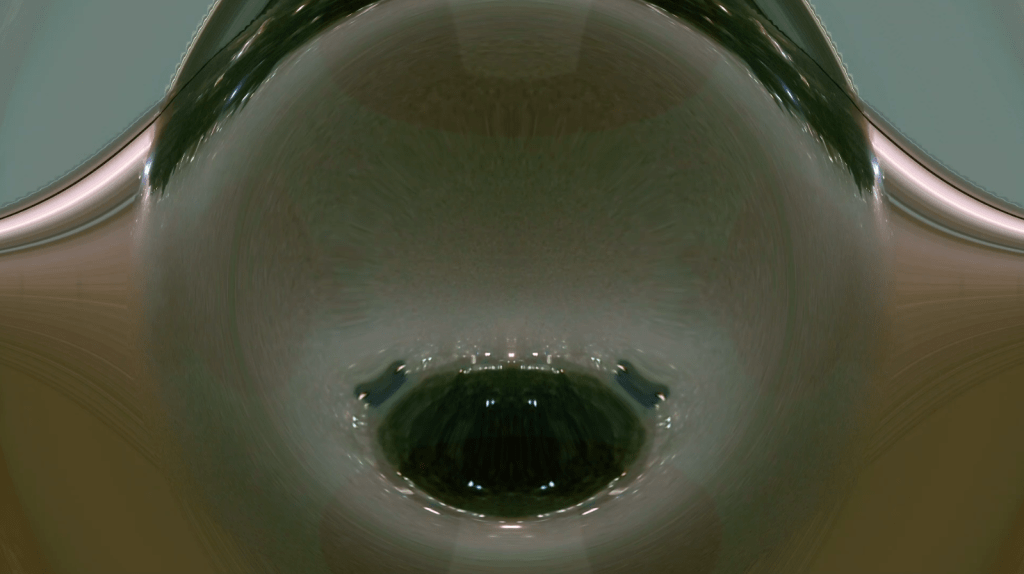
With that, the second hyperspeculation is outlined: becoming-empty as the deactivation of the predictive self-model, as the collapse of the negentropic imperative – whereby it remains irrelevant whether what is thereby experienced is “real,” since it can neither be verified nor falsified.
Here the exhausted emptiness, the burning-out, is no failure to realize oneself. That is the diagnostic error underlying almost every therapeutic discourse. Exhaustion, burnout, is interpreted as collapse, as the inability to continue becoming what one should be – and the prescribed cure consists in realizing oneself still more, managing oneself better. Yet burnout is the compression machine that has completed its work. Where the workers’ movement of industrialization and Fordism had collectivized its rage and its desire for a different future and carried it explosively outward, in post-Fordism it is a compression inward: the implosion of a rage that finds no way out anymore, because there are no solidary colleagues. Depression here is no lack of energy. It is an energy that turns back upon itself – a surplus, not a lack. If this holds, the entire vocabulary of recovery is misunderstood. One does not recover toward the becoming that provoked the collapse. One steps out. To step out therefore does not mean to seek another place – that would remain becoming toward a goal – but to leave the mode in which compression happens at all: to step out of the space that subordinates every point to a meaning, every movement to a purpose. What compression presses through a single channel opens up again only where there is no longer any channel. This place has a name in Deleuze and Guattari: smooth space, the unstriated, in which movement no longer runs from point to point along prescribed paths but distributes itself freely over a surface that prescribes no paths.
iii. Entering the Smooth Space
When our ancestors at the beginning of the Holocene, the warm age, were still nomads, they moved along lines or went from point to point. In contrast to the settled of the hot age, these points are subordinated to the paths: “The water point is reached only in order to be left behind” (Deleuze/Guattari 1987, 380). It is not a matter here of being located and fixed in a place or space, but of freedom from location. To roam and wander restlessly therefore also means to track down the flow of matter and the aggregates of intensity where no one suspects them: ice surfaces, the indistinguishable in the snowstorm, the howling of the winds in sand and stone deserts, the openness of the oceans with infinite sky characterize the smooth and the empty. In this expanse the object-forms of the landscape can intermingle, as lines, surfaces, shadows, reliefs emerge in a single surface and thereby let contingent planes arise, which intensify intuitive experiencing and reduce interpretive seeing. In this context the deterritorialization practices of modern counterculture can be located: hobos, beatniks, and hippies, who on their wanderings were underway crisscross through the USA, Europe, West Africa, or India. The Californian free climbers, the mountaineers in alpine style, or the Qalandariyyah, the wandering Sufi dervishes and yoga babas, too, try to reach where space is wide and decompressed. In the same series belong the wandering Śaiva ascetics: the naked Nāga sādhus rubbed with cremation ash, who know no property and no fixed place, and, at the outermost vanishing point, the Aghori, whose śmaśāna-sādhanā, the meditation on the cremation ground, is no horror ritual but a rehearsal of one’s own dissolution: whoever dwells among the dead, contemplates the decay of the body, and destroys the fear of it plays death against death (Baudrillard 1991, 12f) and practices that de-differentiation of non-dual Śaivism – of pure and impure, self and world – in which the subject must not become something but only unlearn something: the fear, the anxiety of being no subject.
When Deleuze and Guattari ask how one makes oneself a body without organs (Deleuze/Guattari 1987, 151), their instruction to install oneself on a stratum, a layer of rock, can also be understood literally. In heights, on contour lines, among scree, water, mudflows, on firn ridges and sedimentary rock, one can escape not only the terrible alphabet, the severing, incising, and encircling, the notchings, scarifications, and mutilations of the socius. Messner opposes to the programmed world of the city, insured against every risk, the freedom, expanse, and stillness of the mountains, whose calculated certainty he cannot bear (Messner 1997, 7). At the Everest summit he experienced “a kind of psychic orgasm, an emotional resonance in a spatio-temporal all-consciousness” [eine Art seelischen Orgasmus, ein emotionales Ausschwingen in einem raum-zeitlichen Allbewusstsein] (Messner 1978, 215). The passages on firn ridges are also experiences of immanence between life and death. They are an “exposedness” [Ausgesetztsein] (Messner 1997, 83), a “conquest of the useless” [Eroberung des Nutzlosen] (Messner 2002, 201) and an in-between-coming. The in-between-coming begins when far and near senses blur, instincts switch off, pure sensation or an all-feeling sets in. It begins with the ideas, identifications, and codes of reality dissolving and speculations about matter generating themselves, in which a “continuity of echoes, resonances, vibrations between the different levels of reality, between the human and itself or its image” [Kontinuität der Echos, Resonanzen, der Vibrationen zwischen den verschiedenen Ebenen der Realität, zwischen dem Menschen und ihm selbst oder seinem Bild] is newly created (Laruelle 2014, 110).
When Deleuze and Guattari ask how one makes oneself a body without organs, and instruct one to install oneself on a stratum, a layer of rock, this can be understood not only literally but also as a transition to an alchemy of the body itself, in order to develop body-practices that destroy the inscribed and incorporated forces, in order to create a field of immanence, in which desire lacks nothing and therefore no longer refers to any external or transcendent criterion (Deleuze/Guattari 1987, 150ff). Here the affect of becoming is attacked at its bodily root, because a body that lacks nothing is a body that has nothing more to become. What thereby disappears is not desire as lack, which would be stilled, but desire as address as such – a withdrawing that Cvetković (2026) describes as post-subjective aesthetics: the disappearance of desire from the aesthetic encounter, from the moment of approach itself. This principle of potentiation is found already among the ancient alchemists, who speculate about the transmutation of the lower into the higher self (Södergård 1996), in order to produce the all-pervading substance that can take on endless forms and is contained in everything (Golowin 1973). These transmutations depend on fineness – the higher the starting substance, the finer the potency, the more effective, because, so the alchemical speculation, a thousandfold referring-back-to-itself [tausendfaches Auf-sich-selbst-zurück-Verweisen] must contain the essential: the pneuma, the spirit, the chi (Qì) or prana (प्राण), the breath of life.
The refinement of the breath (prana) is an essential component for attaining “the resting of the senses, the impulses, the extinguishing, the slackening, the great ceasing” (Bhagavad Gita 6, 15), until at the end of the prana-holding through Kumbhaka (the breath-retention) the yogi frees the mind and a state of being dead arises (Hatha-Yoga-Pradipika 2, 77; 3, 28). It is decisive that this state is formulated not as gain but as ceasing, so that a levitating in world-inner-space in the great emptiness (Hatha-Yoga-Pradipika 3, 41; 4, 3), a walking on the empty path, becomes possible. The exhalation makes the subject empty; it does not charge itself with pneuma, the “divine spirit” but desubjectivizes itself. Becoming-empty is non-becoming.
At this point the experience of smooth space touches a figure of speculative pessimism: the black as the limit of the thinkable. Thacker (2011) has described the world-without-us as that outside which withdraws from human grasp, and Gianfranceschi (2026) reads depression as such a borderless black, an “un-universe” after the image of Fludd’s black square, into which the depressed person falls as into a singularity without return. Smooth space leads to the same threshold – the indistinguishable in the snowstorm, the darkening of the object-like, the exposedness between life and death. But if in pessimism the black stands for absence, withdrawal, the outside that swallows the human, in smooth space the same darkening arises as fullness: not as the hole into which one falls, but as the field in which nothing is lacking anymore. It is the same place, but the difference lies in whether someone is left over to whom the black would appear as loss. The breathless mountaineers on the firn ridge, Aghoris on the cremation ground, the airlessness in Kumbhaka: they all go not into the black of lack but into the black in which fear is extinguished, because the ego that would have something to lose has already darkened itself.
Herein lies the third hyperspeculation: that going out into smooth space opens no access to a beyond but the experience of a radical immanence, in which the distinction between subject and world, between inside and outside, collapses – no hyperspace, but the One-in-One, which has no place outside itself (Laruelle 2010; Bohm 1980).
iv. A Becoming-Empty That Is No Exhaustion
In this hyperspeculation the matter is most dangerous, because the non-becoming that this essay lays bare is, from outside, indistinguishable from its exact opposite. For there is another empty body, another motionlessness, another falling-silent – and it bears the same signs. When desire, instead of being directed toward the One-in-One, turns against itself – when the self-reproaches, in Freud’s words, are reproaches against a love-object that have been shifted away from it onto the subject’s own ego [Selbstvorwürfe als Vorwürfe gegen ein Liebesobjekt erkennt, die von diesem weg auf das eigene Ich gewälzt sind] (Freud 1917, 435), because the direct aggression against the object is blocked; when the rage that would be directed at the relations finds no addressee, and implodes inward; when the soul itself has been mobilized as labor resource, until depression is not the psychological illness but the psychic consequence of the exhaustion of resources (Berardi 2009), and the future has become not bad but unimaginable (Fisher 2009) – then the system collapses in on itself, and what remains is the “full body without organs” as the unproductive, to which nothing more inscribes itself. Depression is then no lack of energy but an energy that has turned back upon itself, a surplus, not a deficit, an I that has been compressed so long that it stands still. This is the enforced non-becoming: the subject that has, in Lazzarato’s “negative subjection,” already constituted itself as guilty (Lazzarato 2014, 9) and been condensed by the compression machine until it can produce nothing more.
And yet it looks like the other. Both times: no more becoming, no project, no future toward which one develops; no performance, no self-optimizing; a body that has ceased to produce the signs of its own becoming. From outside, the exhausted stillness of collapse cannot be separated from the saturated stillness of one who has ceased to consider himself incomplete. But the difference is exactly the one that can be drawn with Laruelle between an onto-photo-logical and a non-onto-photo-logical appropriation (Paulus 2024b). The exhausted emptiness is still onto-photo-logical: it is representation, the empty remainder that is left over when the copy can no longer be produced – a subject that still stands within the categories of becoming and has only lost their fulfillment, that still measures itself against the permanently enforced repetition of the familiar and of norms and fails at it. It has not left the code; it has broken on it. The saturated emptiness, by contrast, is the non-onto-photo-logical erasure of the code itself – not the failure at representation, but the forgetting of the signs and the erasing of the code of the terrible alphabet (Deleuze/Guattari 1983, 144f); not the remainder of the copy, but the darkening in which no images of images, no reproductions, references, simulations, or self-assurances arise, but their erasure (Althusser/Balibar 1972, 30). In the one case, the emptiness is the zero point, what the machine leaves over when everything is condensed. In the other, it is the emptiness that bears the whole field of possibilities – the individual becomes partly empty, free of signifiers and signifieds, free of interpretations, not because meaning was destroyed but because the subject has stepped out of the regime in which it must incessantly mean, incessantly interpret itself, incessantly become.
It is tempting to say that the emptied subject feels itself as part of the whole and thereby becomes everything – but a part does not become the whole by recognizing itself as part; a drop that thinks itself part of the sea is still a drop. The ancient pneuma-doctrine and the holistic notion of a great whole remain standing in precisely this mereological relation: part and whole, separate and yet connected. The non-dual thought is another and … more radical. In Kashmir Śaivism the subject is not a part that belongs to the whole, but it was never separated from the whole: what dissolves is not the distance between part and whole, but the assumption that there were ever two. The Pratyabhijñā doctrine calls this recognition – the subject recognizes that it is always already the One, which had only misrecognized itself in the world; the recognition adds nothing, it removes solely the veil of forgetting (māyā) that feigns the separation (Utpaladeva 2002; cf. Dyczkowski 1987). Not the drop finds its way back into the sea; there was never a drop, only the sea that takes itself for a drop. The subject thus does not become everything – it ceases to take itself for less than the whole that it never ceased to be.
The subject does not enlighten itself in order to obtain a seat, equal in rank, beside a deity in the sea of radiance and light, but it darkens itself, and in the darkening, in the clouding of the object-like, in the exhalation, there shows itself merely a mystery that withdraws from the unambiguous, the linguistic, from explicability, and is in that sense self-destructive, because the darkening cannot become a real image. The invisible through the darkening is not the outer darkness of exclusion but precisely the inner darkness of exclusion, internal to the visible itself, defined by the structure of the visible (Althusser/Balibar 1972, 30). The becoming-empty and non-becoming is thus no enlightenment but the erasure of the codes and copies. Liberation therefore means to end becoming – not because an endpoint were reached, but because becoming itself was the movement of a subject that takes itself for incomplete and lives toward a later that will never come.
That is the fourth hyperspeculation: that becoming-empty transports no new content but is the recognition of what always already was – the dissolution of the subject not as loss but as the ending of a misrecognition.
v. The Thousandfold Referring-Back-to-Itself
The fifth hyperspeculation begins with a fatal confusion. Whoever takes the exhausted emptiness for the saturated one romanticizes the collapse and abandons the imploded subject to itself, as if its paralysis were already liberation. Whoever takes the saturated emptiness for the exhausted one treats non-becoming as a pathology to be healed and prescribes as a cure precisely what compression was: more becoming, better becoming – work on oneself, in order to reinforce the self-accusation. Both confusions reproduce the machine, the one through transfiguration, the other through working on the self. Non-becoming can be thought as refusal – it is nothing one could test, measure, diagnose from outside. It turns on whether the lack from which becoming came is seen through as fiction or only endured as reality, until the energy is extinguished. With that the fifth hyperspeculation accomplishes itself: that non-becoming cannot be described without missing it, because every description continues the grammar of becoming – it can only be enacted, in the text that folds instead of progressing, in the echo without origin, in the self-similarity that knows no original. With that the essay breaks, at its target point, with its method: hyperspeculation demands producing no doubles of the world, occupying no variable with a value, keeping the results open, subtractable again and again. Yet non-becoming is not treated here as one indeterminate among others: out of the “(Non)-One” there has, apparently, become a One again, a last instance, a new master signifier. The method too is a code, non-philosophy too an appropriation, the “as-if” too still a standpoint. The last indeterminate that remains to be subtracted is subtraction itself: the enactment – no sentence about non-becoming, but a thousandfold referring-back-to-itself that refers to nothing outside itself, because there is no outside that would contain it. Thus nothing closes, because nothing was open; thus nothing ends, because nothing began. There is no outside – and this sentence too has none: it is a loop that, in saying itself, recognizes itself once more as that which it never ceased to be. An echo without origin.
Literatur
Althusser, L. (1977). Ideologie und ideologische Staatsapparate. VSA.
Althusser, L., & Balibar, É. (1972). Das Kapital lesen (Bd. 2). Rowohlt.
Baudrillard, J. (1991). Der symbolische Tausch und der Tod. Matthes & Seitz.
Berardi, F. „Bifo”. (2009). The soul at work: From alienation to autonomy. Semiotext(e).
Bhagavad-Gita. (n.d.). https://ramakrishna.de/vedanta/bhagavad-gita.php
Bohm, D. (1980). Wholeness and the implicate order. Routledge & Kegan Paul.
Bourdieu, P. (2001). Masculine domination (R. Nice, Trans.). Stanford University Press. (Original work published 1998)
Butler, J. (1990). Gender trouble: Feminism and the subversion of identity. Routledge.
Collmer, T. (2002). Hegels Dialektik der Negativität. Focus.
Cvetković, L. (2026, 25. Mai). Deprivatization: On post-subjective aesthetics. Hyperspekulation. https://hyperspekulation.org/2026/05/25/deprivatization-an-essay-in-post-subjective-aesthetics/
Damato, C. N. (2026, 18. Juni). Notes on entropy and negentropy. Hyperspekulation. https://hyperspekulation.org/2026/06/18/notes-on-entropy-and-negentropy/
Debord, G. (1994). The society of the spectacle (D. Nicholson-Smith, Trans.). Zone Books. (Original work published 1967)
Deleuze, G. (1993). Unterhandlungen 1972–1990. Suhrkamp.
Deleuze, G., & Guattari, F. (1983). Anti-Oedipus: Capitalism and schizophrenia (R. Hurley, M. Seem, & H. R. Lane, Trans.). University of Minnesota Press. (Original work published 1972)
Deleuze, G., & Guattari, F. (1987). A thousand plateaus: Capitalism and schizophrenia (B. Massumi, Trans.). University of Minnesota Press. (Original work published 1980)
Dyczkowski, M. S. G. (1987). The doctrine of vibration: An analysis of the doctrines and practices of Kashmir Shaivism. State University of New York Press.
Fisher, M. (2009). Capitalist realism: Is there no alternative? Zero Books.
Foucault, M. (1976). Mikrophysik der Macht. Merve.
Freud, S. (1917). Trauer und Melancholie. In Gesammelte Werke (Bd. X, S. 428–446). Fischer.
Gadamer, H.-G. (1999). Hermeneutik I: Wahrheit und Methode. Mohr Siebeck.
Gianfranceschi, D. (2026, 5. Juni). Expressions in-between time. Hyperspekulation. https://hyperspekulation.org/2026/06/05/expressions-in-between-time/
Golowin, S. (1973). Lord Krishna von Goloka [Tonträger]. Die Kosmischen Kuriere, KK 58002.
Hatha-Yoga-Pradipika. (n.d.). https://de.ashtangayoga.info/philosophie/quelltexte-und-mantren/hatha-yoga-pradipika/
Holzkamp, K. (1973). Sinnliche Erkenntnis. Athenäum.
Horkheimer, M., & Adorno, T. W. (1991). Dialektik der Aufklärung. Suhrkamp.
Kronic, M. B. (2024). A marker. In Sonic faction: Audio essay as medium and method. Urbanomic/MIT Press.
Laruelle F. (2010). Non-Standard Philosophy: Generic, Quantum, Philo-Fiction. Kimé
Laruelle, F. (2013). Philosophy and non-philosophy. Univocal.
Laruelle, F. (2014). Non-Photographie / Photo-Fiktion. Merve.
Lazzarato, M. (2014). Signs and machines: Capitalism and the production of subjectivity. Semiotext(e).
Marx, K. (1962). Das Kapital: Kritik der politischen Ökonomie (Bd. 1, MEW 23). Dietz. (Original work published 1867)
Messner, R. (1978). Grenzbereich Todeszone. Kiepenheuer & Witsch.
Messner, R. (1997). Berg Heil – heile Berge? Rettet die Alpen. BLV.
Messner, R. (2002). Gefühle eines Grenzgängers: Im Gespräch mit Steffen Fliegel, Annette Kämmerer. Psychotherapie im Dialog, 3(02), 201–206.
Nietzsche, F. (1999). Werke. Zweitausendeins.
Parr, T., Pezzulo, G., & Friston, K. J. (2022). Active inference: The free energy principle in mind, brain, and behavior. MIT Press.
Paulus, S. (2020). Deterritorializations – Field recordings, recipes, smooth spaces and body-without-organs. In A. Szepanski (Hrsg.), Ultrablack of music (S. 171–181). Mille Plateaux/NON.
Paulus, S. (2022). Der organlose Körper – Hineingehen in den glatten Raum und Spekulationen über die Leere. Meta: Research in Hermeneutics, Phenomenology, and Practical Philosophy, 14(2), 402–430.
Paulus, S. (2024a). Pharmaco-analysis of psychedelics: Philo-fictions about new materialism, quantum mechanics, information science, and the philosophy of immanence. Philosophies, 9(1), 7. https://doi.org/10.3390/philosophies9010007
Paulus, S. (2024b). n-fach-Belichtungen – Non-Photographie, Materialismus der Begegnung, Bilder ohne Objekte. Journal for Artistic Research, (32). https://doi.org/10.22501/jar.1703471
Paulus, S. (2025a). „He, Sie da!” Subjekt, Subjektivierung und Subjektwissenschaft. In M. Zeller, L. Groß & J. Braschel (Hrsg.), Adressat:innen der Sozialen Arbeit (S. 173–189). Wbv.
Paulus, S. (2025b). Sound fiction: Noise, echoes, feedback. In A. Szepanski & Palais Sinclaire (ed.), Ultrablack of music (Part 2, 233–250). Zero Books.
Penrose, R. (2010). Cycles of time: An extraordinary new view of the universe. Bodley Head.
Södergård, J. P. (1996). Decoding the hermetic discourse in Salomon Trismosin’s Splendor Solis. Scripta Instituti Donneriani Aboensis, 16, 313–344.
Szepanski, A. (2015). Laruelle und die Non-Philosophie. Narthex, (1), 75–84.
Thacker, E. (2011). In the dust of this planet: Horror of philosophy (Vol. 1). Zero Books.
Utpaladeva. (2002). Īśvarapratyabhijñākārikā (R. Torella, Hrsg. & Übers.). Motilal Banarsidass.
Vaihinger, H. (1986). Die Philosophie des Als Ob. Felix Meiner. (Original work published 1922)
Wittgenstein, L. (1989). Das Blaue Buch. In Werkausgabe (Bd. 5). Suhrkamp.
 Hyperspekulation
Leave a comment