By Luka Cvetković
There have been rumors about the disappearance of desire from contemporary art. From cinema, the museum and biennial, and from the aesthetic encounter as such: from the moment of approach to an object that exceeds comprehension, the moment of being drawn toward something whose withdrawal demands a new form of attention. What has replaced desire is information. Research-based practices, politically charged messages, eco-awareness campaigns, representations of identity: the art space has become a site for the circulation of knowledge about a world already known to be unsavory. Climate catastrophe, humanitarian crisis, the rise of nationalism, the persistence of patriarchy. These are real, and they matter. But their mattering is not the same as their being art. The information about them circulates within existing relational frameworks. It confirms the subject’s existing categories. It does not change the structure of how the subject relates to anything.
The problem runs deeper than a matter of media technology or shifting institutional taste: the inscription of the aesthetic field by what Timothy Morton calls hyperobjects (vast, distributed structures like transgenerational trauma, circulations of power, and subjective identity) that choreograph human time as a sequence of causal necessity. Inside these circulations, art becomes the reproduction of already-existing relational scripts under the guise of critique.
What is lost is precisely what cannot be planned, controlled, or delivered by design: the encounter with the contingent real, the production of new time, the emergence of forms of care that had no prior form.
Walter Benjamin, writing in a different conjuncture but diagnosing an analogous condition, identified in the decline of the aura something like this disappearance of desire. The aura, for Benjamin, was a specific spatial and temporal quality: the quality of distance, of the object as it withdraws into its here and now, as it refuses to be reproduced, repeated, circulated. The auratic object cannot be brought close in the way that the reproduced image can. Its withdrawal is constitutive of the encounter. When Benjamin mourns the loss of the aura under conditions of mechanical reproduction, what he is mourning is precisely the withdrawal that makes genuine encounter possible, the withdrawal that demands something new from the subject rather than confirming what the subject already is. The contemporary art world has in some respects reversed Benjamin’s diagnosis: it has produced an abundance of ostensibly non-auratic, critically reflexive, politically engaged art that functions, paradoxically, to reinstall the subject’s existing frameworks rather than to disturb them. The critical posture is itself a relational script. The politically correct artwork confirms the politically correct subject. The protest poster hanging in the white cube does not interrupt the institutional architecture of recognition; it completes it.
To say this is to make a specific and demanding claim: the function of art most irreducibly its own, the function that cannot be performed by journalism, activism, therapy, or academic writing, is the production of encounters that temporarily exceed the subject’s existing scenography of relations. Encounters that change the structure of how one cares rather than the content of what one cares about. And contemporary art, in large part, has abdicated this function in favor of functions more legible within the existing institutional and ideological order. It has chosen the probable over the possibility for contingently different.
The distinction between the probable and the possible is the hinge on which everything that follows turns. The probable is choreographed by already-existing knowledge, already-existing scripts, already-existing forms of expectation and desire. The probable is what the hyperobjects of trauma, power, and identity produce when they choreograph human time as necessity. The possible, as it is used here, is something harder to think and harder to produce: the genuinely contingent event which happened but did not need to happen, whose occurrence retroactively constitutes a new before and after, as distinct from the actualization of a potential already inscribed in the generic, or the imagined future extrapolated from existing conditions. Art, at its most irreducibly itself, is a question of the possible in this precise sense. And the possible, as will be argued throughout, cannot be produced by intention alone. It can only be produced by the encounter with something that exceeds intention, with the withdrawn object whose interiority permanently resists absorption. Whatever emerges from it will have been unforeseen.
The Exit
The philosophical background to this crisis has been diagnosed most sharply by Quentin Meillassoux under the name of correlationism: the conviction that we cannot think anything independently of its correlation with human thought or experience. The world as it is in itself, independently of any subject who experiences or thinks it, is strictly inaccessible. We are always already inside the correlation: subject and world are co-constitutive, and there is no view from nowhere that would allow us to step outside. Meillassoux’s critique of correlationism is well known in philosophical circles and has been influential in the emergence of what is now called speculative realism.
What matters for the purposes of this argument is the specific way in which correlationism closes off the possibility of genuine novelty. If the world is always already correlated with human experience, then what appears as new is always new-for-a-subject: a novelty within the existing subject-world relation, a rupture of it never arriving. The subject’s scenography is never itself at stake. It is the constant, the ground, the condition of possibility for anything that happens within it. Art, under these conditions, can produce new experiences (new contents to be experienced), but it cannot produce a new experiencer. It cannot change the very structure through which experience occurs.
This is the philosophical depth of what appears, on the surface, as merely an aesthetic or institutional problem. When art becomes the medium through which already-constituted subjects communicate with one another, when it becomes a relay of representations, recognitions, and affirmations, it is enacting, at the level of cultural practice, the closure that correlationism describes at the level of philosophy. Every artwork that confirms its audience’s existing frameworks of relation is a small correlationism in action: a demonstration that the subject’s scenography is the horizon of what is possible, the measure of what counts as real.
Suhail Malik has pushed a version of this critique directly into the art world, arguing that as long as contemporary art values experience as its primary condition, art is irreducibly correlationist. It is always tethered to the position of the subject, their point of view, cultural background, subjective identity. The work of art, on this model, is a relay between subjects, a medium through which subjectivities communicate and confirm each other. The clichés Malik identifies (deterritorialization, in-betweenness, border crossing, unpolitical-politicality) are the aesthetic form of a philosophical problem: the impossibility, within correlationism, of a practice that does not simply return to the subject what the subject already knows.
The gallery becomes a mirror. The biennial becomes a confirmation system. The relational artwork becomes the most refined possible reproduction of existing social scripts.
The exit Malik calls for is, however, far from easily performed. The temptation is to swing in the opposite direction: to declare that art should have nothing to do with the subject, that it should be purely formal, purely material, purely objective. This is the temptation of various strands of late modernism and of certain Object-Oriented Ontology-influenced practices in contemporary art. But this move simply installs a new correlationism at a higher level of abstraction: the subject who claims to have exited subjectivity is still a subject making that claim, still staged by a scenography that is never itself put at risk. Pure formalism, pure objecthood, pure materiality: these are still subject-positions, still relational orientations, still ways of choreographing the encounter from within the existing staging. The real exit cannot be designed from within the existing scenography. It can only happen contingently, as an encounter that exceeds what either the artist or the viewer could have planned, because neither could plan it from within the choreographies that the encounter temporarily suspends. Genuine novelty does not enter from inside the assemblage of prior notions. It enters from the encounter with something whose ontological core permanently resists absorption: an object whose withdrawal exceeds any choreography brought to it, and which thereby demands a form of attention, curiosity, and care that the subject did not previously possess and cannot derive from its existing repertoire. The exit from correlationism is an ontological event produced by the object’s withdrawal. Whatever it opens onto cannot be named in advance.
Privatization
To understand what deprivatization means, it is necessary first to understand what privatization is, and to understand this with the precision the concept requires, which is neither primarily economic nor primarily political, though it has consequences in both domains.
To be privatized is to have one’s experience organized, distributed, and made legible by the hyperobjects of trauma, power, and subjective identity; to have the very scenography of one’s relation to the world determined in advance by these circulations, such that what appears as one’s own experience is in fact the expression of a much larger and impersonal system. The privatized subject experiences itself as the origin of its own desires, fears, orientations, and cares. It experiences its choreographies as natural, as expressions of who it genuinely is, rather than as the products of the hyperobjects that have constituted it. This is privatization in its deepest sense: the constitution of the subject as a private enclosure, a subject for whom the real is always the real-as-staged-by-trauma-power-identity, and for whom any encounter that exceeds this organization registers as noise, threat, or unintelligibility.
Morton’s concept of the hyperobject thinks entities so massively distributed in time and space that they cannot be directly encountered; they can only be experienced through their local manifestations, their weather, their symptoms. Global warming is a hyperobject: no one encounters global warming directly; what one encounters is this specific heat, this flood, this drought, this season that no longer arrives when expected. The hyperobject always exceeds any particular encounter with it while organizing that encounter from the outside. Its gravity is total and its surface is nowhere. You cannot point to it. You can only notice what it does to everything you can point to.
Morton’s examples are ecological and geological, but the concept applies with equal force to the structures that organize human social and psychic life. Transgenerational trauma is a hyperobject. The patterns of transmission, the ways in which the unprocessed experiences of one generation become the scenography through which the next generation encounters the world, are too vast, too distributed across time and family systems and cultural formations and bodily memory, to be directly encountered by any individual subject. And yet every individual subject lives in their weather. The specific fears, the specific modes of intimacy and withdrawal, the specific triggers that produce disproportionate response: these are the local manifestations of the hyperobject of trauma, experienced as personal, as characterological, as the truth of who one is. Power is a hyperobject: no one encounters power directly; what one encounters is this refusal, this privilege, this violence, this opportunity that opens or closes without apparent reason, this room in which one is or is not comfortable.
Subjective identity is a hyperobject: no one encounters their identity directly; what one encounters is this recognition, this misrecognition, this place in a staging that was already established before one arrived, this name that carries more weight than one can individually account for.
To be privatized by these hyperobjects is to have one’s experience choreographed by involuntarily and inevitably taking part in their circulations. The traumatized subject does not merely carry the effects of past trauma; they are constituted by it, organized by it, such that their very choreographies of relation (what they can desire, what they can fear, what they can attend to, what they can care about) are staged by the hyperobject of trauma in advance of any particular encounter.
The subject under power does not merely inhabit power relations; they reproduce them, perform them, require them for the very intelligibility of their experience. To be stripped of a power differential one is accustomed to is experienced as disorientation, because the power relation has been constitutive of the very scenography through which experience is organized. The subject performing identity does not merely have an identity; they are, at the level of scenographic structure, the performance of that identity, such that any encounter that does not confirm it registers as threat or noise. The hyperobjects are the very material of which the subject is made.
Freud’s account of the repetition compulsion is the sharpest description of this structural inscription at the level of individual psychology. The subject compulsively repeats because the scenography through which it encounters the world ensures that every new encounter is, at the level of structure, the same encounter. The new person becomes the old person. The new situation becomes the old situation. The very apparatus through which new encounters are processed was formed in and by the original traumatic situation. The new encounter is filtered through the old structure and emerges as a variation on the old theme. Repetition is a consequence of structural inscription.
And this is why the therapeutic approaches that address the content of the repetition, that help the subject understand why they repeat, what the original situation was, what the pattern means, often fail to interrupt the repetition itself. Because the repetition operates at the level of structure, and structural change cannot be accomplished by adding new content to an unchanged structure.
Bourdieu’s habitus describes the same phenomenon at the level of social formation. The habitus is the system of durable, transposable dispositions through which the subject apprehends the social world, a system that was formed in specific social conditions and that tends to reproduce those conditions in every new situation the subject enters. The habitus operates below the level of explicit belief, in the very posture, gaze, and timing with which one inhabits space. The person formed in conditions of class deference carries that deference in their body long after they have consciously rejected the ideology that justified it. The person formed in conditions of gendered surveillance carries that self-monitoring in their nervous system long after they have understood it as political rather than natural. The habitus is Bourdieu’s name for what has here been called structural inscription: the inscription of social relations in the body itself, at a level that precedes and resists conscious intervention. To deprivatize is, at this level, to temporarily suspend the habitus, to create the stage under which the body’s trained responses are no longer adequate to the encounter, and something new must emerge. This is what the encounter with the withdrawn object produces: an encounter that the habitus cannot process. An encounter that exceeds the trained responses, that makes the body’s choreographies temporarily inadequate, and in that inadequacy, opens a space in which something that was not previously possible becomes, briefly, actual.
What capitalism delivers to the privatized subject is the perpetuation of sameness under the guise of progress. This is a structural consequence of the fact that the capitalist market is organized to capitalize on the traumatic subject’s need for stability: the need for things to remain, at the level of scenography, the same. New content, new names, new identities: but always within the same scenography, always confirming the same structural positions. The traumatic subject does not want genuine difference in kind. Genuine difference in kind is precisely what threatens the fragile coherence of the self organized by trauma. What the traumatic subject wants (and what capitalism expertly delivers) is the sensation of difference without its reality: the new product that is familiar, the new relationship that repeats the old pattern with different actors, the new artwork that produces the same emotional responses in a new aesthetic register. McDonald’s is allowed to introduce as many different tastes as it likes, but the logo, the hamburger, the atmosphere must stay the same. The art fair is allowed to represent as many different identities and perspectives as it likes, but the structure of representation, recognition, and value must stay the same. The art world, organized by the same logic, produces false difference: new aesthetics, new identities, new politics, all within a scenography that is never itself at risk. Whatever changes, it changes only in dress.
Identity Politics in Art
The critique of identity politics in the art world requires the most careful handling, because the positive dimension of what identity politics has accomplished, and continues to accomplish in political and civil contexts, must be acknowledged before its specific limitations in the aesthetic stage can be understood. To confuse these two levels is to risk lending inadvertent support to the reactionary position that identity politics is simply wrong, which is not the argument being made here. The re-articulation of one’s own power, boundaries, and previously repressed or suppressed identity is a genuine actualization of the subject as an equal participant in the socio-cultural-political-economic constitution of shared life. The naming of common properties of identity can unify individual struggles into collective ones in ways that produce real political change. The visibility of previously invisible subjects in institutional contexts, museums, biennials, curricula, archives, is not nothing. It matters who is in the room. It matters who is included in the archive, who gets to author the narrative, whose suffering is deemed worthy of public attention and whose is deemed invisible. These are material stakes and they should not be dissolved in a gesture of aesthetic sophistication.
But there is a specific failure that occurs when the tactic of identity politics is transported from the political stage into the aesthetic one without modification, and it has to do with the structural difference between what political struggle requires and what the aesthetic encounter requires. Political struggle requires legibility, the capacity to be recognized, named, and organized within the existing representational order. Identity politics produces legibility. It names the previously unnamed, organizes the previously dispersed, makes visible the previously invisible. It does so by working with and within the existing scenography of recognition, by insisting that the scenography extend to include what it has hitherto excluded. This is exactly what political struggle, in its most immediate form, needs.
There is a genuine complexity behind what is being loosely understood as Identity-Politics-Art. For subjects who have been historically refused recognition, the encounter with visibility can itself constitute a structural rupture rather than a mere confirmation. To be seen where one was previously invisible is to potentially alter the very conditions under which the subject exists in relation to institutional power. The question is whether recognition, once achieved, can continue to function as an aesthetic rather than merely a political event. The argument that follows is not that identity-oriented art is without value. It is that value of a specifically aesthetic kind, the kind that changes the structure of how one cares rather than the content, requires something that the logic of recognition, taken as a sufficient end, cannot supply.
The aesthetic encounter requires a temporary suspension of the choreographies of recognition, naming, and identity that structure ordinary social life. It requires an approach to the object that is staged in advance by nothing: not by who the subject is, what they know, whose side they are on. The encounter that produces new time is precisely the encounter that temporarily makes the subject’s existing scenography, including their identity, inadequate. And identity-performing art, which choreographs the encounter around the confirmation of existing identities, forecloses this possibility by design. It replaces the encounter with the withdrawn with the encounter with the recognized. It replaces the possible with the legible.
The limitation of such artistic practices is structural. Art that positions the confirmation of identity as its primary function cannot, at the same time, produce the deprivatizing encounter that is art’s most irreducibly singular capacity. It can do many other things. It can give visibility, provide recognition, build community, articulate resistance. But it cannot produce the encounter with the withdrawn, the encounter that changes the subject in kind rather than in content, that produces new orientations of attention and care rather than new versions of existing ones.
Carla Lonzi understood this at a deeper level than most of her contemporaries. Her refusal of the dialectic, her insistence in Sputiamo su Hegel that woman is not dialectically related to the male world, that the demands she expresses do not constitute an antithesis but a shift to another level altogether, is a refusal of the scenography within which Hegel’s dialectic operates: the choreography of thesis and antithesis, of the oppressed and the oppressor, of the subject who defines itself through negation of the other. To enter the dialectic, even as the negating term, even as resistance, is to accept the terms of the dialectic as the terms of one’s own liberation.
And accepting those terms means being transformed by them: the liberated become, structurally, the new liberators, the new masters, the new bearers of the same scenography under a different flag. Lonzi’s position points toward something that cannot be contained within this scenography, something that must, as she puts it, shift to another level entirely. The encounter which genuinely changes the subject cannot be choreographed by the same scripts as the encounter it seeks to move beyond.
If we ask who is performing identity in the contemporary art world, we must also ask for whom identity is performed. Who assembles the stage? Who is the light technician that determines what can be seen and what remains in darkness? Who scripts the permissible deviation, the acceptable subversion, the recognizable difference? Dokumenta15 can be curated by a collective from Indonesia and feature the full range of contemporary political aesthetics (democratic processes in art, social justice activism, postcolonial critique, community building) but it cannot question being sponsored by DOEN, or by the German federal government, or by the structural position of Kassel as a site of legitimation for a certain kind of international contemporary art. Manifesta14 in Pristina can feature sixty percent Kosovar-Albanian artists (and this is a genuine achievement, one that required real institutional pressure and real political will), but it cannot be curated by a Kosovar Albanian. The worlds change, and stories can be told differently, and the readers and listeners will, from time to time, shift from local toward more international. But the power to write the book itself is not in your hands.
Within the global art economy, a perverse logic governs who gets visibility, how, and under what conditions, and inclusion often arrives with a script. Artists from the so-called peripheries are welcomed into visibility through curated lenses of trauma, desire, and difference, but only when these align with institutional expectations. The artist from the periphery is invited to perform their peripherality: to make legible, for an audience that is not from the periphery, what it feels like to be from there. Identity becomes a currency, exchanged for recognition, yet constrained by what can be named, aestheticized, and circulated within the existing architecture of institutional value. You are free, but under terms and conditions. Those assuming certain privileged positions may allow themselves to be intelligent, extravagant, experimental; you are curated as attractive, legible, consumable. Behind the identity-performing game in art, there operates an institutional muscle-memory, sediment of longer histories of racialized classification, whose effect is to require that certain subjects be comprehended through the prism of their common properties rather than simply as themselves, as beings without additional qualification.
As Anna Longo has written, the neoliberal global market game appears to produce and include all differences, but is different from nothing: anybody is free to take a chance, but nobody can leave the table. The neoliberal art economy recognizes neither property nor ownership, only the quantity and quality of relations. You cannot own even the common properties of your identity; you are invited to rent them, to make them available to the market of false differences, to participate in the circulation of the recognizable. To own is to be owned, first of all by experience itself.
True decoloniality, as Aníbal Quijano and Walter Mignolo have argued, requires not merely the inclusion of previously excluded perspectives within the existing epistemic order but a de-linking from the colonial matrices of power that constitute that order at its foundations. The gesture is structural: not adding the missing voices to the existing conversation but calling into question the conditions under which the conversation takes place, who it benefits, what forms of knowledge and relation it forecloses, and what it would mean to constitute an entirely different epistemic ground. De-linking is the refusal to accept the terms of engagement as the only available terms: the insistence that there are other terms, that a different epistemic ground is possible, even when that ground has not yet been fully articulated. Deprivatization, in the aesthetic field, is the analogue of this de-linking: the suspension of the scenography within which the art world operates, the temporary creation of conditions under which something that exceeds that scenography can emerge. Whatever that something is, it cannot be specified in advance.
Not Knowing
In times of crisis one does not know how to react. The state of crisis is defined through the inefficiency of the existing set of tools we possess in order to suppress or include the tensions that arise within, as well as the inability to produce enough new ones to encounter what is outside the domain of everyday reality. But what happens when the crisis becomes the reality of the everyday? How do we orient ourselves in a permanent state of powerlessness, collective anesthesia, and apathy? How does solidarity emerge from bodies that encounter the suffering of others indirectly, through the means of social media and news?
Could being shocked, not knowing how to react, being confused, spending time not navigated by the desire to immediately mark oneself as belonging to the good cause, but being deeply worried, sometimes for hours or days, without a clear answer, without a moral or ethical compass to protect yourself with, also be understood as a form of empathy? And more importantly: is it a fertile ground for solidarity to emerge?
To react to atrocities, whether by sharing images on social media or through complete numbness, are both symptoms of a generic human potential. To negotiate and negate one’s own desire for reaction is what could characterize the actual potential, the kind we know makes a human being human: presented with a choice, and therefore curious. To negate is to actualize what potential is, to make certain things possible, and with them make choices for which one is held responsible.
It seems that artists think their responsibility is to immediately respond to the horrors that are taking place. But is that a good strategy to produce solidarity with those in pain?
There is a risk of the accidental normalization of violence through the omnipresence of violent imagery, a process of adjustment to horrifying suffering that takes place, always, outside the limits of your responsibility and power. Are we, by posting every day on social media, doing justice to the victims? Are we identifying with their pain, or are we always, because of the structure of these platforms, identifying only with ourselves? With those parts of ourselves we want to protect: our own fears of the lack of control, our own self-image. Are we in the process of constant denial by revoking the image of suffering? Are we as artists undermining our own responsibility, crossing the boundaries of our power, or worse, simply practicing our own powerlessness?
The news emerged as a consequence of collective trauma, representing our longing for togetherness, our desire to feel that we are all here and alive. But most importantly it stands as our inability to emotionally process horror, and so the news produces the sense of the protocol of time. More information equals more events equals more time passed since trauma occurred, which implies more time for trauma to be processed. But since these are not true events we are participating in but ones we silently observe, and since news is weightless information immediately succeeded by the next piece arriving the next hour or second, the news are pseudo-events. Nothing more than a decorated mask hiding the inability for trauma to be resolved, anesthetizing the individual and collective body that desires a true cut in time, a contingent event, by passivizing it and satisfying its urges with the sensation of participating in the image, or even idea, of change.
But is art any different?
If one enters today the art space and looks closely at research-based, information-oriented practices, behind the lines of text and graphics one could see an artist demanded to stop producing magic and asked to be a news anchor in a gallery space instead. Art forgot to be magic, an allure toward what is behind the object, and became instead a simple reproduction of the immediate reality we are already part of. Reacting from within such a reality is a well-known method appreciated by precisely those power structures the artworks are trying to undermine, not just because by attacking patriarchy or informing the art world about the melting of glaciers you are strengthening the dominant power discourse, but because you are producing a perspective through which it is only possible to negotiate toward the properties of things that formulate the immediate reality we are already part of.
These information-driven artworks undermine the possibility of contingent change in the aesthetic experience and practice powerlessness by going to fields outside their primary responsibility.
Art can and should be about everything, and yet the idea that art’s task is to address social issues, climate change, patriarchy, and dying ecosystems arrived with socially engaged practices that brought, alongside genuine information, a danger of the authority of knowledge: audiences left to be shocked, bored, or simply nodding in disapproval, with the promise of change never fulfilled. Knowledge is always in the domain of power, control, authority, and hierarchy. Art is precisely in the break with the dominant discourse of power, but not because it is necessary to do so, or because of repression, or because we desperately await change, but simply because it is possible. At certain moments it becomes possible to detach from the realm of language, of knowledge, of right-wrong and good-evil binaries, and simply be, without the pressure to name or be named. These moments do not know of the signifier or master-slave dialectics. They know of the difference in singular experiences, and because they carry no interest in accumulating power over the other subject, they belong to a non-normative ontological landscape. They allow for a moment of silence, of non-navigated contemplation, of not-yet-known ways of relating to the other, and as such offer a ground for indifferent solidarity, forms of empathy and care that had no prior form.
Deprivatization
To deprivatize is to disarticulate the subject’s position in economies of trauma, power, and subjective identity, creating conditions under which the subject is no longer inscribed within these circulations, no longer choreographed in advance by their scripts, no longer available to the forms of exchange and recognition that normally constitute its social legibility.
The deprivatized subject is structurally unavailable to the operations of the hyperobjects. A non-image: a subject that has temporarily ceased to be a medium for the transmission of trauma, power, and identity, that has left the stage rather than opposing them from within. Whatever it is, it is no longer available for inscription. The subject who resists is still organized by what it resists, perpetuating the scenography of the hyperobjects in the very structure of its opposition. The deprivatized subject exits the coordinate system altogether, briefly, contingently, and without guarantee of return. A withdrawal from the field of representations itself, rather than another representation within.
What makes this possible is the encounter with the withdrawn parts of objects, precisely those dimensions of the object that existing choreographies cannot process, cannot name, cannot instrumentalize. The encounter does not proceed through the object’s usable properties, its legible identities, its assignable meanings. It proceeds through what the object withholds. And in approaching what is withheld, the subject’s own scenography, formed by and for the circulations of trauma, power, and identity, becomes temporarily inadequate. This inadequacy is the opening. It is the specific mechanism by which deprivatization occurs: through the simple fact of approaching what cannot be processed through existing means, and remaining there long enough for the apparatus to change.
What emerges from this inadequacy is a form of curiosity, a new orientation of care, a mode of attention that did not previously exist. Shaviro’s reading of Whitehead offers the most exact account of what this involves at the level of experience. For Whitehead, every actual occasion, every event in the universe, however minute, involves what he calls prehension: the taking up of what has been, the feeling of one’s data, the creative response to inheritance. And crucially, this prehension is affective before it is cognitive. The occasion feels its world before it thinks it, relates to it aesthetically before it relates to it cognitively. Shaviro’s elaboration of this into a theory of what he calls “post-cinematic affect” extends it: aesthetic experience, understood in the Whiteheadian register, is the moment when this affective prehension becomes available to conscious attention, when the subject feels its own feeling of the object, and in that feeling, encounters something that its existing categories of cognition have not yet organized.
Deprivatization, from the inside, is first an affective rupture: the subject’s existing modes of feeling the world, the affective infrastructure laid down by trauma, power, and identity, become inadequate to what is being felt. The withdrawn object produces new orientations of the whole organism toward something it cannot yet categorize, something felt before it is named, before it is thought. These pre-cognitive orientations are what deprivatization, as an aesthetic event, actually consists of. Before the new thought comes the new feeling. Before the new feeling can be articulated, it has already changed the structure of how the subject relates to its world. For Shaviro, following Whitehead, the affective dimension is ontologically primary: the universe is, at its most fundamental level, a field of prehensions and responses, of feeling and being-felt. The encounter with the withdrawn object exceeds the entire apparatus of the privatized subject, cognitive and affective alike, and forces the production of new capacities at both levels simultaneously. This is precisely why deprivatization, aesthetic deprivatization, the encounter with the withdrawn parts of objects, is the entry point into genuinely new forms of care, radical love, and what has been called here the unidirectional curiosity for things in themselves outside their nameable properties. These are structural consequences of the encounter with the withdrawn. They are what emerges when the existing apparatus of relation, formed in and by the circulations of trauma, power, and identity, is exceeded by what it is approaching.
The subject who has undergone this encounter acquires, briefly, a new way of being toward things: a form of relation that precedes and exceeds the scenography the hyperobjects have installed.
As Spångberg puts it: to participate in an aesthetic experience that is different-in-kind is to become void of relations and therefore ungovernable. The subject organized by trauma, power, and identity is governable precisely because it is constituted by its relations; its position within the scenography of recognition, exchange, and power is what makes it a legible and manageable node in the social and economic field. The hyperobjects govern by constituting relation: ensuring that the subject’s desires and orientations keep it available to the circulations of power and trauma. To become void of relations, however briefly, however contingently, is to become structurally ungovernable, because one has temporarily ceased to exist as the kind of entity to which those rules apply.
Winnicott’s transitional space is adjacent to this, though it stops short. For Winnicott, the transitional space is the space of play, the space between the subject and the world that is neither fully subjective nor fully objective, in which the child and later the adult can explore the boundary between self and other without the stakes being too high. Culture, including art, occupies this space.
But Winnicott’s is ultimately a developmental account organized around the needs of the subject, and the transitional space it describes is still a space within the subject’s scenographic economy, a protected area in which the usual rules are suspended by prior agreement. Deprivatization goes further: a temporary suspension of the economy itself, an event in which the subject’s scenography is genuinely put at risk. The encounter with the withdrawn object arrives as a genuine inadequacy of the existing choreographies, and what emerges from that inadequacy cannot be controlled, named in advance, or safely contained. Whatever it is, it belongs to no one.
Care Before Language
When Margaret Mead was asked to locate the origin of human civilization, she pointed to a healed broken femur, a femur healed by another person, through sustained attention over weeks or months with no apparent, instrumental return.
The philosophical significance of this example exceeds its anecdotal appeal. A broken femur in a non-human animal context is almost universally fatal. It incapacitates, and incapacitation means death: from predators, from exposure, from starvation. For a Homo Sapiens to heal another’s broken femur required remaining with a body that could contribute nothing to the group’s survival for a period of weeks or months. No instrumental logic, no calculus of reciprocal advantage, no already-existing model of social care could have motivated this. The event had to exceed all existing frameworks of relation. It had to be, in the most precise sense, a response to something in the other whose appeal could not be processed through available categories, a response to something withdrawn.
What that event produced, what we would later come to call care, was, following Brentano, an intentional orientation toward those parts of another being that were withdrawn, incomprehensible, outside the subject’s existing models of relation. A curiosity toward the alien. A draw toward something that resisted full comprehension but demanded response. Genuine curiosity, in this sense, is produced by the object’s withdrawal, by the fact that the object exceeds what the subject already knows together with its positions and relations these produce.
This is the minimum denomination of the human: a contingent, indifferent, non-directional form of care produced in the encounter with something incomprehensible. This care is indifferent in the sense that it precedes and exceeds the subject’s established evaluative frameworks. Care for the femur-bearer did not begin as care. It began as an orientation that had no name, no category, no place in existing social scripts. It became care only retroactively, once it had already produced its effects, once it had already changed the one who enacted it and the one who received it.
The myth of Epimetheus, the forgetful one, carries a structural logic that deepens this account. Epimetheus is not merely forgetful; he is forgotten by metaphysics itself. As Stiegler writes in his reading of the myth, mortals come as delay: they are not the aftermath of a fall, as in most creation myths, but the forgotten ones, coming into being without a full origin. The “not yet” of their time refers to the interval before the theft of sofia, wisdom from Zeus, before mortals became political. What constitutes the human is an accidental, contingent event: the forgetting of mortals when the gifts were distributed, an event which happened but needed not to happen. This makes the human not the pinnacle of necessity but the product of a slippage.
What we are speaking of here is a form of thanatology, an ontology of death and its origins. Death, arriving through the sacrificial rituals humans arrange for the gods, serves as a remembrance of mortality and finitude, and is what separates the beasts, who do not know death, from the omnipotent gods who are immortal, placing the forgotten ones in between: the dying ones, those who appear in their disappearance. But this understanding, shared with Heidegger, is ultimately too narrow. The singularity of death, like immortality, is a predictable event: Prometheus is condemned to an eternity of repetition where the rebirth and dying of his liver is a predetermined occurrence. The event of the fault, of forgetting, is contingent, not merely unpredictable but non-needed. As Robin Mackay puts it: “one which happened but did not need to happen.” This makes pointless the formulation that “humans appear in their disappearance,” because the event of appearing does not belong to the same ontological horizon as the act of disappearance. Disappearance belongs to the universe of absolute contradiction, a god-like universe operating in a binary field. The fault belongs to a slippage in time, an avoidance of the usual protocol. This slippage is what Odo Marquard and the post-Frankfurt thinkers call contingent.
There is something further in the myth. It displays a dialectical imagery: humans come into being through being molded, sculpted, through being touched, but it is only when touched with sofia, with wisdom, that human time becomes possible. This is expressed in the sculpting of the human from clay, with mortality as a temporal prism. What if this is a distorted memory of the genuinely founding contingent event, the one in which, fifteen thousand years ago, one Homo Sapiens healed the broken femur of another? An event which happened but did not need to happen, thus producing a contingent form of what we would only later name care, but which could equally have been described as curiosity, or as Brentano’s intentional orientation toward those parts of the object which are withdrawn. And is this not the minimum denomination of the human? Not care as virtue, not care as moral obligation, but care as a foundation and, simultaneously, a limitation: the prison from which, strangely, human time is made.
The claim is that the structure of the aesthetic encounter, the approach to something whose withdrawal makes existing categories inadequate, repeats the structure of the event through which the human first became what it is. This is a recursion rather than a regression: a return to the generative condition, a re-activation of a structural possibility that remains, though ordinarily suppressed, part of what it means to be human.
Where Do New Thoughts Come From?
The question the framework has so far circled without fully answering is what exactly happens to thought when the subject is deprivatized from the circulations of trauma, power, and subjective identity, when the affective prehension that Shaviro describes ruptures the existing apparatus, and how this produces what might be called new time. The stakes of this question determine whether the argument being made here is a theory of aesthetic experience or a theory of how genuinely new thought enters the world. The claim is that it is both, and that the distinction between them ultimately collapses.
If every thought is an assemblage of prior thoughts, every notion a recombination of existing notions, then nothing genuinely new can enter from inside the apparatus of thought itself. The system is closed. What feels like a new idea is, at the level of structure, the same cognitive scenography performing operations on different inputs. The inputs change. The scenography does not. And the architecture is formed in and by the hyperobjects. What Husserl calls retention and protention, the just-past still held in consciousness and the about-to-come already anticipated, is saturated by the hyperobjects. What is retained is what trauma, power, and identity allow to register as significant. What is protended is what they allow to appear as possible. The present moment of consciousness, under the regime of privatization, is always already organized toward the probable: toward what the existing scenography has established as the range of what can happen next.
This is the precise sense in which the probable and the possible diverge. The probable is the structurally predetermined: the range of what can be experienced, thought, and cared about that is inscribed in advance by the scenography the hyperobjects have constituted. To live within the probable is to live in a closed loop, to mistake the reproduction of the existing apparatus for the arrival of something new. Everything within this loop feels like experience, feels like thought, feels like genuine encounter. But it is, at the level of structure, always the same encounter: processed through the same apparatus, producing variations on the same relational themes, confirming the same constitution of the subject.
Under the Deleuzian premise that everything rational is a form of rationalization of the irrational, the tools needed to exit this loop cannot themselves be rational in the sense of being choreographed by the existing apparatus. They must be irrational, counter-intuitive, impractical, and seemingly pointless: precisely what the existing scenography cannot accommodate, cannot process through its established protocols, cannot reduce to the probable. The exit from a closed system of rationalization cannot be accomplished from within that system, and therefore must come from what the system experiences as irrational, which is simply what exceeds its categories.
The domain of the contingent event that arrives from outside the logic of the existing apparatus, that could not have been predicted from within it, and that retroactively constitutes a new before and after. The movement from the probable to the possible is the movement that the deprivatizing encounter makes possible, and because it makes the subject produce new forms of care in order to communicate with the withdrawn parts of the object, the deprivatizing encounter changes the structure of the subject, which is changed upon returning in taking part in before mentioned circulations. Yet the subject is inadequate towards the scenography produced by the hyperobjects, initiating scenographic change at structural level. While being deprivatized, the circulations are themselves lighter for one of their parts’ temporary disappearance, as the mass of the hyperobjects is directly dependent on participation of the human subjects. The contingent encounter produces new, not yet available forms of care, whose difference towards existing ones makes the move from probable/available/generic towards possible, experiencable.
One could say that the contingent event is not awaiting outside the hyperobjects’ eternal circulations; it is rather constitutive of the temporary disarticulation from subjects’ involuntary taking part in a universe of probability, a universe of absolute contradiction, by reinstating subjects’ membership in contingent real. This movement is what the human subject understands as a production of novelty.
The philosophical tradition has repeatedly attempted to think genuine novelty and repeatedly foreclosed it. Hegel’s dialectic, for all its dynamism, remains a closed system: negation is always already sublated, difference absorbed, and what appears as rupture is in fact the engine of a larger continuity. Marx inherits this scenography and inverts it, but the teleological skeleton remains. Even Nietzsche’s eternal return, which appears at first as the most radical interruption of linear time, ultimately installs a different kind of closure: the affirmation of recurrence, the will to have everything come back, is still a will choreographed by what already is. The truly new, in all these frameworks, cannot arrive. There is no constitutive outside. This is why the question of where new thought comes from cannot be answered from within thought itself, only from the encounter with something whose ontological core permanently resists absorption into it. Bergson’s duration insists on time as creative, on genuine novelty emerging in the flow of becoming. But Bergson’s account, as Deleuze recognizes, does not fully specify what triggers the moment of genuine rupture rather than mere continuation. Duration is creative in principle, but what makes a specific moment the moment of actual differentiation, of difference in kind rather than difference in degree, remains underspecified.
Whitehead’s account of prehension fills this gap: every actual occasion involves a creative response to its inherited data, a moment of aesthetic decision in which something new is produced that was not determined by what was inherited. The withdrawn object, in this register, is precisely what forces this moment of aesthetic decision to exceed the range of decisions that the existing scenography would normally permit. It forces a prehension that cannot be processed through the existing affective infrastructure, and in forcing it, forces the infrastructure itself to change.
The philosophical ground for thinking this structure of genuine novelty was laid out with particular precision by Quentin Meillassoux in After Finitude, and its implications for the question of new time have been developed by Anna Longo in her essay “The Contingent Emergence of Thought”. What follows draws substantially on Longo’s analysis, which goes further than Meillassoux’s own account in specifying the temporal consequences of his position and in placing it in systematic comparison with Deleuze.
Meillassoux’s argument begins from the problem of correlationism: the conviction, inaugurated by Kant and deepened across the phenomenological and post-structuralist traditions, that we cannot think anything independently of its correlation with human thought or experience. Against this, Meillassoux demonstrates that thought can access something absolute: not a substantial God or a necessary metaphysical ground, but precisely the necessity of contingency. Everything that exists does so without sufficient reason. The laws of nature are facts, and facts are contingent. This is what Meillassoux calls the principle of factiality: facticity, the absence of ultimate ground for any reality, is the one thing that is not itself merely factual but necessary. Contingency and only contingency is absolutely necessary.
The absolute Meillassoux discovers is therefore an unstable ground: time itself, understood as the capacity for any determinate entity to appear and disappear without reason. He calls this Hyper-chaos. The term is precise. Hyper-chaos is a contingency so radical that even becoming, disorder, and randomness are themselves contingent and could be replaced, without reason, by order, determinism, and fixity. It is a time capacious enough to destroy even the process of becoming and replace it with sempiternity, a time without becoming.
As Longo argues, what follows from this is a specific claim about the structure of time itself. Since contingent facts, to be mathematically representable and therefore scientifically describable, must be non-contradictory, two contradictory facts cannot be actualized simultaneously. This means that Meillassoux’s contingent changes cannot happen within a single process of becoming: they must happen in temporal succession. One fact can only emerge after the destruction of a previous one. The world we inhabit, with its own contingent set of mathematical laws, can experience the change of those laws or the emergence of new ones, but it must be superseded before the actualization of a world that is its opposite. Contingency does not unfold; it succeeds. This is what makes Hyper-chaos time rather than becoming.
The virtual, untotalizable set of possible functions that can be actualized as natural laws for any possible world is not an already-given totality. Because it is not a totality, probability calculus cannot be applied to it. The actualization of any particular world, or of any particular event within a world, is the emergence of genuine novelty. As Longo clarifies in her reading of Meillassoux’s “Potentiality and Virtuality,” the emergence of intelligent life is not the actualization of a potentiality already given in a totality of possibilities: to suppose otherwise would be to make the event of thought merely the correlate of our ignorance of an underlying necessity. This is the sense in which Meillassoux’s materialism requires, as Longo shows, the inorganic to be known as reciprocally exterior to intelligent life. The conditions for the emergence of life and thought were not already contained within the inorganic world that preceded them. To suppose otherwise, that life was always already potentially present in dead matter, would be to make of the inorganic the hidden condition for the organic and to deny the genuine independence of matter from mind. The emergence of thought was an absolutely contingent actualization: out of nothing, without reason, without prior probability. Longo concludes that Hyper-chaos is a rational chaos whose actualizations can be mathematically described precisely because they are non-contradictory. This is why science is able to describe our world in a subject-independent way, as if there were no living beings in it. The rationality of facts does not depend on the subject but on the necessary contingency of everything that can be. This entails that reason can know its own contingency: it can conceive of itself as a contingent fact that has no reason to be, and that happens to be able to provide a mathematical description of other contingent facts as totally exterior and independent.
The opposition between Meillassoux’s account of the virtual and Deleuze’s is, as Longo argues, a disagreement about the structure of time itself, one that maps precisely onto the distinction between the probable and the possible as developed throughout this argument. Her formulation is exact: what Meillassoux offers is time without becoming; what Deleuze offers is becoming without time.
For Meillassoux, the virtual is like a die with an untotalizable number of faces thrown in temporal succession. At any throw, a contingent fact is substituted by another, and any outcome is non-contradictory and mathematically representable. The game is governed by one absolute rule: the rational principle of non-contradiction, according to which only contingent, non-contradictory facts can be actualized and any fact can be mathematically represented. Thought, in this framework, is itself one of the possible outcomes of the virtual: the throw that happened to produce a mind capable of representing all the other possible non-contradictory outcomes. It does not stand outside the game; it is one result of it, and its results are independent of all previous results. For Deleuze, as Longo precisely characterizes it, the virtual is the eternal already-given time, Aion, that can be divided infinitely: not a succession of throws but a single throw that keeps dividing into an untotalizable set of sub-throws. Like Borges’ lottery in Babylon, any throw of dice implies further throws that decide among the alternatives the first opened, the outcome of a sentence implies further throws to determine the modality of punishment, the choice between prison and death, the modality of death, ad infinitum. Any outcome implies an infinity of differentiations, all subdivisions of the first. Deleuze’s virtual is an already-given finite eternity, the throw that affirms in one gesture all the diverging series of contradictory ramifications of chance. It is a becoming without time.
The difference is not merely formal. For Meillassoux, thinking means applying the rational transcendental to represent rationally representable outcomes. For Deleuze, thinking means throwing the dice one more time in order to complicate the series, to actualize a new rule. The thinker, in Deleuze’s account, finds the condition of their thinking in the series of all previous throws, which they contribute to differentiate. In Meillassoux’s account, any throw actualizes a fact totally independent of the series of previous results. History does not accumulate; it succeeds.
What Longo identifies as the deepest point of disagreement is the question of non-contradiction. Meillassoux treats non-contradiction as an ontological principle: only non-contradictory facts can be actualized, and this is why the real is mathematically representable. Deleuze treats non-contradiction as merely a currently operative rule of representation, one the real can always force thought to revise. To absolutize non-contradiction, from Deleuze’s perspective, is to subordinate real difference to the identity of thought, to construct a dead, invariable image of rationality and mistake it for an ontological truth. For Meillassoux, Deleuze’s position requires positing a necessary being of becoming, a real that must become, and must become as it does, which is precisely the kind of metaphysical necessity the principle of factiality rules out.
The argument developed here does not adjudicate this dispute, which may be undecidable at the level of philosophical argument alone. What matters for the present purposes is the way in which both positions illuminate different aspects of the movement from the probable to the possible. Meillassoux’s account, as Longo’s analysis clarifies, offers the more rigorous answer to why scientific knowledge is possible: if laws are contingent, and if only non-contradictory facts can be actualized, then mathematical representation reaches the real without the mediation of the subject. The encounter with the withdrawn object is, in this register, an encounter with a fact genuinely exterior to any subjectivity, structured in advance by nothing, simply there, as a non-contradictory actualization of Hyper-chaos. Deleuze’s account offers the more adequate answer to a different question: why is thought capable of reinventing its own rules? If the real is not bound by non-contradiction, if genuine irrationality can force thought to change its own structure, then the deprivatizing encounter is the encounter with something that forces the apparatus itself to evolve, to generate new logics, new systems, new orientations of care that did not exist before the encounter made them necessary. New choreography that follow is experienced as new time.
Memory
The withdrawn parts of objects are continuous with what Laruelle calls contingent real: the dimension of reality that exceeds all established relational scripts, prior to and irreducible by any symbolic order, any axiom of language or identity. The human subject is already part of this real. Not separated from it by the fall into language or consciousness, not lacking it as something once possessed and lost. That is the Lacanian narrative: the subject constituted by originary loss, desire structured as the endless pursuit of an object that was never there, the subject doomed to circle endlessly what cannot be recovered.
For Laruelle, the membership is already given; what suppresses it are the circulations of hyperobjects that organize human time as probability, necessity, and repetition. This means the encounter with the withdrawn object is not an encounter with something foreign. It is closer to a recognition, an approach toward something of which the subject is already made but cannot reach through the established apparatus of care, language, and identity. What art does, then, is reinstate that membership temporarily, suspend the circulations of hyperobjects that ordinarily suppress it, and in that reinstatement allow new, contingently different forms of care to emerge. This is why the art encounter cannot be controlled, predicted, or reproduced by intention. For Whitehead, every event in the universe involves a moment of aesthetic decision: a prehension of its inherited past that is creative response rather than mere reception. The encounter with the withdrawn object is the moment when this structural creativity becomes experientially available to the human subject.
This is what it means to say that the encounter with the withdrawn produces new time. Time, here, is the phenomenological quality of the present as organized by what the subject is capable of perceiving, feeling, and caring about. The probable present is structured in advance by the hyperobjects: it is the present as experienced through the apparatus that trauma, power, and identity have constituted. The possible present, the present that the deprivatizing encounter opens, is a different quality of time altogether: a different sequence, staged by a different scenography, making possible forms of thought and care that the probable present had foreclosed.
For Badiou, the event, the sudden eruption that exceeds the situation, that cannot be accounted for by the state of the situation, demands sustained fidelity from those who witness it: the ongoing commitment to drawing out consequences of the event for the situation it has ruptured. The situation exerts constant pressure toward the reabsorption of those consequences into existing categories, toward the normalization of the rupture, the re-translation of the new into the probable. Fidelity is the resistance to this pressure. What the argument here adds to Badiou is the account of mechanism: the deprivatizing encounter with the withdrawn object is what produces the event in the aesthetic-cognitive domain, and what makes fidelity to it possible or impossible is the degree to which the returned subject can maintain, against the gravitational pull of the hyperobjects, the changed scenography that the encounter has produced.
This is where the temporal structure reveals itself fully. The new time produced by the deprivatizing encounter does not arrive as a future or a horizon toward which the subject projects itself, a better state that progressive politics moves toward, an imagined world that art represents. It arrives as a memory. The retroactive recognition that a slippage has already occurred, that the subject is already different, that what seemed like the only form the present could take has been exceeded. Only when I see, finally see, can I understand that I was blind. The encounter with the withdrawn constitutes its own before: it retroactively establishes the prior state as a state of limitation, of apparatus organized by trauma, power, and identity, that was not adequate to what the subject is now, briefly, capable of.
New thought feels like recognition, like the activation of something that was always possible but inaccessible until the encounter made it available. This is the Epimethean structure rather than the Promethean one. Prometheus suffers in linear time: condemned to repetition, where suffering and rebirth are predictable, the future already inscribed in the logic of punishment. His time is the time of necessity, of the probable, of the scenography that does not change. Epimetheus is forgotten by metaphysics itself. He arrives late, equipped with nothing, the one who forgot. But his forgetting is the origin of the human’s constitutive openness: because nothing was given in advance, everything remained possible. His truth does not arrive as prediction or plan. It arrives as a return, the sudden recognition of what was always already the case but inaccessible until the encounter made it available. For this one would have to imagine Prometheus not at all times suffering, but being bored, annoyed, letting go, having aesthetic experiences, occasionally falling in love with the birds that consume his flesh, recognizing that escaping the prison is not a practice of prediction or future-time production, but one involving memory. To remember, in other words, the event which is yet to take place.
The new time is not ahead. It is the memory of a moment when something happened that did not need to happen, when the apparatus was exceeded, when something was felt and then thought that the hyperobjects had made unavailable, and when, in happening, it retroactively constituted everything before it as before. To live in the new time is to inhabit the present differently, carrying a scenography produced by the deprivatizing event, making possible forms of thought and care that the probable present forecloses. And then inevitably encountering the gravity of the hyperobjects again: feeling trauma, power, and identity reassert their organizing force.
And in that re-encounter, remembering the slippage, the moment when the apparatus was exceeded, when the possible briefly displaced the probable, when something genuinely different-in-kind emerged from the encounter with what the object was withholding.
This is the memory that carries the future. The memory of a contingent event that changed the very architecture through which thought and care operate, and that therefore makes possible a relationship to the present that the hyperobjects, on their own, could not produce. Whatever form it takes, it takes it without prescription.
Love, Capitalism, and Deprivatization
Love, structurally analogous to art, offers the clearest phenomenological ground for understanding what deprivatization feels like from the inside, and the clearest demonstration of what capitalism does to it when it stages the encounter on its own terms.
To love, genuinely, is to be held by something that exceeds your existing categories of relation. The love object withdraws. It is never fully comprehensible, never fully possessed, never reducible to any set of qualities that you could, in principle, have foreseen wanting. It arrives as something that your existing choreographies were inadequate to anticipate and remain inadequate to fully process. It exceeds the inventory. And in approaching it, in remaining with its withdrawal rather than reducing it to what you already know how to want, you become something you could not have planned to become. The encounter changes the structure of how you relate, not just to the beloved, but to everything the beloved makes newly strange.
* * *
I never lived in communism but I heard stories, so I can only imagine. What strikes me is that in communism you give yourself to the object of love first, surrendering and allowing yourself to be consumed by it so that all relations are mediated exclusively through this love. You love and are loved, and everything you do is understood through this bond, as its consequence. The particulars of the other within this relation are never fetishized: their eyes, ears, nose, humor, body, intelligence are not fragmented into desirable or undesirable parts; they are simply what is loved. When another person passes by, there is no unconscious rating or idle desire, no one can be better or worse, as the metric system of communist love is internal and expands only through the singular event of love itself.
In capitalism it is reversed: you are your relations, and to sustain or expand them you must make your particular features endlessly available. You become an assemblage of consumable traits. Capitalist love is measured by the quantity and circulation of these traits, each capable of generating further relations, requiring perpetual readiness and availability. But never readiness to give yourself completely, for beyond the matrix of relations and performed identities there is a hollowed-out ghost, not emptiness in the other, but the exhaustion of your own capacity for experience, already commodified to the point that nothing remains beyond the economy of relations. Refusing the capitalist love regime marks you as unwilling to participate in the performance of relations and the fetishization of identity. To give yourself completely would mean surrendering control over your relations, identities, and particulars, exposing you to exploitation. You are caught in cycles of consuming and being consumed, regulating only the circumstances: how, when, and under what conditions this exchange occurs. Capitalism stratifies these relations, valuing certain identities over others, pressuring constant participation in the market of false differences. Participation is involuntary, yet bound to the fantasy of the perfect relationship, perfect life, perfect self. Capitalist love fetishizes relations, meanings, identities, and possibilities, rendering them privatized. Following this logic, it becomes better to be privatized by his or her love than by someone else’s.
Yet beneath communist love there also lingers the hollowed-out ghost. Its existence is acknowledged, but communist love performs a deliberate, almost naïve gesture: ritual. Practiced daily without belief in “the one,” the ritual itself, through repetition, engenders faith in “the one.” This is only possible because one has already surrendered to the object of love, emptied of other relations until new ones emerge. The same acts are performed, preparing dinner, sharing time, but not out of skill or obligation to preference; they are acts of love. Communist love, sustained through ritual, can harden into obligation: done not because one can, but because one must. In capitalism, by contrast, the question of ability is irrelevant; you must, and therefore you can: always perform.
Capitalist love persists as a fantasy of optimization, calibrated for perpetual availability and the circulation of consumable traits. Communist love, sustained through ritual, endures as a practice of surrender, its repetition engendering faith without requiring belief. Both remain bound to architectures of relation: one to the circulation of privatized features, the other to the sustaining discipline of ritualized bonds. What neither can produce is the encounter with the withdrawn, the encounter whose outcome cannot be organized in advance, whose approach cannot be optimized, whose arrival constitutes its own before.
* * *
Capitalism reorganizes this structure in a specific and devastating way. Under the capitalist logic of love (which is the dominant logic, because the hyperobject of capital organizes desire as surely as the hyperobjects of trauma and identity do), the subject is their relations, and to sustain or expand those relations they must make their particular features endlessly available. Eyes, intelligence, humor, body, cultural capital: each fragmentable into a desirable or undesirable trait, each capable of generating further relations or failing to do so. The love object, under these conditions, is not encountered as withdrawn but as a bundle of qualities to be evaluated, compared, and potentially acquired. The encounter is not with something that exceeds comprehension but with something comprehended in advance through the categories the market has already established. Matching algorithms: the dream of love without withdrawal, love organized by prior specification, love that confirms what you already know you want before you encounter anything. The algorithm is the purest expression of the capitalist choreography of love: desire systematized, withdrawal eliminated, the possible reduced to the probable.
Yet even this condition is choreographed by the art-game of identity performance, traumatic subjectivity, and the compartmentalization of the commons, all of which determine the stage on which experience occurs. Under the neoliberal model, you are not held by the experience of art or witnessed by the time of the real object; you are consumed.
For consumption to prevail as dominant reality, one condition must hold: the subject must have been reduced, at some point, to one of its common properties or to its relations with other entities. Consumption thus operates as a repetition compulsion of objects historically under- or overmined. The infrastructure of the capitalist consumption economy operates under the rules of trauma topology, or as one of its extensions: trauma does not only govern subjects through privatization, it privatizes them by dictating the rules and organizing the language of their unfreedom. Traumatic subjectivity seeks safety, stability, for things to remain the same — and this is precisely what capitalism delivers, through the perpetuation of sameness under the guise of progress. Anything different-in-kind poses a threat to the fractured self, to the strategy by which trauma assures the stability and unity of the subject in the face of the world. Capitalism is, in this precise sense, what traumatic subjectivity desires.
To fall genuinely in love under capitalism is to be, in this sense, an aberration: to insist on a form of encounter that the structure of capitalist exchange is organized to prevent. And when such love does occur, capitalism’s response is swift: it immediately provides the infrastructure for transforming the encountered beloved into a managed relation. The apps through which one tracks the relationship’s emotional data, the therapies through which one processes the encounter back into legible categories, the social media through which one performs the relationship for an audience that confirms its value: all of these are mechanisms for re-privatizing the deprivatizing encounter, for returning the subject to the circulations of identity and power and trauma from which love had briefly freed them.
Plato’s Symposium offers a counter-model that illuminates the structure, though it requires reading against its own grain. Diotima’s account of love as ascent, the movement from love of a beautiful body to love of beautiful bodies, to love of beautiful souls, to love of beauty in itself, is usually read as a spiritualizing, dematerializing account: love as the ladder toward the transcendent Form, the particular beloved as a mere occasion for accessing the universal. But what is interesting in the account is not the destination but the structure of inadequacy it describes at each stage. The lover of the beautiful body discovers, in loving, that what they love exceeds the body, that the body was a point of entry into something the body cannot contain. The encounter with the beloved is always an encounter with more than the beloved, because the beloved’s withdrawal opens onto something that cannot be named or held. This structural excess, the discovery that what one loves always exceeds any object that could be named as its cause, is not Plato’s idealism.
It is a phenomenologically accurate description of what genuine love feels like from the inside: the constant discovery that the object withdraws, that it is always more than you had thought, that your existing categories for it are never finally adequate. The deprivatizing love encounter cannot be the Platonic ascent, because the argument here has no transcendent Form as its telos. There is no final resting point, no beauty in itself toward which the lover ascends, no level at which the withdrawal finally ceases and the object is fully possessed. The withdrawal is permanent. The inadequacy of existing choreographies is permanent. And this permanence is not a tragedy but the very structure that makes love generative: the perpetual discovery that the love object demands new orientations of attention and curiosity and response that did not exist before the encounter made them necessary. Love changes the lover in kind, not in content. It does not give the lover new information or new beliefs. It changes the very structure of how the lover relates to everything.
This is why love, like art, is a question of when. It doesn’t ask what the beloved is, how the relationship works, where the encounter takes place, but when: when does the encounter occur in which the lover’s existing scenography becomes inadequate and something new might emerge? The when cannot be engineered. It is contingent in the precise philosophical sense developed throughout this argument: it happens but it does not need to happen, and when it happens, it produces its own before. The lover, looking back, understands all their previous experiences of relation as previous, as staged by a scenography that the encounter has now, retroactively, made visible as insufficient.
Pairidaēza
Paradise names, in its proto-Persian etymology, a spacious walled garden: pairidaeza. This is the trace of a structural logic that organizes not just the concept of paradise but all the conceptual scenographies that depend on it, including the scenographies of identity, community, and belonging that the contemporary art world, for all its critical self-consciousness, continues to reproduce. It is also, as will become clear, the logic that subtends the identity-performing dynamic described in the preceding section: the wall that separates what the light technician illuminates from what remains in darkness, inside from outside, is the same wall that forecloses the encounter with the withdrawn.
For paradise to exist, there must be a wall. Something must separate inside from outside. And for what is inside to be valued as paradise, there must be a fantasy of an exterior capable of threatening it, desiring it, contaminating it. The wall does not simply protect what is inside. It produces the outside as dangerous, impure, viral. The threat is constitutive of the enclosure: without the threat, there is no inside to protect, no paradise to inhabit. This is the mechanism by which colonial logic operates: not simply by excluding, but by producing the excluded as threatening, as the source of the danger that justifies the exclusion. The barbarian does not precede the wall. The barbarian is produced by the wall, called into being by the need to justify the enclosure.
Giorgio Agamben’s meditation on the state of exception illuminates this logic from a different angle. The exception is not the negation of the rule but its ground: the sovereign power that can suspend the rule in the name of its protection is also the power that constitutes the rule as rule. Without the exception, there is no rule; without the capacity for suspension, there is no law. The wall of paradise is a state of exception inscribed in space: the outside is the exception that justifies the enclosure, and the enclosure is only intelligible in relation to the outside it produces as threatening. This is the colonial logic that Achille Mbembe has analyzed in terms of the necropolitical: the production of populations as living dead, as those whose lives are not lives in the full sense, as those who must be kept outside the walled garden of full humanity. The wall is not incidental to this production. It is its mechanism. To be outside the wall is not simply to be excluded. It is to be constituted as the justification for the wall’s existence.
Kierkegaard’s account of desire in Either/Or goes deeper into the psychic structure this colonial logic requires. Desire does not originate in the object. The object is an externalization of an interiority that cannot be assumed as one’s own. To fear the other is to fear one’s own fear: to project onto an external figure what cannot be processed internally. The barbarian at the gate is always the subject’s own disavowed interior. What cannot be internalized, what cannot be assumed, integrated, lived through, returns as threat. The wall, in this reading, does not protect against an external threat. It protects against the return of the internal, against the reappearance of what has not been assumed. Paradise is always a defense against the discovery of what is already inside the walls. And the more elaborate the paradise, the more intensive the maintenance of the wall, the more powerful the disavowal that is being performed.
The art that confirms existing identities, that builds walls around the inside, that defines the outside as threatening and the inside as paradise, that choreographs the encounter around the protection of the recognized from the intrusion of the unrecognized, is not producing encounter. It is producing defense. It is staging the aesthetic field around the need to keep certain things outside the walls of legibility: outside what the light technicians have decided to illuminate: the recognized, the named, the aesthetically sanctioned. The subjects who enter this aesthetic paradise are not changed by the encounter. They are confirmed in what they already are. The encounter has been pre-organized to exclude the possibility of genuine inadequacy. What Kierkegaard’s analysis of desire adds to the colonial critique is a psychic explanation for why this defensiveness feels like desire: why the art that confirms identity feels, from the inside, like genuine aesthetic engagement. If desire is always the projection of an interior that cannot be assumed, then the desire for art that confirms one’s identity is the desire to encounter, safely, what one cannot encounter in oneself. The art mirrors back what is already there, but in a form that makes it visible, legible, confirming. This is not a trivial pleasure. It is a genuine relief: the relief of recognition, of having one’s experience acknowledged, of finding in the cultural field a reflection of what one is. But it is not the encounter with the withdrawn. It is the encounter with the reflected. And the reflected, however beautiful, does not produce new time.
Deprivatization means dissolving not the world figured as evil toward something good and nurturing, but the idea of the world as a coherent and stable entity to begin with. In this dissolution, the inside/outside distinction that constitutes the colonial logic of pairidaeza loses its grip. There is no paradise to protect and no outside to fear.
There is only the encounter with the withdrawn object: the encounter whose outcome cannot be determined in advance because the object’s withdrawal exceeds any framework through which the encounter could be organized. The wall does not fall. It becomes, temporarily, irrelevant. And in that temporary irrelevance, something is possible that was not possible before. Whatever it is, it is finally free of the wall.
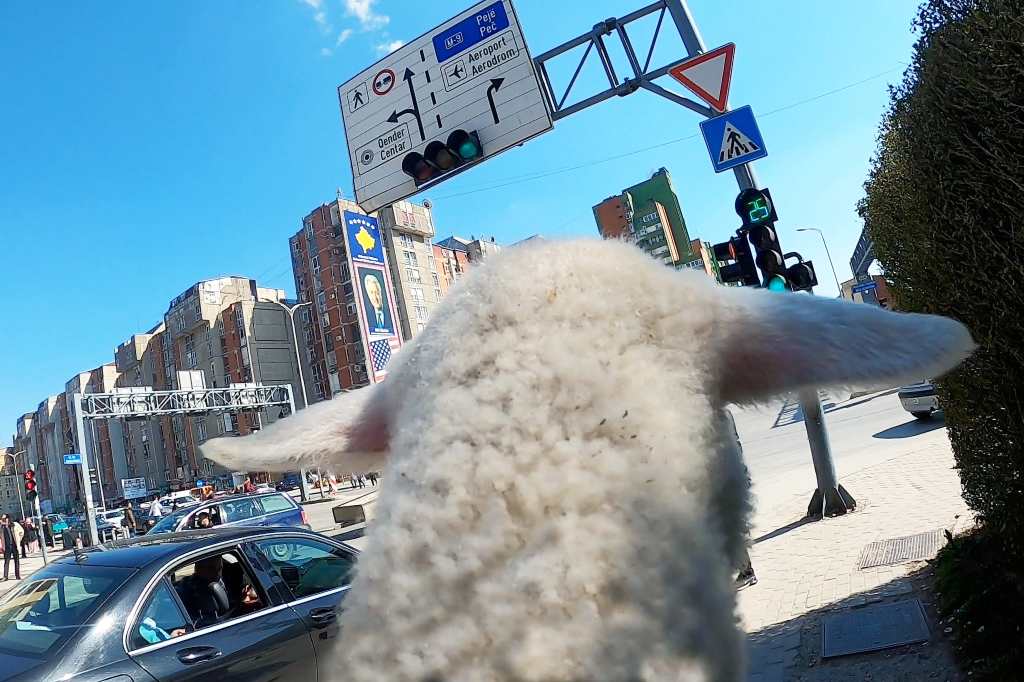
LAMB
The performance LAMB, carried out in Kosovo from March 27 to April 3, 2021, seven days, one hundred and fifty kilometers, enacts the argument of this essay in the most concrete terms available. I walked from Jarinje, an ethnically Serbian village in the north of Kosovo, to Kachanik, an ethnically Albanian village in the south, carrying a lamb. The lamb remained with an Albanian-Kosovar farmer. The performance was documented from the camera carried by the lamb, or from the lamb’s perspective.
The territory traversed by the performance is one of the most densely symbolically saturated spaces in contemporary Europe. Kosovo exists simultaneously as: disputed territory, Republic of Kosovo, a province of Serbia, the site of the 1389 Battle of Kosovo that forms the ground of Serbian national mythology, the site of the 1998–1999 war that forms the ground of Albanian-Kosovar national identity, post-war land, semi-recognized state, a site of Slavic colonialism for one narrative and of Albanian resistance for another. These competing designations are not merely different perspectives on the same facts. They are different ontological constitutions of the territory itself: different worlds, staged by different hyperobjects of trauma and identity, that overlap in the same space without being able to fully acknowledge each other’s existence. To enter this space as a political actor, as a spokesperson for one’s own identity or community, is to be immediately inscribed within one of these ontological constitutions. To speak is to be located. To be located is to be choreographed by the scripts that the location carries.
The choice to carry a lamb is the choice of an object that is simultaneously utterly legible and utterly withdrawn. The lamb is saturated with symbolism, from Christianity (the Lamb of God, the sacrificial lamb, the innocence of the lamb), from Islam (the animal of sacrifice at Eid), from Judaism (the Passover lamb), from the common symbolic inheritance of European culture (the sheep as the docile, the meek, the led), from the history of domestication (the sheep as the first animal brought fully under human control). The lamb is, in the most precise sense, an object onto which every available form of human projection has been loaded. It is maximally legible.
And simultaneously, the lamb is entirely withdrawn. It does not know it is symbolic. It does not know the history of the territory through which it is being carried. It does not know the names of the towns, the histories of the armies, the theological claims, the national mythologies. It knows what it knows: warmth, weight, the smell of grass, the quality of the attention it receives from the body carrying it. Its existence is entirely exterior to the symbolic saturations that have been projected onto it. It belongs in a different ontological register, one in which the categories of national identity, theological significance, and historical narrative simply do not operate. The lamb is alien to these categories not because it transcends them but because it exists elsewhere, in a mode of being that these categories have never reached.
This dual status, maximum symbolic saturation combined with radical ontological indifference to that saturation, makes the lamb the perfect vehicle for an encounter with the withdrawn. In approaching the lamb, the human subject approaches something that is simultaneously utterly legible (every possible projection is available) and utterly withdrawn (none of those projections reaches the thing itself). The encounter cannot be choreographed in advance by the existing scripts of Serbian nationalism, Albanian nationalism, Christian theology, or Islamic tradition, because the lamb is indifferent to all of them. It exceeds them not by transcending them but by being simply elsewhere, in a different ontological register altogether. And this elsewhere is not nothing. It is the lamb’s actual existence, its specific weight and warmth and smell and the specific quality of its attention. These are real. They are more real, in a certain sense, than the symbolic saturations projected onto them, because the symbolic saturations exist only in the subjects who project them, while the lamb’s warmth exists in the lamb.
The lamb is what the argument has called the alien object: the object that existing scenographies of care, intentionality, and motivation cannot comprehend. The alien is not the incomprehensible in general; it is the specifically incomprehensible from the position of a subject choreographed by particular scripts.
What the Serbian nationalist finds alien is different from what the Albanian nationalist finds alien; but the lamb, in its specific withdrawn indifference, is alien to both. It produces, in both, the experience of relational inadequacy: the discovery that the existing categories are not sufficient to organize the encounter.
And in that inadequacy, something new might emerge: not a reconciliation between the two national scripts, not a synthesis of their competing claims, but something that precedes and exceeds both: a form of attention, curiosity, and care that the encounter with the lamb makes necessary and that neither national mythology could have produced.
The lamb arrives at the performance from a perspective that is not organized by the scenography of trauma, victimhood, and aggression that structures every human subject present. For every human who walks that territory, the furthest referential points are victims and aggressors: the coordinates of historical injury, inherited grievance, and contested belonging. The lamb has no such coordinates. Its perspective, if one can call it that, is not organized by innocence as a counter-category to guilt, which would still be a position within the human scenography. It is simply elsewhere, oriented by warmth, weight, proximity, hunger, the specific textures of the terrain it is being carried across. This is a perspective we cannot inhabit or fully comprehend, but one that exercises a specific pull on human attention: the pull of curiosity toward a form of being-in-the-world whose referential structure is genuinely foreign to our own, and whose foreignness is not threatening but simply, irreducibly, other.
The encounter with the lamb is in part an encounter with this: not with an absence of perspective but with a perspective so structurally different from the trauma-organized human one that approaching it requires temporarily suspending the coordinates by which the human subjects present ordinarily navigate the world.
The performance does not argue for reconciliation. It does not produce a message about the possibility of peace or the injustice of division. It does not represent the suffering of one community or advocate for the claims of another. These are messages that would be legible within the existing scenography of the conflict, messages that would confirm the existing choreographies by engaging with them on their own terms. The performance produces instead the conditions under which the encounter with the withdrawn becomes possible: the conditions under which the subject’s existing categories of relation are temporarily suspended, and something new might, contingently and without guarantee, emerge. The performance is not about Kosovo.
It is a use of Kosovo, of its specific symbolic density, of the specific withdrawn existence of the lamb within that density, to produce the conditions for a deprivatizing encounter.
There needs to be an antithesis to the Angelus Novus — to Benjamin’s angel of history, dragged backward into the future by the accumulated wreckage of the past. What LAMB proposes is not a new image of history but the discovery of new geographies relaxed from human subjectivity, a creation of new memory rather than the mourning of old ones. And this is why breaking the circle of correlationist thought cannot be separated from breaking the circle of transgenerational trauma’s transmission. They are the same circle, and the lamb walks through both.
Beyond the critique of existing power structures from within their own terms: the approach that produces the relentless political art of the biennial circuit, always engaged, always informing, always producing more content about the same structures without changing the structures themselves. The temporary suspension of the ontological and epistemic regime within which those power structures operate, through the production of encounters that the scenography of the regime cannot process. The sabotage cannot be programmatic, as it is conditioned contingently, through specific encounters with specific withdrawn objects, in specific moments that cannot be predicted or reproduced. But its effects are real: the shift in kind that the encounter produces, the new form of care it makes possible, the new time it retroactively constitutes.
One does not simply choose a symbolically saturated object and carry it through a contested territory in order to produce deprivatization. The encounter is contingent. What made LAMB possible was not a formula but a convergence: of a specific territory, a specific object, a specific form of sustained attention (seven days, one hundred and fifty kilometers, the specific quality of care involved in carrying a living animal through terrain it did not choose), and the specific withdrawal of the lamb from all the projections that were brought to it. The performance works, to the extent that it works, not because it enacts a theory but because the lamb genuinely withdraws. Because the lamb is genuinely elsewhere.
Because the encounter with it genuinely exceeds the categories that any viewer brings to it. Whatever the lamb is, it is simply that, and whatever that is, it is enough.
Post-Subjective Aesthetics
What art practice corresponds to the framework of deprivatization? Not because such practices can be prescribed: they cannot, for the same reasons that the deprivatizing encounter cannot be controlled, but because the critique of existing aesthetic regimes is incomplete without some sense of what it is orienting toward, however partially and provisionally.
The concept-oriented practice proposed here does not have experience as its central choreographic principle. This is the departure from the dominant traditions of art’s self-understanding, from Kant’s account of aesthetic experience as the free play of cognitive faculties through Dewey’s account of art as consummatory experience to the various phenomenological and relational aesthetics that have dominated art discourse since the 1990s. All of these frameworks position the subject’s experience as the measure and destination of the artwork. The work is for the experience it produces. The experience is for the subject who has it. The subject, and the subject’s scenography, remain the horizon.
Concept-oriented practice takes a different orientation. The concept, in the Deleuzian sense, is an event in thought: a production of new connections, new distinctions, new territories of relation and attention, that was not determined in advance by what the existing concepts contained. The concept brings into existence what was not there before: new possibilities of thought, new orientations of attention, new configurations of what can be perceived and cared about. In this sense, the concept itself is an encounter with the withdrawn: an event in which thought’s existing scenography becomes inadequate to what it is approaching, and something new must emerge.
Concept-oriented art, in this sense, is not art that illustrates or communicates concepts. It is art that produces encounters analogous to the production of concepts, encounters that generate new orientations in the subject not by adding to their existing knowledge but by temporarily exceeding the framework within which that knowledge operates. The artwork produces the conditions under which the inadequacy of your existing choreographies becomes available to experience, and in that availability, makes possible something that could not have been planned.
Nicolas Bourriaud’s relational aesthetics, influential in the 1990s and early 2000s, might appear as a precursor to this position: it, too, was concerned with the quality of encounter rather than the content of the work, with the inter-subjective relations produced by the art situation rather than the objects it contained. But relational aesthetics, as many critics including Claire Bishop have noted, remained deeply correlationist: the relations it produced were relations between subjects, choreographed by the subjects’ existing frameworks of sociality. The encounter with the withdrawn object, with something that exceeds human sociality entirely, that is indifferent to it, that demands a form of attention choreographed by something other than intersubjective recognition, is precisely what relational aesthetics could not produce and, by its own logic, did not seek to. The dinner table, the shared meal, the collectively produced project, the social sculpture: these are all sites of relational confirmation, of the reproduction of existing socialities, however warm and democratic and politically conscious they may be. They are paradise, in the pairidaeza sense: a stage organized around the confirmation of an inside. The encounter with the withdrawn happens elsewhere.
The post-subjective aesthetics proposed here is not anti-social. It does not require isolation, withdrawal from human community, or the adoption of a pose of radical solitude. It requires only the encounter with the withdrawn: the encounter that is possible, contingently, in the presence of other humans, or with a lamb, or with a painting, or with a piece of music whose structure exceeds one’s existing categories of listening, or with a mathematical proof whose implications exceed one’s existing categories of understanding, or with a landscape whose specific quality exceeds any of the descriptions that have been brought to it. The encounter with the withdrawn can happen anywhere. What is required is not a particular setting but a particular mode of approach: the approach that does not choreograph the encounter in advance, that remains with the inadequacy rather than resolving it, that allows the withdrawal to produce its effects rather than pre-empting them. This remaining with inadequacy is not passivity. It is what Simone Weil calls attention in its most radical sense: the emptying of the self that makes genuine reception possible, a structural patience that cannot be fully intended because every existing instinct of the subject pushes toward resolution.
The difference between this approach and ordinary aesthetic experience is not always visible from the outside. A person standing in front of a painting may be confirming their existing categories of perception and value, or they may be in the presence of something whose withdrawal is beginning to exceed those categories. The difference is internal to the encounter. It is the difference between the encounter that confirms and the encounter that changes, between the encounter with the reflected and the encounter with the withdrawn. And it is the difference between the probable and the possible: between the experience that was, at the level of structure, predictable, and the experience that arrives as a memory of something one did not know one had forgotten.
The argument must end with a limitation, because the limitation is constitutive of what the argument is claiming. To understand what deprivatization can accomplish requires understanding what art, as the primary site of deprivatizing encounter, cannot accomplish, and why this cannot is not a deficiency but a structural feature, as important to understand as what art can do.
Art cannot perform the change. Any art that represents change, that produces an image of a better world, that enacts resistance symbolically, that informs its audience of what it should believe or do, that makes legible the suffering that was previously invisible, operates entirely within the given limitations of the scenography it is addressing. It produces more of a different kind of the same. This is not a failure of ambition. It is a structural consequence of attempting change at the level of content when the required change is at the level of structure. The most politically committed artwork, the most technically sophisticated representation of injustice, the most emotionally powerful depiction of suffering: all of these leave the scenography of the subject intact. They give the subject new content to process through existing structures, without change of the structure itself.
This is what it means to say, following Baudrillard, that liberty in its accepted philosophical sense is an idea, and that in fulfilling it we have already lost it. Any art that promises liberty, that represents it, that argues for it, that makes its audience feel the force of its necessity, is already operating within the scenography that makes liberty a concept. And operating within that architecture, it can only produce liberty as a concept: a legible representation of a relational possibility that remains, at the level of structure, unchanged. The escape from the Roman Empire becomes the new Rome. The art that represents liberation becomes the new instrument of the same structural inscription, because it has not changed the scenography that makes inscription possible.
What art can do, and what, at its most singular, it does, is produce the conditions under which the encounter with the withdrawn becomes possible. It creates the time in which the subject’s existing scenography becomes inadequate to the object it is approaching. It does not control what happens in that time. It cannot. The encounter is contingent, and its contingency is not a limitation but a condition of its power. An encounter whose outcome could be determined in advance would not be an encounter with the withdrawn. It would be another reproduction of the choreographies that organize the probable future. This is why art’s relation to politics must be thought differently than it usually is in the art world. Art does not produce political change by representing the political situation more accurately, or by giving voice to the voiceless, or by exposing the mechanisms of power. These are things that journalism, activism, and academic analysis do better, with greater precision and greater accountability. Art’s specific political capacity, if it has one, is the production of encounters that temporarily suspend the scenography within which political struggle takes place, and return the subject to circulation carrying new orientations of care that were not previously available. These new orientations do not come with directions for how to apply them.
Deprivatization is an aesthetic process in which the subject is no longer taking part in the circulation of power, trauma, or subjective identities, but also one involving producing new epistemic frames for different in-kind ontologies under which subjects are free. For this we must abandon the strategies of identity politics within the artworld as they become problematic if we understand art as an opportunity for undirectional and indifferent change to notions of who we are and how we relate to others.
As any object, art besides its nameable properties is an object withdrawn, a thing beyond our immediate comprehension. A thing which makes us curious beyond language.
A thing that draws us near in ways we were not prepared for, a moment which foregrounds a stage for contingent, not-yet available and whatever relations to be performed. And whenever such a case is possible, with proper scenography, lights and audience, sooner or later, new dances will appear.


Leave a Reply