By Eric Schmid
For Eric Schmid, Sean McCann, Matthew Pang, Giangiacomo Rossetti, and Hélène Fauquet
This essay proposes the name Gnostic Futurism for a tendency shared by a small group of painters, composers, photographers, and philosophical writers working between London, Milan, Paris, New York, and Los Angeles. The proposal is substantive: Gnostic Futurism designates a position in the philosophy of meaning before it designates a style. Its motivation is given by Eric Schmid’s book talk The Other Will Speak, which formulates an emancipatory alternative to accelerationist resignation. Its mathematical backbone is supplied by Brice Halimi’s reconstruction of context dependence through Grothendieck’s theory of fibered categories and descent. The thesis is that a politics of irreducibly local positions, coordinated through interfaces rather than subsumed under a master rule, has a precise mathematical home in the structure of a stack: a fibered category in which local data glue, where they can, into global items without any guarantee that a global section exists.
1. The Name
The name Gnostic Futurism is both proposition and provocation. Gnostic, because the movement treats knowledge as initiation—as the patient awakening to structures the dominant order renders invisible. Futurist, because it constructs forward—not as a manifesto of mastery but as a wager under conditions where no foundation is guaranteed.
The artists I want to gather under this banner are five. Sean McCann (b. 1988), the Los Angeles–based composer who has run the Recital imprint since 2012 and whose chamber, vocal, and Fluxus-archival editions have provided the connective tissue for a generation of experimental music. Matthew Pang (b. 1988), the British painter, Aberdeen-trained and Royal College of Art–educated, currently showing oil-on-canvas paintings of eyes-as-prison-bars and Chanel-bottle–derived oblong panels at ULRIK in New York. Giangiacomo Rossetti (b. 1989), the Italian painter, Brera- and Basel-trained, working between Milan and New York and showing with Greene Naftali, Mendes Wood DM, and Galleria Federico Vavassori; his small oils on panel embed self-portraits into citations of Leonardo, Hayez, Renoir, Böcklin, and the Pre-Raphaelites. Hélène Fauquet (b. 1989), the French photographer and conceptual artist, Valenciennes- and Städelschule-trained, whose UV prints of found amateur photographs of bubble mirrors, stained glass, and soap films have been installed on tables and salon-style multi-frame arrangements at ULRIK, Kunsthaus Glarus, Édouard Montassut, and Schiefe Zähne. And Eric Schmid (b. 1990), the composer, philosophical writer, and philosopher of mathematics whose book Transcendental Mathematics (Centralbanken / Penultimate Press, 2025) supplies much of the theoretical apparatus through which the movement reads itself.
The network is dense and concrete. McCann and Schmid have collaborated on a sequence of editions, including St. Francis (with Mattea Landry), and McCann masters and engineers across the Recital catalogue that constitutes part of Schmid’s discography. Pang and Fauquet both exhibit at ULRIK at 175 Canal Street in New York. Rossetti and Schmid have both shown with Galleria Federico Vavassori in Milan. What unites the five is not a shared style. It is, rather, a shared epistemological situation. Meaning is local. The universal must be built rather than inherited. The proper response to systemic acceleration is neither resignation nor mastery but the patient construction of interfaces between irreducibly different perspectives.
The argument of this essay proceeds in three movements. First, the philosophical motivation, drawn from Schmid’s talk The Other Will Speak. Second, the mathematical scaffolding, drawn from Halimi’s Context-dependence and descent theory. Third, a sketch of how each of the five artists localises this position into a fibre of practice.
2. Against “Time Will Tell”
In The Other Will Speak, Schmid identifies a tendency in contemporary thought—exemplified by the late writings of Nick Land and certain accelerationist programmes—which he names, after Haela Ravenna Hunt-Hendrix, libidinal nihilism. Its rhetorical signature is the phrase time will tell: the deferral of all ethical interrogation to the impersonal verdict of Capital, the market, the Singularity. As Schmid writes, the refrain “is not humility. It is a strategy of exemption. To say ‘time will decide’ is to offer a reason while pretending reasons are obsolete.”
Gnostic Futurism refuses the deferral. But it refuses it not by reasserting the universal—the view from nowhere, the philosophical king’s-eye perspective—but by insisting on the dignity and constructive power of local positions. Schmid argues that there is no view from nowhere “not as a matter of pessimism, but as a mathematical theorem about the structure of meaning.” Local positions can cohere; they can translate; they can coordinate; but they cannot be unified into a single master perspective.
Here the gnostic turn becomes legible. Classical Gnosticism distinguishes the pneumatic, who recognises the world’s brokenness and the demiurgic character of its dominant order, from the hylic, who is wholly absorbed in it. The Gnostic Futurist position is neither cosmic pessimism (the world is irredeemably fallen) nor naive emancipationism (the world will be remade by historical necessity). It is, rather, the position of the Maître drawn from Catren and Mallarmé: the captain at the top of the mast who throws the dice, in Schmid’s words, “under full awareness of contingency, finitude, and the irreducibility of what he cannot control.”
This is not nihilism’s twin. It is its negation. Where libidinal nihilism collapses the agent into the trajectory of a single attractor—the cybernetics of one feedback loop subsuming all becoming—Gnostic Futurism opens onto a cybernetics of many. The proper mathematical formulation of this opening is supplied by Halimi.
3. Contexts as Fibres
Brice Halimi’s Context-dependence and descent theory proposes a striking reorientation of the philosophy of meaning. The dominant Anglophone tradition—running from Frege through Carnap, Montague, and Kaplan—treats linguistic meaning as a function: an expression’s content in a given context is the value of its meaning evaluated at that context. Halimi argues that this functional scheme cannot accommodate the actual phenomenology of context-dependent expression. He observes that meaning “is not an invariant obtained by abstraction”; it does not sit behind its contextual instances as their common core.
The alternative Halimi proposes is what he calls a functorial scheme, drawing on Grothendieck’s theory of fibered categories. The central slogan, which I take as a watchword for this entire essay, is
Context-dependence = context-shift-dependence.
That is: the content of an expression in a given context is not computed from scratch by evaluating a function at that context. It is the transposition of the content of that expression in some prior context of reference, transported along the context-shift that relates the two contexts.
3.1. The fibred category of contexts
The mathematical home of this idea is the structure of a fibered category. Let me sketch the construction.
Let 


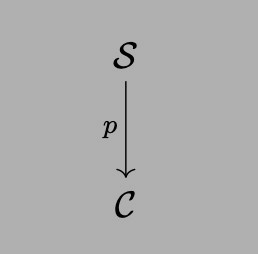
The fibre 

3.2. Cartesian lifts and reindexing
The Cartesian lift is the categorical apparatus through which Halimi’s slogan context-dependence = context-shift-dependence is made precise. Given a context-shift 


The complete two-level diagram is:
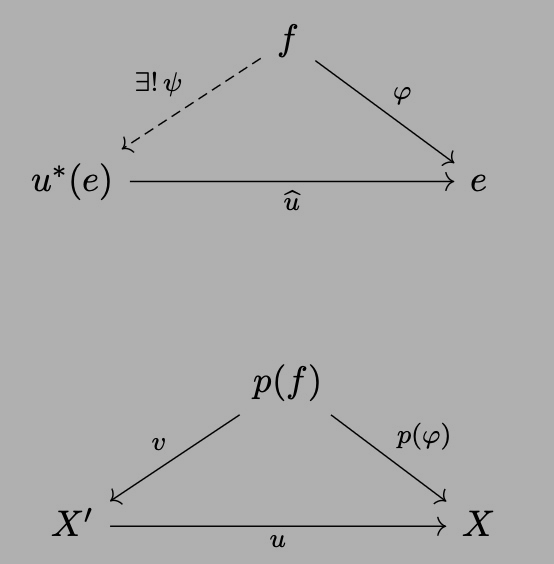
The upper triangle lives in 

The object 


In Halimi’s prose: a context-dependent semantic content does not have the form 
3.3. An example: “red”
A concrete illustration, in Halimi’s register. In a context 

![[\![\mathrm{red}]\!]](https://s0.wp.com/latex.php?latex=%5B%5C%21%5B%5Cmathrm%7Bred%7D%5D%5C%21%5D+&bg=B0B0B0&fg=000&s=0&c=20201002)


The content 
4. Amalgamation, Not Abstraction
The second pillar of Halimi’s construction concerns the construction of linguistic meaning itself. The traditional picture is that meaning is whatever is abstracted from the various contextual contents of an expression: their common core, their invariant form. Halimi rejects this picture. The relatively general meaning of “red” is not obtained by abstraction; it is amalgamated.
4.1. Descent data
The relevant mathematics is Grothendieck’s descent theory. Given a morphism 

A descent datum above 


satisfying the standard cocycle condition on 

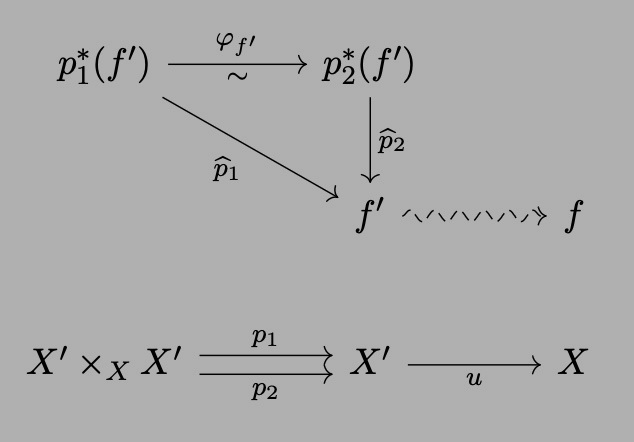
The morphisms (the Cartesian lifts of the two projections) slide 


4.2. Meaning as gluing
In the case of linguistic meaning, the role of the descent datum is played by a family of contextual contents—paradigmatic uses of an expression in different contexts—which agree where their contexts overlap in a more specific common refinement. The descent question is whether these overlapping local contents glue into a single more generic content in a more generic context.
Halimi’s first slogan was that context-dependence is context-shift-dependence. His second is no less sharp:
Contextualization is a Localization.
The general meaning of “red” is not the invariant left over after the particular uses have been factored out. It is the amalgamation generated by the projections, along specific context-shifts, of several particular contents attached to different specific contexts. The same content can contribute to entirely different amalgamations—and to the same amalgamation in entirely different ways—depending on the projection of its context.
The distinction between abstraction and amalgamation is conceptually decisive. In abstraction, isomorphisms register sameness of structure: two different instances exemplify the same form. In amalgamation, isomorphisms register coherence of overlap: two different local data are revealed as compatible aspects of a single global entity. Two altogether different concepts of structure emerge from the two pictures, and only the second is faithful to how meaning actually works.
4.3. Stacks and Grothendieck topologies
The full apparatus comes into view when the base category 


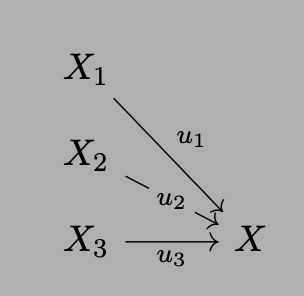
where the first map is 


Halimi’s working hypothesis is that the fibered category of contextual content over the category of contexts forms a stack with respect to a natural Grothendieck topology, generated by the families of contexts in which competent speakers exemplify the meaning of an expression. The hypothesis is, as he puts it, “a way to account for the fact that natural language works.”
5. No Global Section
Schmid’s central political claim follows by exact analogy. The fibered category that interests Gnostic Futurism is the category of artistic contents over the category of artistic contexts. Its fibres are the dense local worlds in which the artists of the movement work—small downtown New York rooms, Milanese galleries, Los Angeles home-studios, RCA painting studios, Recital editions of one hundred copies, Penultimate Press print runs of a hundred. Its context-shifts are the comparisons between these worlds. Its descent data are the moments at which different local practices reveal themselves, under refinement, to agree.
The crucial structural feature, drawn directly from the sheaf-theoretic picture, is the absence of a guaranteed global section. As Schmid writes: “You can have perfect local coherence and still no global truth.” There is no master fibre. There is no all-encompassing context 
Schmid’s mathematical observation is the formal counterpart of the political claim. The categorical imperative of the movement is to build the interfaces: to construct the reindexing functors, to identify the descent data, to define the Grothendieck topology under which the practices of irreducibly different artists can be recognised as covering a common artistic situation. The work is not the discovery of a hidden universal but the construction of a topology fine enough that coordination becomes possible without erasure.
6. The Five Fibres
What follows is not biography but localisation. I want to indicate, for each of the five artists, the fibre in which their work lives—the local category 
Sean McCann
Sean McCann is a Los Angeles–based composer (b. 1988) who began self-releasing cassettes of improvised experimental music in 2007 and who has run the Recital imprint since 2012. His own discography turns on chamber composition for piano, strings, and voice—works such as Music for Private Ensemble (2013), Ten Impressions for Piano and Strings (2015), A Castle Popping (2015), Music for Public Ensemble (2016), and Puck (2019). Recital, alongside this compositional work, publishes contemporary experimental music together with archival editions in sound poetry and Fluxus. The label is the medium through which McCann curates a network of correspondents—Loren Connors, Graham Lambkin, Maxwell August Croy, Sarah Davachi, Ian William Craig, Eric Schmid—each working in their own fibre and contributing to the descent data of the network as a whole.
The fibre McCann works in is dense with genre-historical references that do not transpose cleanly into the generic context of “experimental music” as currently institutionalised. To hear the work in its own fibre requires the right reindexing functor: acknowledgement of the postal economy, the hand-glued sleeve, the editioned book of scores. The label is the Grothendieck covering. Each release is a context 

Matthew Pang
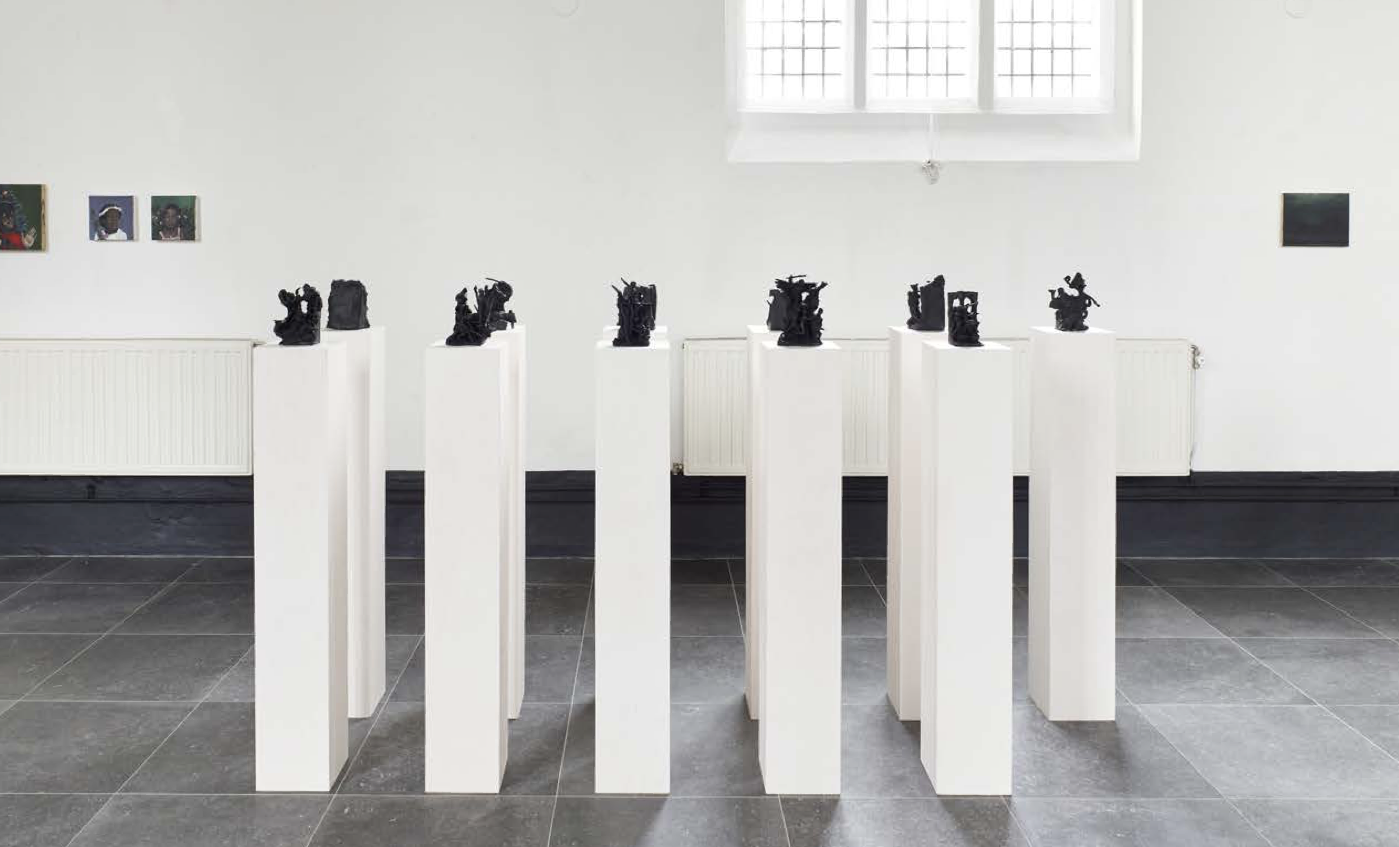
Matthew Pang is a British painter (b. 1988) raised in Edinburgh, trained in fine art and printmaking at Gray’s School of Art and in painting at the Royal College of Art. His exhibition Looking in the Bottle at ULRIK in New York (March–May 2026) consists of two formats of oil paintings. The hanging paintings of the Traitor series depict an eye contiguous with vertical bars—image and prison bar mapped onto a single visual field. A second series, Head in Bottle, consists of oblong, box-shaped panels whose imagery derives from a Chanel perfume bottle. The work is articulated through restrictive procedural constraints which, in the words of one reviewer, look like simplicity but turn out to be the point.
The accompanying text for the show name-checks the philosopher Peter Osborne, and a critic could be forgiven for reading Pang’s refusal to perform painterly mastery as a style as the natural artistic consequence of Osborne’s thesis that all contemporary art is post-conceptual. The reading is wrong, or at any rate too easy. Pang did not in fact study with Osborne; the citation is a ruse, a paratext designed to lure the kind of reader who is satisfied as soon as a name has been dropped. In personal conversation Pang has indicated that the Traitor series and the romantic core of his practice operate in zones of intimacy distinct from the procedural surface the press material foregrounds. The Traitor canvases are not philosophical exercises about post-conceptual painting. They are paintings about betrayal, watching, attachment, and the kinds of imprisonment that occur between people who know each other well.
This duplicity is part of the point. The Pang fibre is the fibre of post-conceptual figurative painting under self-imposed formal constraint, and simultaneously the fibre of an intimate iconography—the eye, the bar, the bottle—whose romantic content is addressed only to those readers who are already inside the zone. The categorical imperative of this double fibre is not to produce contents that are stylistically “original” but to expose, through restriction, the shape of the context-shift that converts one painted image into another and the context-shift that converts the public reading of the work into its private one. The Cartesian lift becomes a procedure: this particular eye, on this particular canvas, is the unique transposition of a more general intention along a chosen restriction, addressed to a reader who can recognise from which fibre the intention has been pulled back.
Giangiacomo Rossetti
Giangiacomo Rossetti is an Italian painter (b. 1989, Milan) who lives and works in New York. He trained at the Accademia di Belle Arti di Brera and at the Institut Kunst at FHNW Basel, and has shown with Greene Naftali in New York, Mendes Wood DM in Paris, Brussels, São Paulo, and Germantown, Galleria Federico Vavassori in Milan, Riverside in Bern, and Fiorucci Art Trust in London. His recent exhibitions—Cabbage Field (Greene Naftali, 2024) and Résurrectine (Mendes Wood DM Paris, 2026)—and the forthcoming The Dead at Fondazione Bevilacqua La Masa in Venice show small oil paintings on panel in artist’s frames, in which self-portraits and figures from the artist’s life are embedded in compositions that cite Leonardo, Hayez, Renoir, Böcklin, the Pre-Raphaelites, and Domenico Fetti.
The fibre Rossetti works in is the fibre of late European figuration—small panel, oil paint, the inheritance of the cinquecento, the artist’s frame as a context-fixing device. To read his work as merely formal or merely citational is to compute the wrong reindexing functor. Each canvas is a descent diagram in miniature: the pullback, along the context-shift from the historical fibre into the contemporary one, of a prior composition that the painter has chosen to amalgamate with his own self-portrait. The meaning of any single Rossetti picture cannot be read off it in isolation. It emerges from the gluing data—the multiple pull-backs along multiple context-shifts—which the painter has arranged to agree.
Hélène Fauquet
Hélène Fauquet is a French photographer and conceptual artist (b. 1989) trained at the École Supérieure des Beaux-Arts in Valenciennes and at the Städelschule in Frankfurt. Her work consists of UV prints on wood of found amateur photographs—photographs of bubble mirrors, op-art panels, stained glass, Saturn-ring mirrors, soap films, dew-encrusted insects, and other reflective and refractive surfaces—together with installations in which these prints are arranged on tables and in salon-style multi-frame configurations. She has exhibited at ULRIK in New York (Nuit de Cellophane, 2024), Kunsthaus Glarus (Phenomena, 2023), Édouard Montassut in Paris, Schiefe Zähne in Berlin, Max Mayer in Düsseldorf, Meyer∗Kainer in Vienna, and Rodeo in London.
The fibre Fauquet works in is the fibre of the “poor image”—the already-mediated, already-photographed object—refracted through the discipline of installation. Her central operation is precisely the one Halimi names: the construction of a global content by the amalgamation of local pullbacks. A bubble in one of her photographs is at once reflective and transparent, at once “mirror” and “window” in John Szarkowski’s famous division of post-1960 American photography. The bubble does not resolve the question of which fibre it belongs to. It is the descent datum: the local content whose pull-backs agree, whose meaning is constituted by the agreement, and which can be glued, but not into a single global section.
Eric Schmid
Eric Schmid is a composer, philosophical writer, and philosopher of mathematics (b. 1990). He holds a BA from New York University in Continental Philosophy and Visual Art with a mathematics minor and an MS in Applied Mathematics from DePaul, and works as a member of technical staff on categorical semantics and applied category theory. He has exhibited at Vilma Gold in London, Neue Alte Brücke in Frankfurt, Croy Nielsen in Berlin, Svetlana in New York, and Galleria Federico Vavassori in Milan, and has released music on Recital, Mille Plateaux, Regional Bears, Bánh Mì Verlag, Careful Catalog, and his own imprints. His Transcendental Mathematics (Centralbanken / Penultimate Press, 2025) provides much of the philosophical apparatus through which the gluing data of the other artists’ practices become legible as a sheaf.
The fibre Schmid works in is the fibre of the gap between art and music, philosophy and practice—the apartment-gallery fibre, the imprint-as-curatorial-instrument fibre, the conference fibre. His collaborations with McCann—including St. Francis (with Mattea Landry)—and his recent exhibition at Triest, whose statement explicitly proposes sheaf-theoretic formalisms against Land’s “nihilistic determinism,” make explicit what is implicit in the others. The book, the label, the talk, the roundtable: each functions as a Grothendieck covering, exposing the descent data along which the movement is constituted as a stack rather than a heap.
7. The Drexciyan Analogue
Schmid’s central image in The Other Will Speak is the Drexciyan mythos: the underwater civilisation constructed by James Stinson and Gerald Donald across a sequence of records released in the 1990s. The mythos posits that the unborn children of pregnant African women thrown overboard during the Middle Passage adapted to breathe underwater and built a technologically advanced society on the ocean floor.
The Drexciyan civilisation is the Gnostic Futurist exemplar in another register. It is a microutopia constructed from the materials of catastrophe. It lives in a fibre—Detroit electro, sonic fiction, Black diasporic narrative—that the dominant accelerationist genealogy renders invisible. Its meaning is not abstracted from any general theory of liberation. It is amalgamated from the specific overlaps between Black diasporic experience, post-industrial Detroit, and the speculative ocean.
The point of the analogy is not that any of the five painters, composers, or photographers above is doing what Drexciya did. The point is structural. The Drexciyan situation is a descent diagram in which
8. The Other Will Speak
Schmid closes his book talk with the sentence that I take as the slogan of Gnostic Futurism:
Against the long con of “time will tell,” we propose: the other will speak, and we shall build the interfaces through which that speech can be heard, translated, contested, and revised.
This is the movement in a sentence. The other—the other context, the other fibre, the other community whose internal logic is irreducible to mine—will speak. The task is not to subsume that speech under a universal grammar. It is not to abandon the project of coordination. It is to construct the interfaces: the reindexing functors, the gluing data, the Grothendieck coverings, the descent isomorphisms.
The mathematics is descent theory. The politics is the patient construction of the sheaf. The aesthetics is the work of these five artists—McCann at his console in Los Angeles, Pang at his easel in London, Rossetti at his panel in Brooklyn, Fauquet in front of her vitrines in Paris or Glarus, Schmid in his old apartment gallery or at his text—in their five fibres, glued where they overlap.
Coherence without unification. Coordination without conquest.
A civilisation on the ocean floor, built from what the surface has thrown overboard.
Sources
Eric M. Schmid Jr., The Other Will Speak: A Talk on Transcendental Mathematics and Why Formalization Cannot Save Us—But Might Help (book release talk, Milan Art Week, 2025); Schmid, Transcendental Mathematics: Homotopy Type Theory, Husserlian Constitution, and the Limits of Formalization (Centralbanken / Penultimate Press, 2025); Brice Halimi, Context-dependence and descent theory (Alexander Grothendieck Conference, 25 May 2022); Halimi, Context-Sensitivity in Language. Artist biographies and exhibition details drawn from the public press materials of Greene Naftali, Mendes Wood DM, ULRIK, Recital, Penultimate Press, Kunsthaus Glarus, Édouard Montassut, Schiefe Zähne, the Manhattan Art Review, and the artists’ own statements. Grothendieck’s original treatment of descent is in SGA 1, VI.8; the central reference for stacks is the Stacks Project, stacks.math.columbia.edu.
Notes
[1] Lynne Tirrell’s usage aside—see in this essay’s companion piece. Brice Halimi, Context-dependence and descent theory, lecture delivered at the Alexander Grothendieck Conference, 25 May 2022. The expanded treatment appears in Halimi, Context-Sensitivity in Language. All quotations from Halimi are drawn from these sources.


Leave a Reply