By Daniel Gianfranceschi
In the essay “A Marker”, Maya B Kronic argues the following:
“…I think of depression as a kind of turning of your energy back on yourself, an expression of excess rather than lack.”
To the depressed person, this statement might seem phantasmagorically counterintuitive. In the depressed state, the depressed person perceives time as, as Kronic argues further in the essay, a “a dead grey time in which nothing can possibly happen”, a sort of inescapable limbo between productive time and a chosen non-productive expenditure, In fact, depression expends quite a lot, seducing its host’s organism into a paradoxical kind of stasis; the negation of existence becomes so unbearable to the point of discarding action for stasis. And yet, it is arguable that what Kronic already points out is almost inevitably true: depression, as a negative affect, lacks nothing in its nothingness of presence.
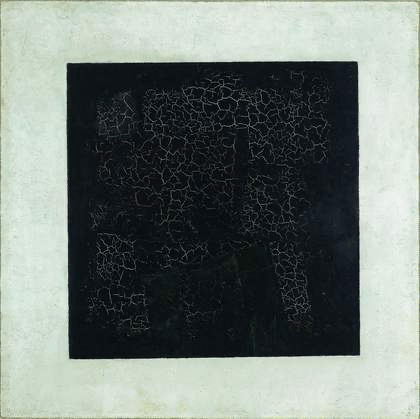
This becomes quite evident when one considers Robert Fludd’s representation of the universe in “The Metaphysical, Physical, and Technical History of the Two Worlds, the Major as well as the Minor” (1617 – 1621), a volume adorned with all sorts of diagrams and imagery. Fludd’s universe, or, as Eugene Thacker calls it, a kind of “un-universe” is pictures as a simple black square. Here, black as a color that is not really a color and yet consumes all other colors is used to indicate a certain negation, a formless “retinal inactivity”. Fludd goings even further than to merely situated the presence of absence into a trivial geometrical form, for, at the edges of the diagram, an inscription reads “Et sic in infinitum”, “And so on to infinity”. Thus, one must imagine the negation of the color black as something boundless, something that calls for encapsulation only because the anthropocentric view the human has of itself needs certain limitations of the visual in order to better imagine it. In its ideal state, Fludd’s un-universe would not even be representable, ranging from a point A to a point B that form a kind of singularity, a point of neither return nor departure but a pessimistic mist that has settled onto as far as the eye can see and beyond.
The links the color black and depression might be a rather banal comparison, but it is precisely this boundless effect of Fludd’s imagery that points to its particular insistence on the paradoxical representation of something that exceeds it. Much in the same fashion, one can re-imagine Kronic’s quote about depression suddenly making much more sense than the depressed person might give it credit, with the tremendous power of the condition stemming precisely out of its ability to defy location. In so far, the depressed person, always turning every criticism and despair at the world onto itself in a cruel game of mirror-chess, is destabilized into what might appear as emotional shrinkage from the stratosphere of the planet, but what actually ends up happening is an over-riding of the value system of size itself. Even a tiny drop of black into any other pigment will darken it effectively, but what remains is not the tiny drop of black that was added at the inception of the condition but the contaminated hue of an otherwise bright color. The depressed person, incredibly attuned to their emotional and mental reality, feels everything at once, much like the bright yellow pigment has no choice but to surrender to the sunless black, resulting in a porous over-presence of absence. One can try to add white pigment into the mixture in order to lighten it back up again, but the original state cannot be reached anymore, only emulated.
In the same essay, Kronic, paraphrasing Kant, relates that the essence of time lay not in it being an experience in itself but a condition for all possible experience to emerge out of. For experience to cohere, he explains, it must be formatted into a “linear continuum in which events succeed one another”. He further argues, rightfully so, that one of the most incessant claims of capitalism is its insistence on one homologous notion of parallel-time, of humans and their machinery working interlocking at a common set of temporal coordinates for what he beautifully calls a “temporal administration system”. The depressed person, in a depressive state, is suddenly crushed by this need for cancellation of heterogenous private-time-zones, but even here one must not consider depression as a temporal deficit, as slugging behind, but actually of breaking out, of refusing to be subordinate to a common temporal mode and thus breaking out of the temporal continuum altogether. Forced productive expenditure has driven the depressed person into a kind of downwards spiral of guilt and shame, effectively leading them to come up with entirely erroneous though-experiments like the following:
“What am I doing feeling so bad about nothing and everything when I should be working?”
“I cannot be depressed, for I need to work (in order to sustain sustenance and, most often, not out of a joy for the activity in itself)”.
“I must get better quickly in order to return to productive expenditure as soon as possible”.
“I should not feel this way because everybody else is seemingly able to function. Why can’t I make myself function?”.
“I will make myself function, for no other reason than the fact that not-functioning, comparatively and in the mind of the depressed person, is not the alternative one should be option for”.
“I should try working again, maybe I will not be as depressed as I am right now”.
“Why am I the only depressed person, like, ever?”.
Worst of all, the depressed person, often, opts for talking to someone whose job – whose productive expenditure – is to fix others into rehabilitation into productive expenditure, a kind of ouroboros of the depressed and the system needing them back into a linear time-space continuum of a common temporal topography. What actually happens for the depressed person is a crossing of that which is perceived as being temporally adjust into a kind of excess in matter that turns into an unwilful critique of the former; a kind of demonstration that, like Fludd’s un-universe, knows no bounds. What’s more, it is so fixated in his critique of everything that the critique cannot help but to not turn inward, both mentally, psychophysiologically and even simply physically: self-harm, whether as a kind of immobile act of becoming the boulders to life’s crashing waves or in the form of corporal punishment is not a lack of outside-targets but a crashing of the system out of which it is born, self-destruction for preservation. It is both a resignation and the loudest alarm-clock one has ever heard, screaming “if you can’t break out of the temporal capitalist inferno on your own, I – the hurt – will break out of you”, at the cost of self-deletion. The depressed person thus, perhaps only unconsciously seems to begin asking itself the question: if experience ought to be coherent in order be formatted into the capitalist hellscape we inhabit, is the incoherence of experience in the same temporal time-frame necessarily a defect or am I just in the wrong temporal assessment of reality?”. Beyond this, it quickly becomes evident that what Kant and Kronic refer to as “coherence” has been morphed into what one might call to be “routines” of the inhabitation of consumer and communicative capitalism. These routines, like going to work of working on your pathetic parody of a garden on the weekend, are what allows the alleged temporal reality of the twenty-first century to subsist. People do not stick to routine because it is comfortable, but the inverse: it is comfortable to stick to routine because it implies a coherence supposedly needed to not lose your mind every other day. So far so good. Yet, at what point do events turn from, as Kronic puts it, “succeeding one another” into a kind of homogenous soup of there-is-despair-around-the-corner? At what point does a routine itself break out of the temporal modes of past, present and future and transmogrify into a fifth temporal zone – the clearly belonging to the depressed, the mentally ill, the handicapped, those unable to, for one reason or the other, join in on the hyper-production of nothing-expenditures – where events simply blur into each other’s orbit; a grey sea and a grey sky collapsing on each other into a vanishing point of utter indifference.
One of the first behavioral trait the depressed person engages in in a depressive state is comparison. “Why am I the only depressed person?”, “Why are they so happy”, “How do I make myself as happy as them?”, “Maybe if I was as happy as them, I wouldn’t be as depressed as I currently am”, and so on. Apart from being a faulty comparative system to begin with, it also does not consider the incoherence of alleged temporal coherence in as far as it positions routine and successive acts, inherent to the way in which the capitalistic system works, as inside the past-present-future matrix. What one should actually be attune themselves to is to understand routine not as successive but as regressive, a turning inward that, contrary to the presence of absence in the excess of depression, is a lack, an absence of presence, an absence of anything that might situate it into linear and sequential temporal states. Instead, the temporally successive logic is subjected to a depression itself, a kind of excess of mundanity that cannot, under any circumstance, belong to the time we have all been granted supervised access to. The routine approach to what Mark Fisher calls capitalist realism reveals itself to be a complete farse, for in it, time, that which conditions all possible experience, is effectively experienced in its absence of presence; the clock is monitored with the military precision and diligence, awaiting the moment the temporal zone of absent-presence can be traded in for a present-absence, a time relegated to sanctioned non-productive expenditure in the illusion that tomorrow, the clock’s presence in the routine might become and absence. In fact, when is it that we experience time as absent, as something secondary to that which we are doing? Either when we are in transit within life’s imposed temporality or when we are, God forbid, experiencing enjoyment out of a particular activity. Why do we feel enjoyment? Because, deep down, we know that we are momentarily transmuting into our own private villains of directional time-zones, eluding them altogether. The routine, masked as an aid t the villain, the sidekick of the hero of the story, soon reveals itself to be from a different temporality as well, but one merely dressed in armor and cape but lacking all supernatural forces that would enable it to be of any interest at all. Kant’s temporality elapses its own logic, inversed into and experience of time because of it lacking the conditions for successive emanence of a linear time continuum, resulting in routine collapsing into and thus out of the temporal altogether. By comparison, the depressed person, although in a state of physical inertia, finds themselves in a perpetual state of transience, driving a lightspeed into required permanence without moving a muscle, and often times in physical distress if not outright pain. A bruise or a cut is not defined by the conditioning itself, but by the excess of blood coming out of it; an aperture revealing an abundance of temporariness distilled into becoming omnipresent.
In addition, one ought to whisper the question: in a post-Videodrome-ic world where overstimulation is not quantitative anymore but the given standard, how could one ever assume depression to be a lack of anything? Therapy is only a few apps away while your feed is switching between people being murdered in the middle east, endearing dog videos and the latest viral recipe for instant-ramen; the only thing actually lacking is the acknowledgment of the mere existence of other possible temporal frameworks, not the framework of the depressive being a lack in itself. There is absolutely nothing missing anywhere, we have too much of everything and yet we are only ever seldomly satiated by anything. If overstimulation is the norm – the prefix “over” implying an excess of something – the depressed person is certainly part of that very excess in the first place, perhaps its most exemplary consequence. Young people are more depressed than ever before. It wasn’t always like this, it simply wasn’t. Moreover, when the whole earthly universe is operating in a different temporal zone but masquerading as linear, routines and successive experiential events based on reoccurrence are only broken time machines, The Fly trapped in the telepod, turning the gun onto itself. Each so-called “marker” into a different time-zone is only a portal to the undead for the depressed person, already in a parallel bifurcation of temporality filled with irregularities suddenly recognized as the norm they have always been. Solid foods hurts. Voice not recognized. Switch back to manual input. We can’t trust the insect. Theory against practice.
In this way, depression is easily understandable as a bodily phenomenon, or rather it’s epiphenomenon belonging to the body in as far as the excess causing the hurt is actually not physical, and yet the behavioral extension of this psychic ailment is decidedly of the body itself, most often supine, horizontal, immobile and crumbling under its own newly perceived sense of weight. All of these, for the depressed person, catastrophical events are not what follows a lack of something, but rather that which happens when the body perceives too much of what it cannot either control or contain, as if it becomes the hostage to its own escape-plan, interiority externalized in so far to nullify relations with the outside world. Connected to the subconscious, depression’s act is at odds with a body that usually neglects the subconscious in favor of being willfully restricted by capitalism’s temporality. Since the subconscious has no sense of time, or rather, it doesn’t even know what time is and the depressed body has become too sensitive to the excess of unfulfilled energy, a rift between the two occurs; hyper-attunedness to a sense of temporality one cannot merge with combined with the drifting of that which lays perfectly outside of any notion of time can only ever lead to a hurtful stagnation.
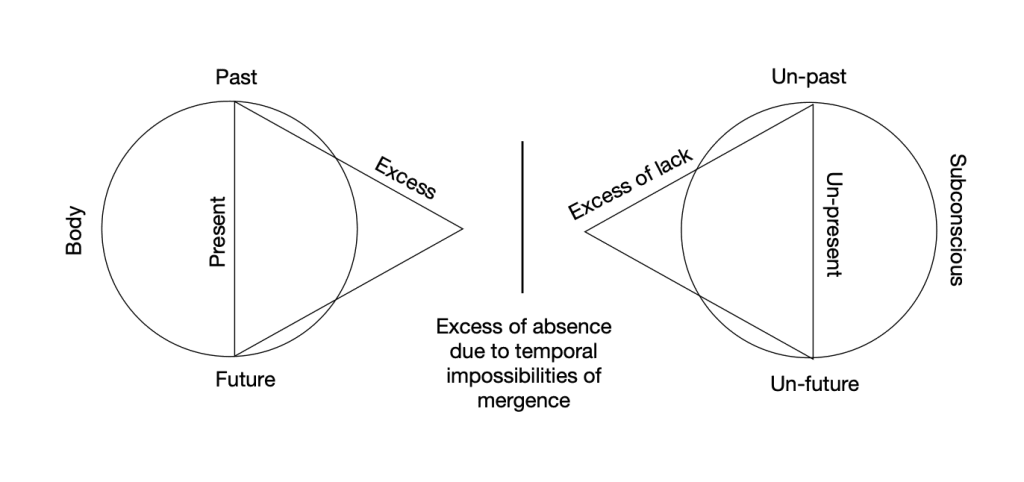
Often times, the depressed person will emerge out of a depressive state when the conditions for betterment are not presented to them on a silver platter, but instead when betterment is given the conditions to arise at all. For the depressed person, even a small change in the temporal-rift can lead to the end of stagnation. This almost always only seems to happen when the subconscious of depression is tricked into thinking it has stumbled onto a sense of temporality, whether past, present or future. With a positive excess, the subconscious of the depressed person is able to circumvent the excess of absence in order to attach itself to one of the three possible temporalities of the body. Yet, as pointed out beforehand, what is perceived as the “excess of absence due to temporal impossibilities of mergence” really out to be seen as an entirely different temporal mode in the first place; one that breaks new ground, fertile yet unexplored. For the depressed person, this temporal mode is the worst of all because, much like a ship lost at sea, it cannot operate on coordinative terms; in fact, it cannot even find the horizon leading to shore and if it eventually does manage to reach it, it often is out of pure chance. The intensity of this rift as a consequence of the rift itself is the unforeseen tsunami; its waves collapsing on the coast in order to reach it at all.
If the mergence itself is part of – if not the whole – problem, wouldn’t the solution be to not attempt fusion in the first place? Isn’t this the condition of mankind; the body at odds with the mind and the mind restricted because of the body. Philosophy tells us that, through the years, we have learned that to let one or the other roam freely will only enhance the problem, with the only possible solution for social coexistence being the intertwining of the two. Yet, what the excess-dilemma represents is the precise inability of this intertwining; the inaptitude of how we have managed to let the experiences we build in time crumble under the weight of their own irresolution. Hyper-productive expenditures of consumer-capitalism essentially argue for a loss of the subconscious, the against-depression in as far being depressed means being unable to participate, both in production as well as in consumption because the temporal zone, the inter-zone one inhabits lays outside of the parameters that would make production or consumption viable (both belonging to the time-zone-present, which the depressed person is oblivious to). If anything, the depressed person is the exempla par excellence that different temporal attitude are possible, only that, in its case, the conditions for a differentiated approach to time-zones is oppressed by current operational and economic modes that do not allow it to drift off without being accompanied by the malevolent undertone of not complying, of doing something wrong. No, the depressed person isn’t doing anything wrong; it is, most likely, often only drawing the right conclusion to otherwise already bleak situations, with the unfortunate attitude being one of revolt through retreat. Naturally, the depressed person in a depressed state does not feel this way, in so far as it might know this to be true but, being in a different temporal zone where the present does not make sense anymore, cannot reach the point of aperture in a hopeful, perhaps even prophetic way. Instead, it I distraught precisely because it feel itself drifting off and the body, decidedly of the present, refuse to let it go. The come-down from a depressive state is, thus, either the body regaining control of the subconscious or the subconscious drifting off far enough for the body to become obsolete (mania).
Yet, the depressed person does not wander; if anything, the temporal drift one can describe as being what depression essentially is starts to morph into a kind of coma in which time does not offer the conditions for experience any more precisely because it is time that oppresses the depressed person. Hours turn into the body’s sarcophagus and the presumed unified self is disturbed by an entity that is perceived as both property of this very alleged self – as the saying “my depression” demonstrates – as well as a profound alienation of possession in the sense that depression often feels like something one is rather consumed by, something that swallows one whole, the cloth obscuring the table, so to speak. A split occurs: the phenomenological self must renounce depression as something that isn’t its property, like a fungus that had been left to grow, unattended, with the depressive phenomenological self-knowing no other condition, with even its pre-reflective state being consumed by depression itself. The first-person-self, “the thought I am having is mine” kind of self is left to decode the fog caused by depression, but since the thought of depression, or rather the condition of it, does not occur on a possessive level but instead on one where one is possessed by depression, the non-depressive self cannot ever truly access the fundamental characteristics of depression, just as much the depressive first-person self cannot access the minimal-self of pre-depression, thus doing away with it for good. The depressive self is certain of depression being theirs, which is perhaps why phrases like Kurt Cobain’s titular quote “I miss the comfort in being said” rings so true; with depression, one is usually sure of the “mineness” implied by it. Yet, here is where depression expertly tricks the depressive: since no one actively choses to be depressed, depression is an external factor internalized as excess. The consequent lived body of depression, the body as the center and origin of one’s being in the world, cannot be trusted anymore; it becomes infiltrated by the depressive agent, regressing from the lived-body to the body as a physical object in the way of depression gaining full advantage. In fact, one usually does not say “I am depression”; one says “I am depressed”; we do not become the noun, we become described by the adjective, inherently outside of the perception of the body and mind as nouns.
One can speak of external depression, or perhaps even planetary depression, when one looks at developments like climate change in general, floods or heat-waves, for example, yet when the depression is anthropomorphized into becoming internal to the human, it becomes so invariant as to mimic the self-model that Thomas Metzinger describes as being the “only representational structure which is anchored in the brain by a continuous source of internally generated input”. As an excess of energy, depression jump-starts the self-model into hyper speed, consequently breaking down the whole system, not because of a missing link but specifically due to its reliance on a “persistent dys-functional link” that suddenly becomes equivalent to the first-person self, only of an entropic kind. It is not you who’s having “this” thought, it is the depressive state of the self that, by thinking, actively denies the reliance on a model of phenomenological selfhood. Depression violates the promise of the self, of a self contained in the body, making even the body extraneous to the supposed self. In a depressive state, our alleged consciousness is exempt from direct and immediate contact with the content of the depression; it is, since depression’s effects on the human body are almost irrefutable, tricked into assuming a first-person view of the condition – as in “this must be my depression” – when it could actually be argued that the condition itself is more like a sort of extraneous mist that covers the subject, leading to a feeling of possessiveness that, due to it not being reciprocated, for depression itself does not have an autonomous consciousness, despite the certainty that it must, creates a feeling of displacement. Depression creates the condition for content but is, in itself, much like Fludd’s unending black un-universe, decidedly contentless.
At the same time, the depressive state for the depressed person quickly begins to feel like an Ur-condition, something that, deep in the crevices of either the mind or the mind-world-matrix, must’ve always been there. Why? Because, much like our own representational data-structures, depression is incredibly reliable; when it is, it is despite of anything else. It might be to varying degrees of potency, but the consequences are, most likely, always the same. This is particularly true when one analyzes the relationship between suicide/ suicidal ideation and depression, with the two very often being corelated. Metzinger further argues that our own representational data-structures are, in fact, so reliable that they cannot even be recognized by the host’s system anymore, and perhaps this ought to also be true for depression: a state that, as a kind of apriori-state of the depressed person – the “default base line”, so to speak, since a depressed person will almost invariably never say they are “not depressed”, instead opting for the more general “I am not depressed right now” – circumvents the representational state even further than that which is only a state of the visual system precisely because depression is not a condition of the visual, yet impairs everything in its sight. Contrary to the default representational states of any object around us, depression has an inherent disadvantage: displacement. If one considers that even the depressed person that will say “I am not depressed right now” will inevitably have phases of life where the depression is less acute than at other times, the depressed person can, at the very least, be certain of a shift caused by the non-representational, i.e the depression, that then affects, like a flu or a cough, any other activity. Thus, at the very least, the depressed person is aware of a change in relationality and temporality, it just is not able to access it since they are not able to either make the early un-representational stages of depression available for introspective attention or access depression’s temporal coordinates, with them lying outside of our own time-continuum and the depressed person being crushed because of the very same realization. By consequence, this also impedes on our already flawed extraction systems of the representational; since swimming in a kind of Ur-soup of depressed black water, anything that comes out of it is tainted by design. If, as Metzinger argues, our systems cannot access the representational data structures due to the reliability upon which their very objecthood hinges and if depression supersedes the humanocentric representational trust by disrupting the very nature of the system, it should be no surprise to anyone that the depressed person will inevitably feel alienated by even that which it was previously so sure of. The disruption of the system causes a fracture of the representational; we still cannot recognize the data-structures that make up representation and we finally weep because of it, as if having uncovered a well-kept open secret. The indictment of the representational by something that isn’t causes a kind of meltdown of presumed reality. If I cannot trust myself, why should I trust the world?
Moreover, Metzinger argues that, on a purely evolutionary level, there was no beneficial consequence to accessing the representational data-structure; we just needed to be sure of what we have in front of us, not what is active in the brain. Pointing to scenarios of hunting, he explains that the “cost” of potentially accessing the data-structures would consume too much and not really be beneficiary so, in an evolutionary skydive, humans simply, for practical reasons, must’ve at once opted for the presumed assuredness of the present in favor or not overcomplicating things. “For the functional properties we needed to survive, we didn’t need to distance ourselves from ourselves”, says Metzinger. Fast forward to the depressed person in a depressive state, and the analogy is on of pure horror; the depressed person, now completely alienated from itself, rightfully does not have the tool to deal with such a displacement of energy. This distancing is achieved at the expense of the depressed person, taken prisoner by its own reliance on representational data-structures by an entity that moves in the dark, that has neither center nor edges and, certainly exactly because of it, is able to circumvent the, so to speak, instantiated-self, the self that is so sure of not needing to distance itself from itself.
Depression, one could argue, is, especially in the more clinical sense, the ultimate state of inner experience in so far as it knows no origin. For individuals that suddenly fall at the mercy of depression, the displacement is often too potent, too acute of a sensation so that they must find the root of the condition, often grounded in a consequence of a particular way of life that has unwilfully distanced itself from the experience the self would want to have. Not coinciding, a rapture occurs. In more clinical and long-term examples, especially those in with the depression is treatment-resistant, often the individual will be unable to pin-point one particular advent that caused the depression, almost as if, again, the depression is pre-human, as if the human in question is built with the system for depression already engrained in them. Whether the theory of a chemical imbalance hold true I am not at liberty to say. Yet, as a profound inner experience, depression, much like experience itself, resists existing as a project – to quote Georges Bataille – in so far as it reminds the depressed person of their process-based self. More than that, depression as a stable, quasi immobile entity then clashes with the processual; more than just, as Bataille puts it, “not being able to exist as a process”, depression, personified, cannot bare to witness the human in process, the human as faulty by nature. So, depression takes over the being, forcing it to be related to itself, disrupting the process in its process. In a depressive state, the depressed person will tell you that nothing can grow from that phase; that the air they breathe is toxic and the bed they hide their body away in made of spikes. Where many might attribute Bataille’s “putting existence off until later” to the essence of a depressive state, if could be arguable that it is actually quite the contrary; depression forces the depressed person to exist, despite its lazy wish to remain a project. It cannot bear to see the individual wasted on tomorrow, on that which might come but never arrives, and thus depression forces its way to the front of the line, exclaiming: “in this moment, you have to be, no matter the cost”. In fact, one is decidedly more in a depressive state than in the bowls of everyday life, it just so happens that one is outside of the normative temporality sphere. The excess of being that is depression transports the depressed person into a site of time where the process is mitigated by time “not passing”, by time remaining still, infertile and dry. In treatment-resistant depression, the individual is arguably always living in a fourth time zone, with the time-space continuum of the past-present-future-parable being completely alien to them. They might attempt to find their find into said matrix by routine, without realizing that routine actually belongs to a fifth temporal zone, leading them not into a time-zone that might bring them closer to reality – i.e compromising their own space-traveling condition – but into a different one altogether that also does not belong to the past-present-future-parable. In doing so, in wanting to exist as a project, thus in harmony with realization, the depressed person actually rejects time from outside; since process ebbs between past, present and future without ever finding a resting place, it cannot ever know anything outside of it. If one is already outside of this paradigm, returning inside of it will offer them nothing but anguish. To remain outside of said matrix only leads to despair because modern life prohibits it in the first place, not because of the inability of the individual to remain enclosed within it. The body, as the only extension of the being that can offer tangible protest, reverts back into a process of un-becoming, of stasis not as lack comparatively to the rush of modernity, the on-demand-neurosis that governs our relationship to the “real” but as the only viable rejection of the outside’s lack of offering an extreme to the human project, unending, The depressed person in a depressive state, socially speaking, “ends becoming”; the vernacular of depression is of “being depressed”, not of a process towards it (although, as previously explained, the depressed person is always in fear of the next depressive episode, for when not in a depressed episode they are essentially “becoming”), thus reinforcing the split between the self as a project and the self as a temporary outcome (the depressive state); the dromomaniac, condemned to forever travel, constrained to the restraint-chair of being.
In a depressed state, the depressed person cannot imagine ever returning to a state outside of depression, like a time-traveler stuck in the accretion disc of a black hole, not quite at the point of no return (suicide) but certainly not quite escaping the scope of danger. In a sense, the depressed person has a point, only that the conclusion is not compatible with the life required from the capitalistic-individual: why would one want to be a process if the certainty of being, even while orbiting a black hole of deception, is so seductive and all-consuming? Depression presents itself as an extremity, as a point without beyond, definitive zero in solar oblivion, a state where one finally “is”, even if the object of that being is depression itself, at the cost of the depressed person.
References
B. Kronic, Maya: „A Marker”, in: Sonic Faction: Audio Essay as Medium and Method. MIT Press/ Urbanomic: USA/UK, 2024
Thacker, Eugene: In The Dust Of This Planet. Zer0 Books: UK, 2011
Cronenberg, David: The Fly, 20th Century Fox. Canada/USA, 1986
Metzinger, Thomas: Being No One. MIT Press: USA, 2004
Hillman, James: On Melancholy & Depression. Spring Publications: USA, 2026
Bataille, Georges: Inner Experience (translation by Stuart, Kendall). State University of New York Press: USA, 2014
Bahbak Mohaghegh, Jason: Omnicide. Mania, Fatality And The Future-In-Delirium. Urbanomic/ Sequence Press: UK, 2019


Leave a Reply