
Curses and Stones: Towards a Mundane Quantum Cosmotechnics
Cobra Coil/Disorientation Diagram, 5th May 2014/1993/1964/DeepTime
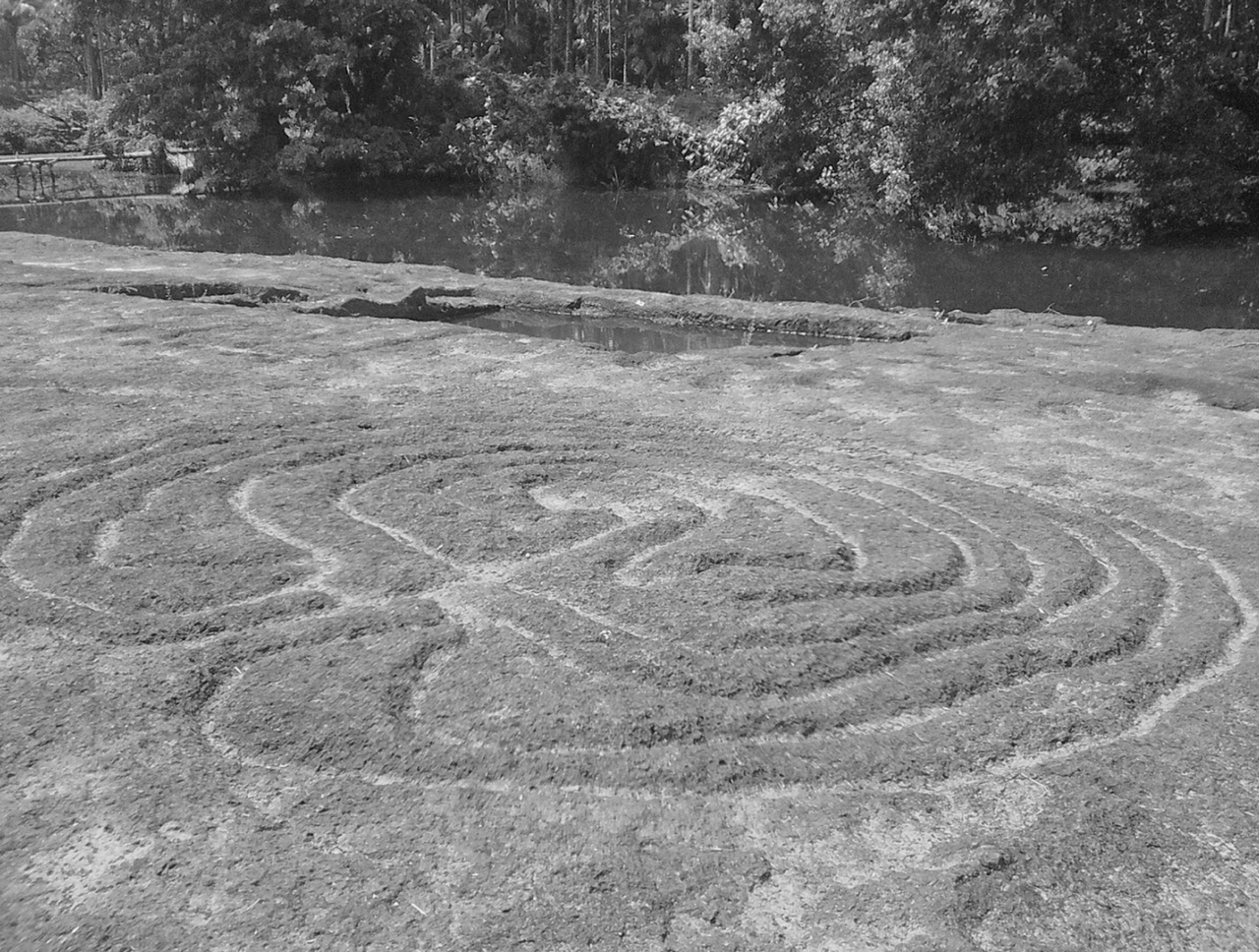
Many years ago, I visited a place called Usgalimal in the western ghats of India in order to see the pre-historic petroglyphs discovered here in 1993. These rock carvings have been dated to around 6000-8000 years ago, belonging to the mesolithic-to-neolithic turn in the subcontinent, a period which according to archeologists marks the tail-end of a slow and eventful shift from a nomadic hunter-gatherer way of life to an agrarian milieu. After a fateful encounter with a sunbathing king cobra who ceremoniously moved along to let us pass further inside the tropical forest, we arrived at a rusty weathered signpost put up by the Archeological Survey of India to mark the site. On a red laterite riverbed that gets submerged in the Kushawati waters every monsoon, there are about a hundred carved inscriptions — images of humans, dogs, bisons and other animals, one depicting the ribcage and innards of a bull, one of a mother and a child connected by an umbilical cord. But the one that struck me with the most force and lodged itself in my memory, was one of the few unrecognizable carvings on the riverbed. It was almost circular in shape but for an opening on one end, and almost five feet in diameter, so that one could comfortably curl up and lay down upon it. The red laterite stone was meticulously carved with precision tools of the time. The circular boundary folded in upon itself in undulating concentric spirals that seemed to delineate an inward path towards a center that ended in a lopsided question mark. The grooves of the spiral grew slightly wider as they grew inward, almost giving an impression of a multi-limbed figure at its center. Others disagreed. Was it depicting an astronomical phenomenon, or perhaps a whirlpool observed in the water, or a coiling serpent, or a peacock spreading its feathers to make a giant fan?
A few months later to my amazement, the same figure hurtled towards me from the cover page of a book of short stories by the Argentinean author Jorge Luis Borges. The particular edition was published in the United States in 1964, and it seemed to have no plausible connection with the mysterious abstract form I had encountered on the riverbed a few months ago. But it was beyond doubt that they were both the same thing. Seeing it in black and white on the familiar computer screen immediately made it so much easier to recognize it for what it really was. Like an old friend it brought back memories of afternoons spent carefully tracing lines on paper trying to find the right path through the mazes printed on the back pages of newspapers. It was a labyrinth.
After that I started seeing labyrinths everywhere…
The indeterminacy between words and things, meaning and matter, and their relationship with memory and its exteriorisation is at the core of the Usgalimal artefact. The ancient labyrinthine form carved on the riverbed could be more productively read not as a mimetic representational object, but one whose meaning is embedded in its technical relationship with its world — as a symbol to trap spirits, a diagram of force fields, a battle formation, a disorientation machine, a mnemonic device, a ritual totem or an apparatus of magic. Yuk Hui would call such objects cosmotechnical, in the sense that they mediate the unification of the cosmic order and the moral order of a milieu through technical activity, whether craftmaking or artmaking. What kind of morality, which and whose cosmos, and how to unite them vary from one culture to another according to different dynamics, and in turn produce different conceptions of natural and unnatural, human and non-human, sacred and profane. In a civilisational sense, there hasn’t been one or two technics1, but many cosmotechnics. The technological rupture of western modernity produces a particular conception of ‘nature’ as a standing reserve that is always available for measurement, extraction and optimisation. The Indian caste system can be situated within another cosmotechnics premised on a hierarchy of purity that differentially distributes the quality of being more or less than ‘human’. It would be fair to speculate that the Usgalimal inscriptions operate through a cosmotechnics of a third kind, whose distinctive logic might rest upon an immanent choreography of forces of river currents, stone, season, memory, spirit and orientation, and could be enacted through various technics of carving, walking, gathering, trapping, tracing, that bind movement to landscape and landscape to memory.
We are in the midst of a clash of cosmotechnics. From this dimension we can make claims over the stakes of contemporary artistic practices on life. We can argue for thinking as a materially oriented practice mediated through technical activity and recover the question of ethics that is embedded in all technical decisions. We can unearth the intimate relation between aesthetic, philosophical and technological thinking, and we can invent artistic practices that are not premised on representing something that already exists, but to act in the world, and to bring into a relation of proximity that which is otherwise kept far away.
Breathless Bird/Unknown Unknowns, 1657/1927/2019
The 1768 oil painting by Joseph Wright titled ‘An Experiment of a Bird in an Air Pump’ depicts a ‘natural philosopher’ performing one of Robert Boyle’s air pump experiments for an audience of mostly upper class onlookers. It is a highly theatrical composition, and Wright uses many techniques to depict the scientific subject of his work that were formerly reserved for religious scenography. The wild haired scientist towers over a lone bird trapped in a bulbous glass vessel. Wearing a dishevelled nightgown and an expression of reverie, he slowly removes the air from the apparatus with a vacuum pump. The objective of the experiment is to prove the reliance on air for the survival of living creatures, and the brutality of the conclusion seems to have left the audience in varied states of shock, disbelief and dismay that are amplified by the dramatic light of the lone candle lighting the scene. Some turn away, while others bear witness with stoic expressions. Light has a specific function in this composition — that of illumination of knowledge, or Enlightenment. The scientist’s gaze is dispassionate. He is not even observing the bird, but instead looks directly at us, the viewer outside the plane of the canvas. The painting stages a fundamental tenet about the nature of modern scientific knowledge — that it relies on technics that construct strict conditions of separation in order to produce phenomena as ‘objective’. With the advent of quantum mechanics in the early 20th Century, we reached a limit point of this construction, where the nature and arrangement of technics involved in setting up the experiment are themselves implicated in the kinds of conclusions that are obtained through them.
Quantum physics developed through a series of disagreements over the true ontological nature of light — not as a signifier for knowing, but as an enigma in itself. The so called ‘dual nature of light’, the fact that it manifests particle-like characteristics in one set of experimental conditions and wave-like characteristics in other circumstances, and the fact that the same kind of indeterminacy can be observed in matter as well, forces us to confront fundamental assumptions, such as the conditions of possibility of objectivity, the nature of measurement, the nature of nature and the relationship between discursive practices and the material world. In quantum physics, ‘coherence’ refers to the potential of phenomena to interfere with each other to produce quantum behaviour. That is, the state in which the wave-like properties of so-called particles manifest themselves. Quantum experiments try to produce conditions of coherence by denoising or incrementally excluding the world in order to make the system calculable in quantum terms. One may hear a conversation in a quantum optics lab about ‘preparing the light’ — stabilising it’s frequency and polarisation, eliminating random phase fluctuations and steering laser beams through precise paths made up of labyrinthine optical fibers. There may be concern about regulation of extreme temperatures, isolation of the apparatus from miniscule physical vibration and stray electromagnetic fields and the production of near-perfect vacuums. In the lab, taking a measurement with the least amount of disturbance to the system is often spoken of as an art. Objectivity is dynamically constructed as the result of what Karen Barad calls an ‘agential cut’ — a set of temporary localised boundary conditions that stabilise certain relations as measurable, nameable and knowable, while excluding others from the field of observation. The stakes of such cuts exceed the laboratory, as the boundaries they enact participate in the material reconfiguration of worlds. The task for the artistic experiment is to enact the agential cut in ways that could allow us to apprehend a plurality of coherences, treating them as the generative intrusion of a world that refuses isolation.
A key idea that would inform this work is the notion of ‘this-worldliness’. By ‘this-worldliness’, I wish to signal a particular outlook that is oriented towards the lived, material, relational conditions of this world. It argues for taking this world seriously, and proposes attention towards ordinary material life, infrastructure, embodiment and ecology. In that sense, the overall orientation of this proposition is a ‘mundane’ cosmotechnics, where mundane could be understood as ‘belonging to this world’, along with all its inflections of banality and ordinariness. It refuses to apprehend quantum phenomena as abstract or imperceptible, but rather is interested in encountering a world that is always already profoundly strange and intimate at the same time. It is interested in how cosmic background radiation is detected in cathode ray television sets; or the fact that everyday connectivity is contingent upon the bending and diffraction of electromagnetic waves transmitted by WiFi routers through congested architectures of the city; or that weird interference patterns emerge between a cellphone tower and mobile phones on the street during a public protest. It apprehends aluminium mosquito nets as accidental Faraday cages, and optical fiber cables discarded by tethered drones in war zones as material for birds to build nests. A particular technique popular in low network coverage regions of mid-2000s India consisted of throwing a mobile phone (usually the indestructible Nokia 3310) high up in the air in order for it to catch a signal and transmit a message to a beloved. One can find resonances of this activity with the observation Gilbert Simondon makes in relation to TV antennae — ‘…it seems to represent a gesture of sorts, an almost magical power of intentionality, a contemporary form of magic. In this encounter between the highest place and the nodal point of transmission of hyper frequencies, there is a sort of ‘co-naturality’ between the human network and the natural geography of the region.’2
Understanding the emergent behaviour of many-body systems is one of the outstanding problems of modern science. It is often impossible to predict the state of systems composed of multiple bodies because their collective dynamics produce unforeseeable patterns and forms of organisation. Simple interactions between individual particles may quickly compound into incalculable complexity at scale. A system may spontaneously reorder itself; or collapse; a body may flicker across multiple possible positions; an ‘I’ may inhabit many ‘We’s; a relation may hold or slowly fade away; small forces may deliriate large systems. The real question at stake is a dispositional one: how to approach indeterminacy in a non-paranoid way.
Epilogue/Collapse
The seminal Indian modernist artist Jyoti Bhatt, himself a driver of milieus and a keen lore-keeper of artistic chatter, narrates a story that he claims to have helped him understand the fundamental concepts of semiotics. A young man goes to a priest to seek eternal knowledge. The irate priest keeps avoiding him, giving excuses and injunctions. This goes on for many days, until finally the priest hurls a stone at the young man and utters some curses to ward him off. We don’t know why the priest is so vile and inhospitable, perhaps it is that he is protective of some secret knowledge or that he is only trying to hide his own ignorance, or perhaps something else. In any case, the young man takes the stone that was hurled at him and starts worshipping it, using the curses that were hurled at him as chants. Eventually, he attains enlightenment. When the priest hears this news he is shocked, and runs along to meet the young man and ask him how he did it. The young man laughs and replies, “With your words and things!”
I propose that the story carries more to it than a lesson on the arbitrariness of signification processes. Rather, it is important to investigate precisely the cosmotechnics of curses and stones in order to apprehend the kind of knowledge that otherwise escapes priests.
Kaushal Sapre
Land as a Diagram of Dignity
Many Dalit thinkers have observed that colonial modernity has provided untouchable communities a space to express themselves and to reconfigure their lives within emerging possibilities, inspiring a sense of hope and agency from an otherwise barbaric society, entrenched in caste hierarchies and untouchability. However, this does not mean that caste hierarchy and its oppressive dynamics have abruptly vanished in the wake of a new social order. Instead, the spatial and social dimensions have been reconfigured through new technologies of caste relations, leading to what can be termed the modernisation of caste. This does not signify the complete eradication of traditional manifestations of caste either. The point here is that caste, as a power diagram3, continues to permeate most political and cultural experiments in the Indian polity, which are otherwise claimed to be emancipatory. In this context, I will draw two instances: the first being Narayana Guru’s encounter with a fellow passenger during a train journey, which serves as an instance of caste recognisability and spatial precaution within an apparently modern spatio-temporal manifestation. The second instance illustrates how this spatial precaution and caste recognisability continue to take on a new form of spatial modernity in present-day Kerala.
Scene I: the Diagram, the Spatial Precaution, the Capturing Anxiety
A biographical account of Narayana Guru describes an event in Guru’s Life as follows:
So, the next month on the 25th of Kanni, Guru boarded the train from Aluva along with two disciples. He did not appear to get bored on the journey … The question of a person sitting next to Guru roused him from this reverie.
“What is your name?”
“Narayanan”, Guru said.
“Who are you by caste?”
“What do you feel seeing me?”, Guru responded with a question.
“Unable to make out.”
Then Guru said with a smile: “If you are unable to make out by seeing, how can you understand by telling?”
Recalling this conversation with disciples while he was in Madras, Guru explained: “There is only one caste, not many … no need for any special proof that there is only one caste. When a dog sees another dog, it understands that it belongs to its caste. All animals have this understanding. They all live with such an awareness. Only humans have doubts about caste. He has no ability to recognise his caste. It is worse than animals.”
This event or encounter in the train—in this machine of empire, a symbol of colonial modernity —seems, at least momentarily, to rearrange the old order. Within its metallic enclosure, an “untouchable body” can come in proximity with an “upper caste person”, sharing a bench, a journey, a direction. The railway appears to stage a quiet disruption, a fleeting suspension of caste’s spatial logic. And yet, this disruption is only partial—perhaps even illusory. The air inside the compartment remains unchanged. Caste does not dissolve at the threshold of modern infrastructure; it travels with it. It lingers in the hesitation before contact, in the silent negotiations of distance, in the invisible lines that persist even when bodies are forced into proximity. The train, rather than erasing hierarchy, becomes another site for its subtle reproduction. In this moving apparatus, caste is not left behind—it is carried forward, smuggled into modernity, adapting itself to new forms while retaining its old force.
This conversation and the Guru’s rejoinder are a provocation to see the profoundly immanent and diagrammatic nature of caste manifested in a modern apparatus. The traveller’s question— “Who are you by caste?” —or the precaution of knowing the other body in proximity, is not merely a request for information, but a spatial precaution of caste and a technique for managing proximity. It reveals caste as a constantly emerging force of spatial segregation. Founded upon the Brahminical perceptual ordering, the act of seeing itself functions as a mode of territorialisation4. Breaking the genesis or chrono-logic, it proceeds through breaks and fractures, producing new syntheses in its culmination and manifestation—a continual modernisation of caste as a power diagram. Overemphasis on the behavioural patterns of caste encounters may end up disguising a phantom behind it. In other words, it risks producing a mere historicism of caste. Like the way it functions in this context, the logic of caste validation persists across social life. Urban landlords, for instance, often ask cryptic questions to newly visiting tenants seeking apartments or rooms, such as “What’s your surname?” or “What is your father’s name? enact the same regime of caste approximation. It is an attempt to capture the other body within a prefigured grid of caste recognisability. Such moments should not be read as the residual traces of a premodern evil lingering into the present. Rather, they reveal how caste actively reproduces itself within modernity through emergent semiotic codes, continually reconfiguring its modes of perception, validation, and exclusion.
Here, Narayana Guru’s counter-question—“What do you feel seeing me?”—disrupts the flow of this mechanism. Rather than offering an identity, he displaces the very epistemological ground for recognition itself. Here, Guru seems to be proposing a radical ontological proposition: a knowing being founded on an ontological equality across species that escapes any logic of capture. The response or the expression “unable to make out” marks a crucial threshold: a moment of perplexity and indeterminacy, where the body in front resists immediate classification and recognition. Guru’s subsequent response with a question: “If you are unable to make out by seeing, how can you understand by telling?” foregrounds seeing as a primary sensorial act through which one can feel or sense the presence of another being in proximity, without the validation through representation or capture. This becomes obvious in Guru’s later explanation: “No need for any special proof that there is only one caste. When a dog sees another dog, it understands that it belongs to its caste. All animals have this understanding. They all live with such an awareness. Only humans have doubts about caste. He has no ability to recognise his caste. It is worse than animals.” What Guru asserts here is a form of prelinguistic, pre-representational rationality—an immanent awareness of oneness that precedes any symbolic frameworks of classification and identity such as caste.
While our sensorial dispositions—seeability or hearability—are organised and habituated within the regime of Brahminical power, Guru’s notion of “one caste” signifies an ontological equality that exceeds the modes of capture through which visuality and discursivity order humans as representations within hierarchies. Guru’s invocation can be construed as a form of radical ontological proposition: a seeing without capture. Seeing without capture signifies a mode of encounter prior to the diagrammatic organisation of difference into identity. It is not the absence of perception, but perception before its capture by caste. This notion of seeing without capture is not merely an ethical choice; rather, it represents an ontological impossibility within a caste society where recognition itself is already hierarchized. In this sense, it is not an alternative mode of recognition but rather an exposure of the limitations inherent in the concept of recognition itself. Seeing without capture signifies the impossibility of understanding the other as separate, categorizable, or hierarchical, as it can only mirror itself. In this context, ontological oneness is not a metaphysical claim, but a refusal or resistance to the representational apparatus that makes caste legible and operative.
While seeing is not a natural activity, but is cultured or even structured by regimes of power, the sedimented predispositions acquire the status of a mould of capture. Every act of validation in an everyday encounter functions as an approximation to this mould of capture. Mundane Malayalam Phrases such as “avane/avale kandāl ariyām” (one can recognise or know someone from their look or appearance; for instance, whether they are criminals or not) reveal this logic of approximation to the prefigured images. Yet there are moments of contingency in which what is present is not identical with or resistant to the capturing mechanism. This situation marks out the passenger’s encounter with Guru and his expression “unable to make out”. An uncertainty emerges. Let’s not confuse this uncertainty with the affirmative one—the sensory strangeness of an aesthetic moment, or an encounter that breaks with the image of thought. Rather, two subjects are produced: a subject of aesthetic affirmation that escapes capture and a desperate subject failing in its anxiety of caste recognition. The subject outside this scene—the mise-en-scene itself—is also split: between a subject in concord with the police order and an aesthetico-political subject that gestures toward a ‘redistribution of the sensible’. However, the uncertainty in the fellow passenger emerges from the failure of recognition: from an anxiety of recognition. Emerging from the sedimentation, processing in the mould like an attraction in the magnetic field, waiting for its opposite pole, but failing, its failure now transforms itself into a state of perplexity, generating an atmosphere of caste. This moment of perplexity itself is a symptom of caste, which operates at the level of an encounter with the other. In other words, caste operates not just in recognition, but also in its failure. The spectral presence of caste manifests itself as this anxiety of recognition, as this unsettled gaze, as this atmosphere, prior to its completion through displacement. This is the very psycho-pathology of caste, as Ambedkar calls it, a notional entity, a disease of the mind. Caste, in itself, is not a static entity but a power diagram that modernises itself through immanent modulation, crystallising its subjects in a graded hierarchy—a form of stagnation against any liberatory becoming.
Scene II: The Spatial Assemblage
A significant section of the Dalit population in Kerala continues to inhabit caste ghettos or colonies—settlements established through the state’s legislative measures, which are themselves corrective measures taken by the state government after the failure of the Land Reform Act 1963 (instituted in 1970) to ensure minimum housing facilities for the Dalit population. These settlements are named as Laksham Veedu Colonies. Beyond their precarious infrastructural and material conditions, it is important to note how these spaces are continuously re-inscribed within a semiotic regime that codes them as landscapes of segregation and cultural alterity. Here, land operates not merely as territory but as a visual and affective inscription—produced, stabilised, and circulated within a caste regime of cultural hegemony. V. V. Vinu, one of the Dalit artists of Kerala, in a recent conversation, discussed an interesting aspect of the title of his recent work. The work is titled Kazhchayude Purampokkukal; in general, it can be translated as ‘the otherness/margins of visuality’. Purampokku nilam (or Porampokku land) refers to government-owned land that is not assessed for revenue tax, often used for communal purposes like grazing, water bodies, or public roads. It signifies land belonging to the community or state, often categorised as excess land, wasteland, common land, or land set aside for public use. However, these are the lands typically occupied by the landless population for habitation. In the colloquial sense, it was derogatorily used to mean worthless, secondary, or of low status when contrasted with what is considered proper, interior, or prestigious. The term acquired its derogatory status precisely because of the population living there, as with the term ‘colony’ in the rural context. In the urban context, however, the colony acquires a privileged status and is often contrasted with the cheri or the slum.
Vinu uses this term (Kazhchayude Purampokkukal) to denote his concern with the very constitutive logic of visuality itself—its own ghettoisation, the subalternity it produces, its margins and alterities in relation to the caste question. It must be distinguished from its semantic variation —Purampokkile Kazhchakal, which refers to the visuality of the purampokkukal—the landscape of the landless habitation. The latter term corresponds to the manner in which this “outside-land,” the dwelling space of the landless population, is imaginatively constituted and mediated within the cultural sphere. Expressions such as “colony,” “Onamkera Moola” (a place where even the festival of Onam does not arrive), and “purampokku” circulate within everyday discourse, literature, and cinema as signifiers of abjection. The same semiotic operation extends to the notion of “coastal language” (a dialect spoken by the fishing community), framed as an impure or culturally deficient idiom. While it projects Dalit life within a discursive field of criminality, demonisation and undesirability, it also renders these spaces as spatialities of aggression and disgust. Hence, a form of reciprocal attribution of qualities: the sociality becomes the marker of spatiality, and the spatiality becomes the marker of sociality.
Enclosed within this double attribution, Purampokku land emerges here as a caste sensorium— through a process of semiotic and affective inscription. Caste becomes a perceptual regime: the manifestation of caste operates through the organisation of perception itself. Vinu shifts his focus from the territory(purampokkukal) as an ‘object of vision’ to ‘vision as a field of territorialisation’ structured by the regimes of power. In other words, the act of seeing itself functions as a mode of territorialisation, producing subalternities, margins and perceptual alterity. He is attributing the predicate—the purampokku (the outside-land —landscape of landless habitation), a sensorium of caste, to the visuality. Hence, there is a shift of focus from the representation of a marginal territory to the operation of a diagrammatic organisation of the perceptual regime of caste in which visuality itself becomes the site of territorialisation. His shift in focus marks a careful departure from an anthropological objectification of deprivation to a critical diagnosis of the perceptual modernisation of caste, in which caste persists not as a quantifiable fact but as an adaptive visual and semiotic regime structured within contemporary modes of seeing. When land, once distributed, becomes the dwelling ground of untouchable populations, the landscape acquires the status of a new sensorium of caste, as if the very landscape acquires the smell of caste. Thus, the distributed property becomes both the ground and the instrument of a new mode of ontological separation. Caste not only territorialises land and its population, but also territorialises the perception of land. The perceptual regime of caste diagrammatically organised as the ‘perceptual perplexity’, or the ‘capturing anxiety’, is now territorialised as a spatial fact: the purampokku, the colony, the cheri, representing the spatial modernities of caste.
Towards a Counter Cartography
The misrecognition of the spectral mechanism of caste has resulted in the failure of the Land Redistribution Act and its emancipatory potential. As many have noted, the question of land distribution in Kerala has been framed through the category of class, resulting not only in the failure to identify the beneficiaries but also in the failure to address the question of a dignified life. In other words, the caste question in general and the land question in particular are reduced merely to a governable category, which protects and normalises its own epistemic violences. Hence, the Dalit struggle, that is axiomatically declared as a new norm of equality5, cannot be construed merely as a demand for land as material possession; it must be grasped as a process of re-distribution of the aesthetic regime in which caste orders the visible and the sayable. This is not to underestimate the procedural significance of legislative measures in land redistribution, but such measures alone cannot exhaust the meaning of this struggle, nor can they be reduced to a ‘governable category’ within the administrative rationality of the state. The land question, here, exceeds its juridical determination as property; rather, it projects the land as a ‘diagram of dignity’. It could be a terrain where alternative subjectivities and collective sensibilities can take form. The struggle thus unfolds as a counter-cartography of being, where the reclamation of land coincides with the invention of new modes of perception and of being itself.
Praveen Ashokan

FOOTNOTES
- Technics here have to be defined in a wide yet precise sense — not as a collection of tools, but as relations. Technics are processes of binding to, capturing, stabilising and redirecting various kinds of forces, whether physical, biological, social or symbolic. Unlike the narrower term technology, which usually points to machines or devices with instrumentally defined functions, technics is not primarily about objects. Rather it is about different kinds of couplings that implicate bodies, procedures, gestures, instruments, infrastructures into a shared order. For Bernard Steigler, technics are exteriorisation of memory onto material surfaces. This ‘technical memory’ is an aid to forgetting, since it allows for knowledge to be preserved in the form of different materialities and modes of inscription. Consequentially, what appears as interior thought or culture is never self-grounding but always already scaffolded by these exteriorised supports. ↩︎
- Gilbert Simondon, “Entretien sur la méchanologie,” Revue de synthèse, vol. 130/6, no. 1 (2009), pp. 103–32, here p. 111. ↩︎
- Drawing from Foucault, Deleuze defines the diagram as an abstract map of the relations of forces, or as an “abstract machine”. It designates a nonstratified field of power prior to the formation of structures such as institutions, discourses, and subjects. It operates as a virtual configuration and is continually actualised in different historical forms. In the first part of the essay, I will use this conceptual framework to trace the diagrammatic organisation of power as a non-stratified relation of forces prior to the formation of a stratified assemblage, such as a caste ghetto or colony. ↩︎
- Territorialisation, as developed by Gilles Deleuze and Felix Guattari in A Thousand Plateaus, refers to the processes by which an assemblage acquires consistency through the making, coding, and organisation of a territory. A territory is not reducible to a physical space but is constituted through expressive acts— rhythms, repetitions, and signs— which stabilise a milieu. In this case, the perceptual regime of caste operates as a territorialising force— seeing functions as a semiotic coding of abjection. ↩︎
- Here, I am referring to Ambedkar’s Mahad Satyagraha speech and its further articulation by Soumyabrata Choudhury in his Book Ambedkar and Other Immortals. ↩︎
KEY REFERENCES
- Ambedkar, B. R. Annihilation of Caste. Annotated critical edition. New Delhi: Navayana Publishing Pvt Ltd, 2014.
- Babu, Roshni. “Philosophy of Technology in India: Reinventing Cosmotechnical Materialisms.” Technophany: A Journal for Philosophy and Technology 3, no. 1: 1–24, 2024.
- Barad, Karen. Meeting the Universe Halfway: Quantum Physics and the Entanglement of Matter and Meaning. Durham, NC: Duke University Press, 2007.
- Choudhury, Soumyabrata, Ambedkar and Other Immortals: An Untouchable Research Programme, New Delhi: Navayana Publishing, 2018.
- Deleuze, Gilles. Difference and Repetition. Translated by Paul Patton. New York: Columbia University Press, 1994.
- Deleuze, Gilles. Foucault. Translated and ed. by Sean Hand. London: University of Minnesota Press, 1988.
- Deleuze, Gilles. Guattari, Felix. A Thousand Plateaus: Capitalism and Schizophrenia Translated by Brian Massumi. London: University of Minnesota Press, 1987.
- Hui, Yuk. Art and Cosmotechnics. Minneapolis: University of Minnesota Press, 2021.
- Hui, Yuk. The Question Concerning Technology in China: An Essay in Cosmotechnics. Falmouth: Urbanomic, 2016.
- M.K, Sanoo. Sree Narayana Guru – Life and Times (Biography).Edited by: O.V. Usha. Translated by Mukundan P.R. Open Door Media, 2017.
- Maharaj, Sarat. “Unfinishable Sketch of ‘An Unknown Object in 4D’: Scenes of Artistic Research.” Art & Research: A Journal of Ideas, Contexts and Methods 2, no. 2, 2009.
- Majaca, Antonia, and Luciana Parisi. “The Incomputable and Instrumental Possibility.” e-flux Journal, no. 77, November 2016.
- Malatsie, Kabelo, and Lantian Xie, eds. Matter Mattering Matters: A Scienticity Reader. Milan: Mousse Publishing, 2025.
- Moten, Fred, and Stefano Harney. The Undercommons: Fugitive Planning & Black Study. Wivenhoe, UK: Minor Compositions/Autonomedia, 2013.
- Rancière, Jacques. The Politics of Aesthetics: The Distribution of the Sensible. Translated by Gabriel Rockhill. London: Continuum, 2004.
- Sadanandan, Santhosh. (2025). Decasting Caste: Spatiality and Sociality. Critical Times. 8. 309-337. 10.1215/26410478-11806657.
- Simondon, Gilbert. On the Mode of Existence of Technical Objects. Translated by Cecile Malaspina and John Rogove. Minneapolis: Univocal Publishing, 2017. Originally published 1958.
- Stiegler, Bernard. “Technical Decision.” Angelaki: Journal of the Theoretical Humanities 16, no. 4 (2011): 1–11.
The authors wish to thank YS Alone, Soumyabrata Choudhary, Rakesh, Debjyoti, Pravesh Kumar, Anupam Roy, Jithinlal NR, Vibin George, Aryakrishnan R, Santhosh C, VV Vinu, Aasma Tulika, Shveta Sarda, Santhosh S, Jeebesh Bagchi, Kaldi Moss, Lantian Xie, Rahul Juneja, Suvani Suri for the charge.


Leave a Reply