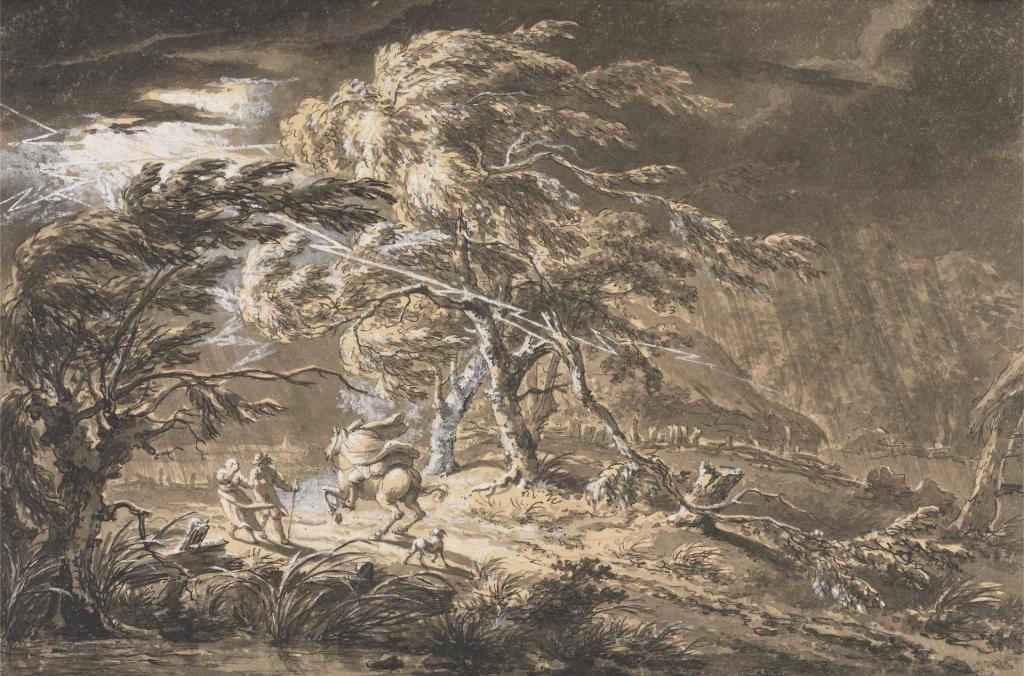
Heraclitean aphorisms rip across the mind like a lightning bolt.[1]
Fragment 60: ὁδὸς ἄνω κάτω μία καὶ ὡυτή. The road up and down is one and the same.[2]
My first encounter with this aphorism produced in me neither awe nor confusion; rather, it was an overwhelming sense of banality. This was the philosopher known for his obscurity, the riddle-weaver,[3] yet the statement felt so inane. Of course the road is the same road, regardless of which way one travels along it. The road is a mere object, mere material; in what way could the human pedestrian change the road by simply walking on it?
As I have gotten older, I have become less certain about this. I have begun to take notice of the experience that arises when walking down a familiar road from the other direction. There are certain paths which we travel frequently, but only in one direction; when this is reversed, one’s sense of space and place is destabilized. It feels as if one is experiencing something new, something which is only now being seen for the first time.
From 1957 to 1972, an eclectic constellation of European radical and avant-garde groups came together to form the Situationist International, which would produce, among many things, a technique of urban exploration known as psychogeography. As a reaction to the perceived sterility of 20th century urbanism, the Situationists encouraged the free, spontaneous wandering of the urban environment. In doing so, one purposefully subjects oneself to the otherwise hidden flows of the space, letting oneself be drawn along the trajectories carved out by the lived environment. Simultaneously, the practice of psychogeography is also one in which these flows are subverted through the intentional introduction of chance—the flipping of a coin to determine the direction one would turn at an intersection is but one example of this—forcing oneself to experience these urban flows as simultaneously familiar and foreign, human and alien.
Guy Debord (perhaps the most famous Situationist to the point of being almost synonymous with the movement) stated in the “Introduction to a Critique of Urban Geography” (1955) that psychogeography
is not inconsistent with the materialist perspective that sees life and thought as conditioned by objective nature. Geography, for example, deals with the determinant action of general natural forces, such as soil composition or climatic conditions, on the economic structures of a society, and thus on the corresponding conception that such a society can have of the world. Psychogeography sets for itself the study of the precise laws and specific effects of the geographical environment, whether consciously organized or not, on the emotions and behavior of individuals. The charmingly vague adjective psychogeographical can be applied to the findings arrived at by this type of investigation, to their influence on human feelings, and more generally to any situation or conduct that seems to reflect the same spirit of discovery.
So, insofar as psychogeography is based on materialism, the road itself is the same road; the road which, in the classical Marxist formulation, is the “objective nature” that conditions life and thought. The singular and simple substrate—the road—gives rise to a variety of different subjective configurations in the lives of the individuals who trod upon it. The road is the condition of lived experience, the basis upon which the psychic landscape is thus generated.[4]
All cities are geological. You can’t take three steps without encountering ghosts[5] bearing all the prestige of their legends. We move within a closed landscape whose landmarks constantly draw us toward the past. Certain shifting angles, certain receding perspectives, allow us to glimpse original conceptions of space, but this vision remains fragmentary. (Ivan Chtcheglov, “Formulary for a New Urbanism”)
The word here rendered as “road,” ὁδός, can refer to a physical road or pathway. But it can also mean travel, a journey, an expedition—the venturing forth to a new location. Ὁδός can be both the object and the activity, much in the same way that the path to and from a location is less the literal dirt upon which the person walks than the route overall, the lines of motion that connect two places in space.[6] One does not have to walk along the same spots to traverse the same path; the ὁδός is the space between, the yawning gap which bends like a bow[7] between two extremes.
The ὁδός as journey, then, is hardly one and the same. The journey undertaken by Odysseus to Troy was so uneventful that it is scarcely even remarked upon; the voyage back home to Ithaca, on the other hand…
When one embarks on an expedition, it is a venture into the unknown to return home again with new knowledge and new understanding. The traveller is changed in virtue of having made the journey; the one returning is not the same person as the one who embarked at the beginning. This is why some translators prefer to render ὁδός not as “road” but “the way,” the means by which one ascends upward and the same means of conveyance by which one then descends back down.[8]
The road may be one and the same, but what is encountered along the way is often completely different. The lines of flight occupy different trajectories, different velocities. The well traveled road is like the moon—something which only presents a single face—and when we see the dark side of the object, the side which is normally hidden to us, we are struck with the uncanny sense that “the true nature of a thing tends to hide itself.”[9]
We know that an object that is not consciously noticed at the time of a first visit can, by its absence during subsequent visits, provoke an indefinable impression: as a result of this sighting backward in time, the absence of the object becomes a presence one can feel. More precisely: although the quality of the impression generally remains indefinite, it nevertheless varies with the nature of the removed object and the importance accorded it by the visitor, ranging from serene joy to terror. (Ivan Chtcheglov, “Formulary for a New Urbanism”)
These different trajectories are therefore both spatial and temporal. The presence of all sides of the object are felt, even if they are felt as absent. The invisible sides fold around the visible. That which does not reveal itself is sensed as something haunting, even as it conditions us with its invisible and indefinite presence. After all, “How can anyone be overlooked by that which never sets?” (DK22B16).
Heraclitus the psychogeographer is thus concerned with both motion and space. The ὁδός, being both the objective nature of the material road as well as the motion of the journey along its surface, is bounded by two contraries in space.[10] The “up,” ἄνω, is tied up with the Greek experience of lived space; it is the climb up into the mountains that occurs when one travels inland away from the coast. The ἄνω is the motion inward and away from the boundary-space of land and sea,[11] which is in one sense a relocation away from this liminal zone[12] of geological dissolution into the security of terra firma while also being an ascent away from the inhabited places of human commerce and civilization.[13] The motion upwards takes one high above the human world and into the place of the gods; the gods living high up in the mountains, are able to see the world from above, a vantage-point which reveals that which is common rather than being limited by the provincial viewpoints of mere mortals.[14]
Paired with the motion up, ἄνω, is its antonym, κάτω. This is the motion down, the trajectory which takes one below or underneath something. It is the word for the descent into the underworld[15] and the direction toward the coast; the soul, having tasted the ambrosia of the gods on Olympus, thus becomes heavy and wet as it returns to the world of ordinary human life.[16] In going down, the soul retreats back into ignorance; it is the descent of the soul once again falling back into the human body.
Our Ancestor wandered the metaphorical mountains, the heights of spirit, and practiced the Wild wherever he roamed. Above all, and below all, in the city. He saw that nowhere are we closer to nature than at its wild center, if we can find it. (Max Cafard, Lightning Storm Mind, 19)
Heraclitus himself was a wanderer, a self-exiled philosopher. How, then, can he say that the path up and down is the one and the same? The road up: enlightenment, divinity; the road down: ignorance, animality.
Heraclitus says that these are μία καὶ ὡυτή; one and the same.[17] Why the repetition? If they are one, are they not identical?[18] If they are the same, are they not also one?[19]
The Situationists toyed with this same dilemma in their own psychogeographical investigations. On one hand, the great sickness afflicting modern urban planning was the relentless homogenization of space:
Darkness and obscurity are banished by artificial lighting, and the seasons by air conditioning. Night and summer are losing their charm and dawn is disappearing. The urban population think they have escaped from cosmic reality. (Ivan Chtcheglov, “Formulary for a New Urbanism”)
Space is becoming the same everywhere.[20] The homogenization of space means that the individual’s experience of the lived environment is entirely replaced with artifice in an attempt to remove the city from the necessities imposed upon it by “objective nature.” In being the same, it strips both the path up and the path down of the exciting, surprising, revolutionizing character that gives them their transformative powers. By making both the start and the end identical, space itself collapses into nothingness; no journey can occur when there is no change in the lived experience of the space along the way.
Simultaneously, the Situationists also called for a unitary urbanism; a mode of urban existence which broke down the imposition of the division of labor and distinct modes of life which coalesced geographically into the segmented, compartmentalized city.
All space is already occupied by the enemy, which has even reshaped its basic laws, its geometry, to its own purposes. Authentic urbanism will appear when the absence of this occupation is created in certain zones. What we call construction starts there. It can be clarified by the positive void concept developed by modern physics. Materializing freedom means beginning by appropriating a few patches of the surface of a domesticated planet. (Attila Kotányi and Raoul Vaneigem, “Basic Program of the Bureau of Unitary Urbanism”)
The alternative to the infinite spiral into increasingly private spheres emerges in the positive void created by the non-spaces between these realms.[21] The gods are born out of yawning chaos,[22] spiraling forth from the gap that sits at the heart of things. For the unitary urbanist, the city is inextricably many when it should be one; it represents a species at war with itself, rather than embodying the vital flux of the organic human community.
For the Situationist as much as the Heraclitean, the individual that turns away from the commons into a private world is the person who attempts to step into the same river twice (DK22B12, 91, 49a; cf. Plato, Cratylus 402a8–10). As Heraclitus says, we ought to live in accord with what is common (DK22B2); those who base their world on that which is private turn away from that which they are most continuously in contact (DK22B72). Donkeys, after all, prefer straw to gold (DK22B9).
The ultimate futility in the attempt to homogenize space encounters the same limit; it is the impossibility of making the same sun appear again (DK22B6). As such, the liberation of urban space is the realization of a genuinely human space wherein life can be experienced neither as the endless toil of work nor the private hell of the domicile, but in the inexhaustible freedom of freeform play. “We know that the more a place is set apart for free play, the more it influences people’s behavior and the greater is its force of attraction” (Ivan Chtcheglov, “Formulary for a New Urbanism”); “Time is a child at play, moving pieces in a board game; the kingly power is a child’s” (DK22B52).
I searched for myself. (DK22B101)
One of the great open secrets of mysticism is that the experience of attaining enlightenment is the realization that one was enlightened the whole time. The mystical journey is not a journey to somewhere new; it is the coming to awareness that one has been here the whole time. It is not the gaining of a new knowledge; it is the awareness that one had known this all along.
The road up and down is one and the same.
[1] I take inspiration from the excellent and highly eclectic reading of Heraclitus by Max Cafard in his book Lightning Storm Mind. I highly recommend it, even for those not particularly interested in classical studies. Cafard traces the contours of an anarchic Heraclitus, a Heraclitus whose thought is characterized by the radical refusal to be chained to the harsh bounds of necessity that characterized prior Ionian thought. The title itself is a riff on fragment 64 (DK): “Thunderbolt steers everything.” The lightning bolt (κεραυνός) is the epiphanic flash of Zeus—the one and only truly wise being in the world (DK22B32)—which manifests as a whirling vortex of fire that sets in motion the cosmic flux of all things. Like in Anaxagoras, God works on the world through stirring it into order (DK22B125; cf. DK59B9, 12–14); an order which itself can only be sustained as a whirling, unceasing centrifugal motion.
[2] English translations hide the terseness of Heraclitus’ prose here. Robin Waterfield renders it differently: “Road: up and down, it’s still the same road.” But even this introduces much more in the English to smooth things out. Road up, down; they are identical is perhaps the most literal rendering.
[3] Diogenes Laërtius quotes Timon of Phlius’ rather negative appraisal of Heraclitus: “In their midst uprose shrill, cuckoo-like, a mob-reviler, riddling Heraclitus” (Lives of the Eminent Philosophers IX.6). As a riddler, Heraclitus is something of a Pythagorean, despite his criticism of the school’s founder as κοπίδων ἀρχηγός, “the chief of swindlers” (DK22B81). In another interesting parallel, after his revulsion toward his fellow Ephesians became intolerable, Heraclitus “wandered on the mountains, and there he continued to live, making his diet of grass and herbs” (Lives IX.3).
[4] DK22B45: “Even if you travel every road, you will not be able to discover the limits of soul (psyche); so deep is the principle (logos) it contains.” The road is finite, being bounded on both ends by antipodes of origin–destination. In contrast to the unidimensional road which functions as the concretization of kinetic velocities in finite space, the psyche is planar and unbounded. The psyche in modernity is the singularity, the dimensionless point which constitutes experience in the projection into space—for the ancients, psyche is planar because it, rather than constituting its own inner experience, is best understood as the place within which thought occurs. Put plainly, the ancient psyche is not the thing which is the source of thinking, but rather the space within which thoughts appear and announce themselves.
[5] DK22B88: “It makes no difference which is present: living and dead, sleeping and waking, young and old. For these changed around are those and those changed around are again these.” Presence is always the presence of a certain unstable appearance, the chasing of fragmented images as they undergo transformations into their reciprocal opposites. In this regard, space is best understood not as something independent of time: space is the sedimentary accumulation of historical time(s).
[6] The Czech philosopher Vilém Flusser remarked that our inner organization of space is inextricably and inescapably bilaterian: “WE ARE LIVING TUBES (WORMS). The world flows in through one of our openings (the mouth) to flow out again through the other opening (the anus). This is why we can distinguish between ‘forward’ and ‘backward.’ Most of us are bilaterally symmetrical, and this is why we can distinguish between ‘right’ and ‘left’ (though some of us, like sea urchins, are too many-sided to do so). Originally we all crawled forward and backward, and left and right, on the beach of some Precambrian ocean, and thus there was no need or possibility for us to distinguish between ‘upward’ and ‘downward.’ Somewhat later some of us (the birds and insects) took off from the ground, and some others (the cephalopods and humans) stood upright, though still sticking to the surface. For those who had taken off, a sphere of dimensions like ‘up to the right’ or ‘down behind’ opened up; for those who began to stand upright it was instead a hemisphere that became accessible to locomotion. This may be taken to be a description of vital space, of which all other kinds of space are either derivatives or abstractions. If you consider the hemisphere of human space you will find that it looks more like a box than a bowl, because it is shallow. We can measure the length and breadth of the space we cross in thousands of miles, but until quite recently the height of our space only measured a few yards and its depth but a few inches. This wide and long but shallow box that is our vital space is better suited for geometry (measurement of the ground) than for topology (science of space), because it consists of two dimensions to which a third has been added. We upright worms think geometrically; equations of the third degree make us nervous, and we had better leave topology to birds, bees, and angels” (Flusser, “Three Spaces”). Rupturing forth out of Cambrian biotraumas, our primordial spatial orientation follows the unidirectional flow of our gut. The motion inward is digestion; outward, emesis. The move to abstraction—that which gets us beyond linear space into the unbounded three-dimensionality—is on one hand a kind of angelic depersonalization that conceived of itself as an escape from the corporeal constraints of the vertebrate lifeworld and, on the other, a convulsing disgorging of the contours of our inner space into the otherwise pristine territory of the pure mathematical concept.
[7] As Heraclitus says, “they are ignorant of how while tending away it agrees with itself—a back-turning harmony, like a bow or a lyre” (DK22B51). The road is a line which sits upon a non-Euclidean space; in going one way, one is simultaneously pulled back to the start. The road is the same road precisely because, in reaching one extreme, one finds themselves having traversed no distance at all.
[8] It should be no surprise, then, that ὁδός is taken up in Christianity as “the Way,” the path of spiritual transformation and the means or method of the soul’s salvific journey. When Christ says “I am the Way, the Truth, and the Light,” he declares himself ἡ ὁδός (John 14:6).
[9] DK22B123: φύσις κρύπτεσθαι φιλεῖ. This is not, as the fragment was often translated, “nature loves to hide itself.” Daniel Graham makes the convincing case that φύσις is not “nature” hypostasized as the organic whole of living reality, but rather the individual nature of a thing. Similarly, φιλεῖ, which is often translated in its literal sense as “loves,” should be understood idiomatically, connoting a tendency or inclination. The inner nature of things recoils inward, away from outward appearances. After all, non-apparent harmony is better than apparent harmony (DK22B54).
[10] “Revolutionary urbanists will not limit their concern to the circulation of things, or to the circulation of human beings trapped in a world of things. They will try to break these topological chains, paving the way with their experiments for a human journey through authentic life” (Guy Debord, “Situationist Theses on Traffic”). The Situationist impulse is one which seeks to liberate motion, here understood at the circulation of things and people (M-C-M’), from the finite space of a closed totality to the infinite space of Ionian cosmology. While Parmenides secured Being on all sides by divine great bonds (μεγάλων … δεσμῶν; DK28B8.26), it was Melissus who, like Hercules freeing Prometheus, declared his “what-is” to be infinite and unlimited (DK30B2–4).
[11] The coast is the place of elemental transformation, the location where the solid matter of earth cascades into the fluid swirl of the endless ocean. It is at these places that the underlying principle—fire—reveals itself in the form of lightning: “the turning-points of fire: first sea, and of sea half is earth, half lightning. Sea drains off and is measured into the same principle as before it became earth” (DK22B31; cf. B126). With our feet firmly planted on the ground, we gaze across the infinite sky and sea.
[12] “Even if, during a transitional period, we temporarily accept a rigid division between work zones and residence zones, we must at least envisage a third sphere: that of life itself (the sphere of freedom and leisure — the essence of life). Unitary urbanism acknowledges no boundaries; it aims to form an integrated human milieu in which separations such as work/leisure or public/private will finally be dissolved. But before this is possible, the minimum action of unitary urbanism is to extend the terrain of play to all desirable constructions. This terrain will be at the level of complexity of an old city” (Guy Debord, “Situationist Theses on Traffic”). The constraints of a transitional period require transitional zones, but a liberated society is one in which the boundaries marked out by private property are dissolved into the élan vital of an organic mode of existence. After all, as Cafard reminds us, “it is instructive that the word ‘idiot’ comes from the Greek idiotes, meaning both ‘an incompetent person’ and ‘a private person.’ Privatization is idiotization” (Lightning Storm Mind, 23). This third sphere, the sphere of life, is one which reconciles the antipodes of work–play by bringing them into the primordial unity of that which is common (cf. DK22B2, 89).
[13] According to Diogenes, “[Heraclitus] would retire to the temple of Artemis and play at knuckle-bones with the boys; and when the Ephesians stood round him and looked on, ‘Why, you rascals,’ he said, ‘are you astonished? Is it not better to do this than to take part in your civil life?’” (Lives IX.3). The game of knuckle-bones is a far better pastime than politics, after all. Cafard takes note of the significance that the temple of Artemis plays here—Diogenes explicitly says that Heraclitus dedicated his book On Nature to the goddess and placed it in her temple—because of her connection to both children and the wild. On Cafard’s reading, “hers is the realm not only of childbirth and generation, but of children and childhood. The World of the Child, and the World of the Wild. Single-minded commentators keep this resolutely out of mind while being scandalized by Our Ancestor’s wise counsel to turn the city over to children and his healthy propensity to roam the wild” (Lightning, 110). According to Heraclitus, “the Ephesians deserve to be hanged, every last one of them, and to leave the city to boys” (DK22B121).
[14] To a man, a child is utterly ignorant; for a daimon, a man is even more so (cf. DK22B79). One of the often unmentioned goals of the Situationists was to try to incorporate this cosmic perspective back into the fabric of everyday life. “The latest technological developments would make possible the individual’s unbroken contact with cosmic reality while eliminating its disagreeable aspects. Stars and rain can be viewed through glass ceilings. The mobile house turns with the sun. Its sliding walls enable vegetation to invade life. Mounted on tracks, it can go down to the sea in the morning and return to the forest in the evening” (Ivan Chtcheglov, “Formulary for a New Urbanism”). Rather than treating the whole of the natural world as an object to be overcome, we ought to be constantly bombarded by the subtle rays of our cosmic conflagration.
[15] On the one hand, “what awaits men after death cannot be anticipated or imagined” (DK22B27). On the other, “souls sniff in Hades” (DK22B98).
[16] That the underworld is associated with the coastline is in part due to the detrimental effects Heraclitus attributes to wetness accumulating to the soul. A dry soul is wisest and best (DK22B118), while the ignorant stupor of a drunk man is due to the moistness of his soul (DK22B117). Gábor Betegh investigates this peculiar connection between fire and the soul in two articles which I highly recommend, “On the Physical Aspect of Heraclitus’ Psychology” and “The limits of the soul: Heraclitus B 45 DK. Its text and interpretation.”
[17] Μία is simply the feminine form of εἷς, “one.” The first numeral in Greek mathematics, εἷς is the singularity of the first principle, the primordial unit out of which all plurality is derived (Chrysippus was an exceptional rarity among the Greek philosophers for declaring that one, too, was a number; the standard opinion that the term number, being a defined ratio measured in a finite unit, could only be applied to integers from two onward). Ὡυτή is also in the feminine nominative declension, though the more well-known form of the word is its Attic root, αὑτός, “the same.”
[18] If the One is not self-similar, then it is contains within itself the two. The One cannot be anything other than perfectly identical with itself, otherwise it is not the One, but the Many.
[19] If two beings are the same in some sense, they are in that respect One; what makes them common is that they have the one shared in two places, in two instantiations. If they are the same in all respects, then it cannot even be said that the same One is present in two places, because then they are not the same in place. If they are the same in all respects, they are not Many, but One.
[20] “The development of the urban milieu is the capitalist domestication of space” (Attila Kotányi and Raoul Vaneigem, “Basic Program of the Bureau of Unitary Urbanism”); “a mental disease has swept the planet: banalization” (Ivan Chtcheglov, Formulary for a New Urbanism).
[21] The concept of the positive void is prefigured in ancient atomism: the void is the space into which atoms can move. It is not defined primarily as being a space which exists independently of motion. Rather, it is the condition of possibility for motion to occur and, therefore, is the womb which gives birth to the infinite worlds of the atomist universe.
[22] “Verily at the first Chaos came to be, but next wide-bosomed Earth, the ever-sure foundations of all the deathless ones who hold the peaks of snowy Olympus, and dim Tartarus in the depth of the wide-pathed Earth, and Eros (Love), fairest among the deathless gods, who unnerves the limbs and overcomes the mind and wise counsels of all gods and all men within them” (Hesiod, Theogony). In the beginning, all things rested upon the primal waters bed; from this, the whole cosmos.
 Hyperspekulation
Leave a comment