By Yanis Iqbal
In the essay “Existence and Death,” Alain Badiou presents a critique of what he calls “ante-predicative” theories of death. These theories secretly elevate death into a constitutive power lying beneath or beyond determinate beings. Whether in the guise of Bergsonian life, Heideggerian finitude, Sartrean nothingness, or Deleuzian becoming, death ceases to be a simple limit encountered by finite beings and becomes the very operation through which an underlying over-existence manifests itself. The death of singular beings then testifies to the superiority of a deeper process that survives them. Every disappearance says, in effect, what Badiou sarcastically formulates as: “I, life, exist.” Death thus becomes the transcendence through which finite beings are subordinated to an impersonal power of Life, Becoming, Spirit, or Difference.
Jean-Luc Nancy’s “The Heart of Things” offers a remarkable escape from precisely this schema because death never acquires such constitutive dignity. The thing does not emerge from a primordial Life, nor does it derive its truth from Death. Instead, it appears through the sheer contingency of a “there is,” through what Nancy calls the thing’s co-incidence, the fact that “the thing co-incides: it falls with itself on itself, in itself.” This fall is neither a descent from a higher principle nor an expression of a deeper process. The thing does not fall from Life, nor toward Death. It falls only into its own taking-place. Its coming and its place coincide so completely that “only its fall and its coming make the here.” So: neither the transcendence of death nor the persistence of life, but the singular event whereby something occurs, whereby there is, here, this thing.
Nancy’s entire effort consists in remaining faithful to this discreet occurrence before it is translated into a metaphysics of origins or ends. The thing does not express a hidden power that survives it. It does not bear witness to an underlying élan vital. It does not announce, through its mortality, the triumph of some generic process over its particularity. Instead, it simply arrives, exposing itself in the nakedness of its own “here.” For this reason Nancy can insist that finitude does not signify mortality in the first instance. Ordinarily, when one speaks of finitude, one almost immediately thinks of mortality. A being is finite because it dies. Death appears as the final truth of existence, the horizon against which every life acquires its meaning. Nancy wants to reverse this entire order of thought. He wants to think a finitude more primordial than mortality itself, a finitude that belongs to existence before any opposition between life and death has been constituted.
This is why he places “Life” and “Death” in quotation marks. He is speaking neither of biological life nor of empirical dying. He is speaking of two great metaphysical figures. “Life” names the fantasy of a self that possesses itself, gathers itself into itself, appropriates itself completely. Hence Nancy defines it as “the absolute antecedence of self-appropriation.” Life, in this metaphysical sense, would be an original fullness, an absolute self-presence preceding every loss, every fracture, every exposure. It would be the dream of a being that already belongs to itself before it encounters anything else. Such a conception haunts many philosophical systems, whether in the form of Spirit, Substance, Subjectivity, Nature, or History. In every case, existence would emerge from an underlying power of self-coincidence, from a principle that already possesses itself before appearing.
Death, conversely, would be the inverse figure. If Life represents perfect self-possession, Death represents the catastrophe of that possession. Hence Nancy defines death as “this appropriation’s absolute failure to pass itself on.” Death appears as the moment at which the self can no longer maintain itself, can no longer carry itself forward into the future, can no longer transmit its own presence. Yet death remains caught within the same conceptual economy as life. It remains merely the negative counterpart of self-possession. Death appears as the failure of what life sought to accomplish.
Nancy’s gesture consists in showing that existence belongs neither to one side nor to the other. Existence neither begins from complete self-possession nor ends in its simple collapse. Existence occurs elsewhere. Or better: it occurs in the spacing between these categories, in a dimension that they fail to capture. This is why he writes that existence appropriates itself only “in the discretion of the ‘there is/there occurs something’ and the ‘there is not/there no longer occurs anything.’” The crucial word here is discretion. Existence does not seize itself. It does not gather itself into a substantial identity. It appropriates itself discreetly, silently, almost furtively, in the simple occurrence of a “there is.” Something takes place. Something arrives. Something is exposed in the world. Then something withdraws. Something ceases. Yet neither occurrence nor withdrawal belongs to a process of self-possession. The thing exists in the interval itself.
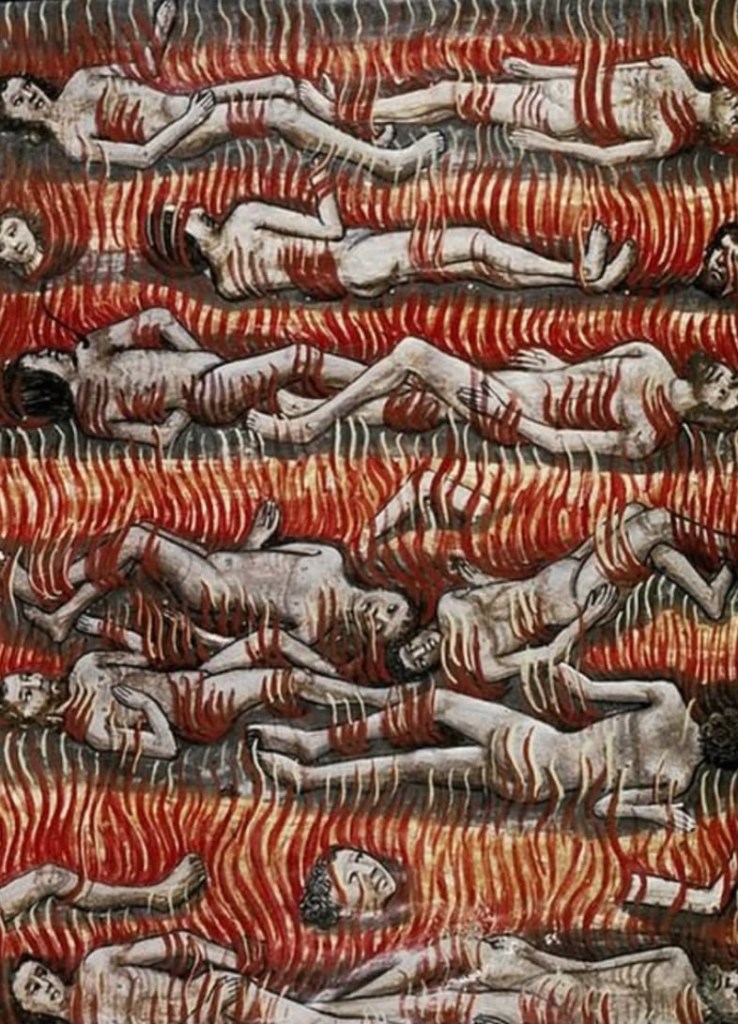
One might say that Nancy is attempting to think existence at the level of its sheer advent. Before life becomes a property of a subject, before death becomes the negation of that property, there is the simple event that something appears. A thing comes. A thing lies here. A thing occurs. The miracle, if one may still use such a word, is neither that the thing lives nor that the thing dies. The miracle is that there is this thing here at all. Ontology begins from this astonishment. It begins from the bare fact of a singular occurrence whose reason remains withdrawn into the occurrence itself.
This is why Nancy repeatedly returns to the motif of the “there is.” The phrase “there is” designates existence before every substantial determination. One could almost say that the thing is nothing other than a “there is” that has taken place here. A stone, a tree, a body, a thought, a memory, a voice: each exists as a singular inflection of this event. The thing is the local crystallization of existence’s occurrence. Its truth lies neither in an eternal essence nor in its eventual disappearance. Its truth lies in the finite exposure of its being-there.
Death enters this picture only in a very peculiar manner. Death belongs to existence because existence is finite. Yet death never becomes the truth of existence. Nancy carefully refuses such a move. The truth of existence is existence itself. Death marks a limit internal to that truth, though it never reveals the truth. Indeed, death cannot reveal anything because, as Nancy says with remarkable force, “there is no there for death.”
This phrase deserves prolonged attention. Everything that exists possesses a there. Every thing has a site, a position, a singular exposition. Even absence possesses a certain place within experience. Death alone lacks such a there. One can witness a dying person. One can see a corpse. One can experience mourning. Yet death itself never appears. Death never presents itself as a thing among things. It has no phenomenality of its own. It withdraws precisely where appearance ceases. Hence death can never become an object of possession, knowledge, or mastery.
This is why Nancy speaks of “an extreme reserve, an extreme discretion of and toward death.” Death must remain reserved. Every attempt to transform it into a substantial reality falsifies it. Religious metaphysics transforms it into a passage toward another life. Existential pathos transforms it into the supreme revelation of authenticity. Dialectical thought transforms it into a moment within a larger process. Nancy seeks something else: a thought that leaves death in its withdrawal. A thought that recognizes death while allowing it to remain inaccessible.
At this point one begins to understand the extraordinary final formulation: “Here is exposed the finite, and the infinite exposure of the finite.” The finite is infinitely exposed because it never closes upon itself. Every thing exists as an opening. Every thing arrives from a withdrawn origin and departs toward a withdrawn limit. Neither origin nor limit belongs to the thing as a possession. The thing possesses only its exposure. It possesses only the event of its taking place. Thus finitude is not a deficiency awaiting completion. It is the very opening through which existence occurs.
Death therefore marks the edge of this opening, though it never fills it with meaning. Death traces the limit of exposure without ever becoming exposed itself. It belongs to existence as its withdrawn extremity. Yet existence remains irreducible to death because existence consists, first and last, in the astonishing fact that something takes place, that something comes into presence, that there is, here and now, some thing. The deepest truth of finitude lies in this fragile occurrence, this discreet advent of a “there is,” whose mystery is neither life nor death but existence itself.
Where the positions criticized by Badiou transform death into an ante-predicative power operating beneath beings, Nancy relentlessly returns thought to the surface of existence itself, to the irreducible fact that something lies here, that something takes place, that a thing falls into its own occurrence and, in falling, coincides with nothing deeper than the exposed singularity of its being-there. In this sense, the heart of things beats neither with Life nor with Death, but with the infinitely finite event of a “there is.”


Leave a Reply