By Gary Hussey
About the Project
Monochromatic Intensities is an ongoing photographic and textual exploration of post-socialist Hungary, examining how the material textures of everyday life—its infrastructures, monuments, industrial remnants and overlooked spaces—continue to shape perception, memory and political imagination. Developed through repeated visits to the same locations over changing seasons, the project approaches photography not as a means of documenting places already understood, but as a practice of lingering with encounters that resist immediate recognition.
The project has increasingly found resonance with Gilles Deleuze’s notion of the “being of the sensible” in Difference and Repetition. Rather than beginning from what is already known, categorised or rendered legible, these essays are interested in those fleeting moments in which something interrupts habitual perception and compels thought to begin anew. Photography becomes less a technology of representation than a method of remaining with such encounters before they settle into familiar meanings.
Working across image and text, Monochromatic Intensities explores the entanglements of post-socialist landscapes with memory, analogue photographic processes, neurological experience, ecology, music and the temporal layers that continue to inhabit contemporary urban life. Rather than offering definitive interpretations of these places, the project seeks to remain attentive to their unresolved qualities, asking how different ways of seeing might disclose different ways of imagining collective life.
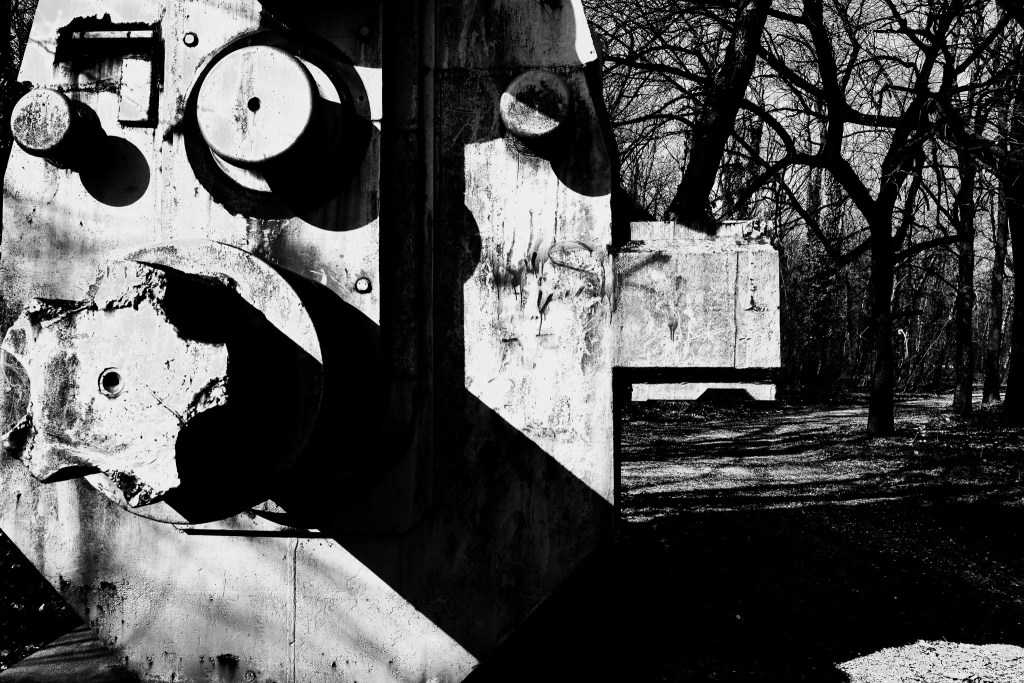
The machines were waiting. The light was dying. And the two rolls of film in my pocket were urging me to get going; they knew that the darkening mid-summer skies would push them to their chemical limits. Yet, a force – or forces – conspired to delay my departure from Kelenföld vasútállomás, one Budapest’s major transport hubs to Dunaújváros a city approximately 70 kilometres south of Budapest, or about an hour by train. This trip to Dunaújváros had a routine. The city stands as a remarkable, indeed exemplary, example of 1950s socialist planning as well as socialist modernism more broadly. Initially taking the name Sztálinváros after the Soviet leader, underlines where the city featured in the hierarchy of large scale socialist projects in Hungary. Sztálinváros was grounded in a utopian vision of urban design; a site orbiting around huge steelworks, and designed to be a liveable proletarian city.
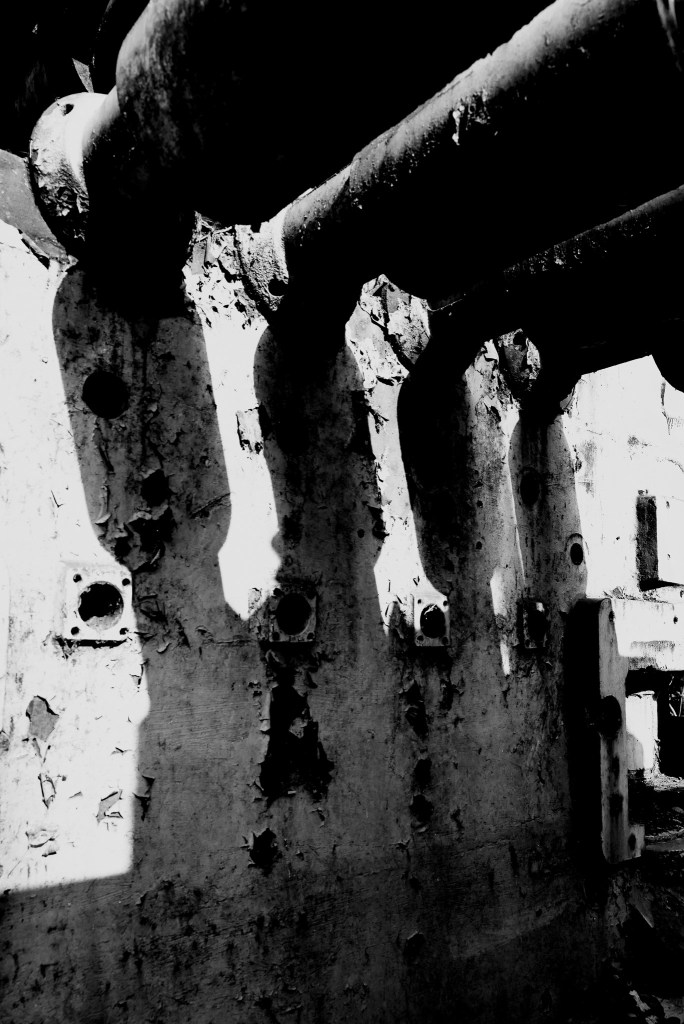
The great interpolative pull which had repeatedly dragged me to this post-socialist and, perhaps now, almost post-industrial city, are the uncanny machines that lay scattered along a path that cuts through a woods which brushes against the impressive industrial complex around which the town was built (for an essay on my first winter visit to the site see monochromaticintensities.com). These massive machine bits are fragments from old socialist era factories and helped form the incessant cacophony of production, of giant gears, of screeching and clashing steel surfaces, the hammering of new forms into existence, of an immense background hum which spread itself outwards like protective wings over a town whose people depended on the continuation of this constant though comforting aural assault. Much like how the roar of the sea sounds to a fishing community on the Atlantic Irish coast where I spent my formative years.
My first encounter with these machines was strangely exhilarating. They stand more like biblically accurate angels rather than intelligible factory fragments – in part because the colossal assemblages which these collections of metal teeth and angular steel shapes are not present to us. One can imagine shepherds cowering before them, with a strange voice filling the entire scene with the words ‘Do not be afraid!’ They are an in-breaking into our world. They do not exist behind, as in the past or beyond; but as part of a different universe. This world they hail from is entangled with our own. They are not only spectres that haunt us, to invoke the usual clichés of cultural memory discussions, but we also haunt them. They are tokens of a future that did not arrive, but so are we. We have become something alien to the world that these machines, as nodes within networks of means and modes of production, provided material-ontological anchor points. They no longer recognise us. Our dreams have become opaque to them.
I first took the train to Dunaújváros in the late-winter of 2026. Then, the machines seemed comfortably nestled in the stark though still dense woods. They could breathe. They were imposing. These machine parts are intentionally emplaced along the wooded walkway which lies just beyond the factory complex boundaries. They stand as sculptures and monuments of a different kind; a mode of post-socialist memory that is of a distinct order from the sober encounter at sites such as Memento Park in Budapest. Memento Park, an extensive outdoor museum park for which I am an ambassador for, has also been the site of my repeated photographing. At Memento many enormous statues from the socialist period are quarantined as sorts of spectral and material remainders of the past. Again, on any given day, the experience of these often overwhelming monuments will shift in accordance with environmental conditions. A visit to the park when it is bustling with families on a mid-May Sunday will are remarkably different from a cold snow covered morning in early-January.
My compulsive re-turnings to the same sites, then, has taken a methodological and epistemological shape. The photographic imperative, then, lies in repetition – or more so, its illusion – and less the famed and elusive ‘decisive moment’ which has organised much of the most striking examples of street photography, for example. The point here, if not the main one, is that photographing the post-socialist spaces of everyday life, spaces which have been re-articulated and re-territorialised under capitalism and presume different subjectivities and temporalities, is that such spaces can fleetingly become more sensible – and maybe by such methods we can hold this rent in the given for a moment longer – before it becomes ordered under the sign of the legible. The purpose of such a delaying of legibility? Well, that is to tarry with dislocation and radical contingency. And to put it simply, other configurations of the social/space were once operative and others can be seen in a prefigurative glimpse if we can halt the autonomic reproduction of sensory experience of the given and the governmental logics which undergird these realities. As Deleuze (2023) plainly insists ‘Something in the world forces us to think. This something is an object not of recognition but of a fundamental encounter… It is not a sensible being, but the being of the sensible. It is not the given, but that by which the given is given… Its primary characteristic is that it can only be sensed. In this sense it opposes recognition.” This is tense and fleeting space in which this essay resides, the rent in the given, before the axiomatic takes custody of our experience and distributes it according to the constitutive empirical facts, whose claim to truth is nothing more that appealing to their own ground as a self-sufficient
During my last visit to Dunaújváros I was accompanied by a masterpiece of optical performance and engineering, that is, the Lecia Q2 camera. This time, however, coincides with the phase of this project were digital has been reluctantly scrapped in favour of analog. This is not some nostalgic celebration of film photography. I am agnostic on such questions. I hope that I have not pursued a trend, and instead this turn has been about process. Analog film photography not only provides a sometimes productive resistance (though just as often a sometimes decidedly frustrating unproductive resistance). But of greater significance here, it provides a processual trace. No repetition is ever the same. The iterative process of photographing the same sites with analog, the non-repeatable nature of this process comes to the fore. Light collides with the silver halide of the film differently in a given moment. Too much of this connection and the film becomes obliterated. Slight variation in chemical development from the developer used, to chemical temperature, to drying times will all impose their contingencies on the outcome of the images produced. What is more, and I understand this less as a mistake to be corrected, flecks of dust will cling to the drying film strips – again, adding their own temporal layer to the process which always remains partially unrepeatable despite it iterative character – it thus remains always ungovernable. Furthermore, that temporal and spatial distance from the time a photograph is taken to when it is finally developed, and in my case, scanned, also serves to dislocate our sense of space. When the image of what was taken asserts itself through the developer it reaches through the layers of time that have passed since the shutter was pressed; it is as if the rendered ‘thing’ comes up for air. The viewer will readily discern the difference between the digital and the analog film photographs presented here.
The reason for my delayed departure from Budapest was that the icons of heavy metal, Metallica, were in town. It was strange and slightly melancholic experience not to be counted amongst the sea of Metallica t-shirts, the best of which bore the classic artwork of Pushead – an artist closely associated with the band throughout much of their history. The graphic style of Pushead as an artist conjures 1980s thrash metal, hardcore punk, skater culture – all that once seemed to rail against prevailing conservative cultural norms. The work of Pushead, which in some form was always ready-to-hand during my years of fanatical Metallica fandom, was once part of my aesthetic experience of everyday life. Seeing the heaving masses of these images moving through the city, and being distinct from this crowd, brought a sense of exile.
For me, as for countless others, Metallica provided cathartic relief and direction to adolescent confusion and anger. The barrage of riffs compelled us forward; encouraged us to pick up guitars like a mantle and shield and contort our fingers in strange and painful shapes to recreate the same sounds that had assaulted our and especially our parents’ ears. Yet, as those early years rolled on, and my music vista expanded, the confusion and bouts of anger, followed by collapses into a deadened nihilism and despair remained and indeed only intensified. The soundscapes had changed. The emotional landscapes only became more severe. The enthusiasm for the sounds that made the up the rather well-worn (and behind it all quite safe) iteration of teenage rebellion, turned out less to be a phase but rather the starting gun from which one could chart a descent into somewhat disordered life of bipolar. I still prefer the term ‘manic depression’. It captures the ruptured sense of existence – its violent oscillations. So maybe looking on at the aging figures who once were nothing less than idols, is to re-trace my own course. While they are now in their sixties, and I just turned forty, my body and face too tell a story. Maybe this is why I lingered on in Budapest despite that I was determined to get to Dunaújvaros. I wanted to at least hold on to a feeling when this inner thing was merely highs and lows of an adolescent life lived in a fairly fulsome way. But the fact that I was moving away from the city, and that I had not bought tickets, was a real acknowledgement that I knew that whatever I might seek out in a Metallica concert today could not be (re)captured. Whatever I now carry, exceeds and does not answer to the power of the riff.
I can feel a dense knottedness. The brain is a site of competing and interrupted desires. Deeply encoded memories, fragments of which are brought together and summoned to consciousness. Recent experiences of Budapest, including a bipolar relapse, are being grafted to these older fragments as they make their way to the front of my attention. This inner sea is formally inscribed within the boundaries of collagen and calcium phosphate, the stuff and textures of the skull. Despite this definitive measurability, this site at least appears to be of expanse that is unknown in its depth, or, perhaps, shallowness. Phenomenologically speaking, it presents as a sea of older and deeper currents, and its newer insurgent surface waves grasp for form, struggling to reach beyond the temporal lobe and into those deeper regions where sensation and fleeting images become the material of self and its archive. This turbulent sea is also being called to calm by a chemical cocktail I am sometimes reluctant to admit the efficacy of. Today, though not as diluted as the potency of a thrash riff, the power of the expertly crafted prescription has its limitations too it seems. Yet, those who are similarly affected as I am, for whom this medical alchemy is out of reach often die in despair and in want for these cryptic scripts. Such secret spells are denied by the various modes of social murder that overdetermine not the medical science as such, but its distributions and financialisatons which allocate the boundaries life and death. The (not so hidden) death worlds of neurochemical and pharmacological apartheid. Lately, due to an inappropriate medication being prescribed, I felt as though an electric fishing net had caught itself on one side of my face and skull. This net would become entangled in external objects, and the more I pulled the greater the intensity of the shock. Bright lights of a passing car would speed past this neural net dragging and would feel that it was ripped from its place and falling out onto the street; forming impossible connections. Attention wrapped around a streetlamp, pooled around an abandoned doorway – before it is then spooled back into place. Similarly, as the low sun forced its way through the dense evening woods and peaked over the uncanny machines at Dunaújváros, the light would also set off this electric face-grid. The light, strangely for a photographer, in this instance had become an enemy on two counts; I need just enough light to see, to render shapes, but not enough to expose the senses to that which perpetually seems to assault them. My own intensities, perhaps, looking to take root and ontological anchorage in these giant machines drove me once more out of the city towards these blocks of iron – even when the time of day was no longer ripe.
When I finally got on the train, having weaved through the crowd of fans moving in the opposite direction, I had a sense that my memories of the time Metallica conjured, the faces of friends and the countless hours spent in their easy company, could not be transposed on to life in Budapest. My memories were of a different cartography, a map sometimes faint and hardly legible and other parts being hyper saturated and still accessible, was of little use in contemporary Budapest – especially when my history of fandom and the friends with whom I concelebrated the associated rituals, are no longer immediately present – is of a different world; a discrete and bounded temporal layer. To see Metallica now, without such camaraderie, would be like listening to the band in a different key – interesting for sure, but not the same. Plus, in a needless addendum, the hyper-capitalist manner in which an immense roving touring band like Metallica operate, which seems to chaff against all that made them seem dangerous, has hollowed out the experience for many fans who feel the fan has become merely a site of extraction.
Prompted by all things Metallica, with large noise-cancelling headphones waiting in place, I scroll through the phone to find something heavy and loud- but not Metallica as that would seem to fall prey to nostalgia. Instead I opt for a band I have barely listened to, who go by the rather visceral name of ‘Cattle Decapitation’. Contrary to what their appellation suggests, this death metal, gore-grind, or perhaps technical death metal band depending on who you ask, rail against the anthropocentrism which is the source of immense cruelty and violence inflicted on animals. The music is brutal and compelling, and most importantly for now, fully immersive. It drowns out the din of loud children and the regular acoustic rhythm of the train. It smothers that cognitive static that has built up. Cattle Decapitation offer an intense soundscape where humanity is doomed – and crucially whether this is deemed good or ill is left (to put it conservatively and for all their obvious sense of humour) yet to be determined. The band’s vision is at times nihilistic, where human hubris has ushered in an era of cascading ecological crises. The album I’m playing is 2019’s Death Atlas. It ominously cites climate reports from 2018 which in 2026 give the impression that it is already too late. Given my mood and destination, Decapitation provide an appropriate and total soundtrack.
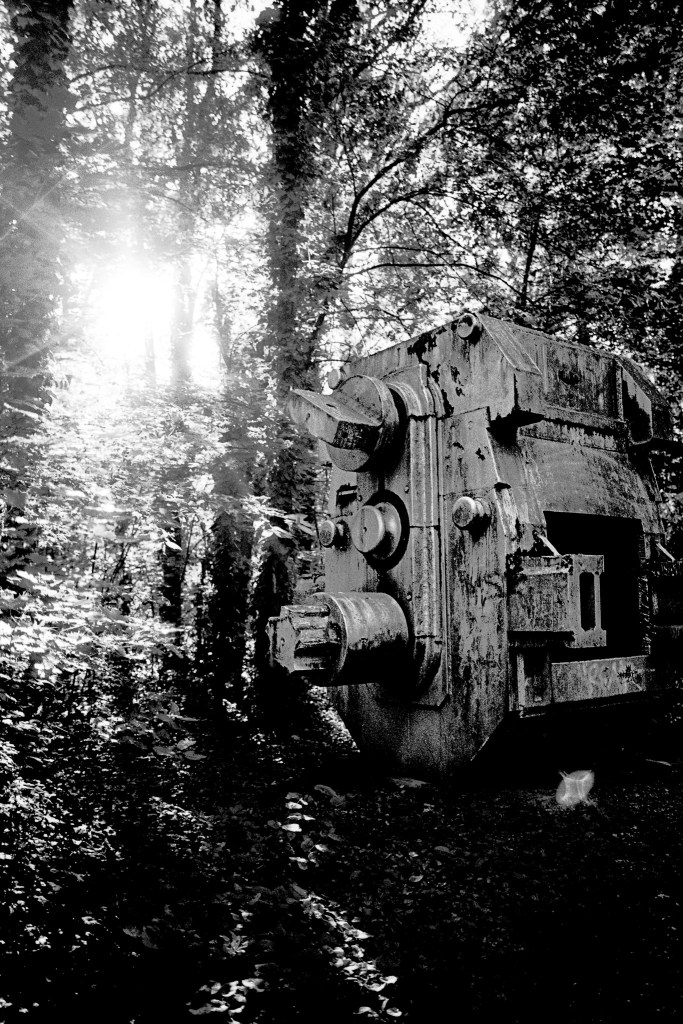
Whatever I was hoping to find on occasion at Dunaújváros was absent. I had charted how the change of seasons, from the deep snows of winter to abundance of summer growth, impacted the experience of Memento Park. Here, too, I thought I would have an approximate experience. While the communist era monuments of Memento Park were all the more stark in winter, forming part of landscape from a lost world, in summer they become more entangled and emplaced within the landscape they are part of. Here, in Dunaújvaros the opposite was the case. Amongst the bare winter trees, these massive industrial artefacts seemed more organically part of these environment than they are in summer. While of course their strangeness remains arresting, and as previously discussed, dislocating. Now, with the summer having since exploded out of the winter landscape, these machines are strangled by foliage, smothered under the density of the forest. These machines look even more decayed. They appear more lost and discarded, washed up on a hostile shore. They look less the objects of careful curation and instead look like that some massive angry thing has thrown them across the factory wall. The have been overwhelmed by forces greater than themselves. Here, they truly look like post-anthropic ruins, rather than provoking a merely post-human encounter. They no longer raise questions about the human and the machine, where one begins and the other ends. These sculptural fragments, choked by the environment, cannot remember the time from which they hail or the hands that made and worked on them. Humanity and human-ness appear forgotten and overpowered. My presence seems unwelcome, as I appear as a ghost of that which has been conquered. This is not only a landscape of the past, it is a spectre of the future. Given the fires that are sweeping through the European continent, this dense all-engulfing woods which ever-tightens its grip on these machines may well be preparing itself as kindling-to-come for a fire that will further erase the trace of the human.
We are animated by dreams that have a terrible will to power. Powers that flow through us which we do not yield. Instead they bind us, not to dreams of liberation, collective or individual; But to dreams of sameness – of predictability and stability. Of a future which is an extension of the present. What is this present? It is a mode of spatial and imaginative closure, where space is governed by a ‘structural law of succession’, to put in it Ernesto Laclau’s controversial though misunderstood formulation of the spatial. All that appears as new, seems merely a tool to preserve the present order of things. Production is about re-production. The event becomes pattern. The new powers of the machine and the wizards of techno-capital for all their promise of radical reconfiguration, merely promise the deepening of existing relations of power. All machines have terrible dreams of power. The ultimate and terrible fantasies of power revolve around legibility. It is about a enforcing of a cartography of the visible, or what is known, what is measurable. But our dreams are terrible too – they must be, for all dreams are terrible in the eyes of someone. But our modes of collective dreaming will need to become differently terrible, so that today’s and tomorrow’s machines along with their masters will no longer recognise the subjectivities they tried to govern. Whatever that means, I remain unsure. But it will require making the given sensible and the destruction of the legible.
As the train rolls back along towards the journey’s terminus of Budapest, though deeply tired I have been marked by the counter with, as already asserted, not only the post-human but the post-anthropic. What this means for the complex entanglements I feel both constituted by and nestled within, I am not so sure. But disentangling the neurochemical, the pharmacological, nostalgia, despair and something like its opposite – but not hope, unruly ecologies, and the machine seem to be unreasonable. And perhaps that is of significance, life becomes the stuff of a problem when it is a puzzle to be solved rather than a series of forces and affects to seized by.
More information on Monochromatic Intensities and companion essays to this piece can be found at the project’s website www.monochromaticintensities.com
K. Kissfazekas & M. Benkó (2023) ‘Dunaújváros: Transforming and Rebranding the Largest New Town of Hungary’s New Era’, published in Post-Utopian Spaces, edited by V. Mihaylov and M. Ilchenko. Routledge.
Hussey, G. (2026) ‘Dunaújváros UnCanny Machines’, available at http://www.monochromaticintensities.com
Cartier-Bresson, H. (1952) The Decisive Moment. New York: Simon & Schuster.
Deleuze, G. (2023) Difference and Repetition, trans. by Paul Patton. Bloomsbury.
Cattle Decapitation (2019) Death Atlas. Released by Metal Blade records.


Leave a Reply