By Tauri
Gilles Deleuze claimed that paintings, or art in general, can be viewed not as a manifestation of a philosophy, a meaning, a way per se, for one can see instead the capability of philosophy in its extraction of ideas from art.[1] What can cybersigilism and eurotrash give us? What does it tell about the subject and the subject’s sociality? This is not an attempt to discover the essence of cybersigilism or eurotrash, for it is an understanding of its formation and the philosophical significance of it. The traditional Western understanding of tattoo art increasingly shows its difference with non-Western (so-called tribal) tattoos beyond the classical cultural differences, for it allows an understanding of the perception that the tattooee has regarding structures and relations.
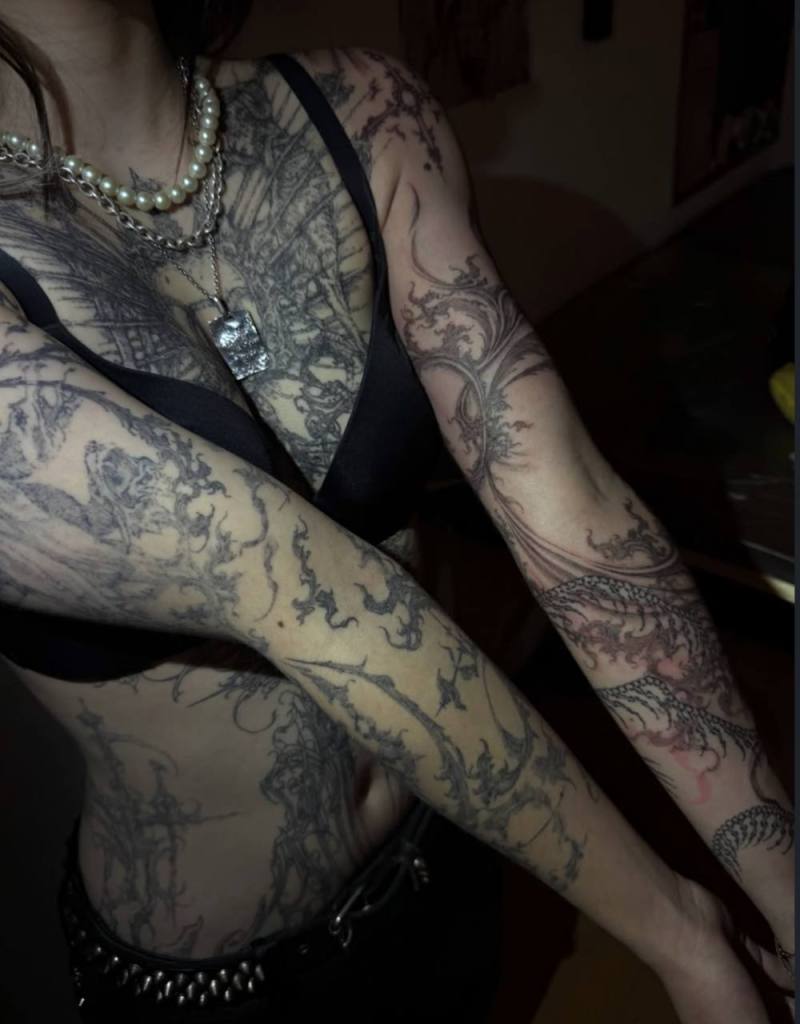
The emergence of tattoos as an act of solidifying oneself as a relation to other entities or forces were shown in lines that do not depict a start nor an ending, therefore they took a decentralized form where each part of the tattoo was appreciated based on the relation it has with the other entities on the skin; for the sake of easing the process of the reader, I will call the tattoo styles that follow this description as relational tattoo styles. The main form of tattoos that dominates the traditional Western understanding of tattoo art, or is appreciated above all others, are subject-oriented tattoo styles, this includes but is not limited to old/new-school, realism, watermark, illustrative, (neo)traditionalism. These forms of tattoos are more often than not consistent with a center, that is the structure that is hierarchical; the tattoo is built around a focal point, a face, an object, an animal, a scene, and the entire design organizes itself around that central subject. This distinction describes compositional tendencies, since no tattoo tradition is purely centered or purely relational.
The art of the painter is to incite the spectator’s eye to a report, a discussion between this given, geometric center, and that which, doubtless due to the color and the design—but above all to something else!—results from the composition, a center, I should say rather a focus, creating a pull, a common appeal coming from the interior, and addressed to all the different objects compelled by the frame to make something together; and why not employ the correct word—a sense!—that constitutes what is called the subject.[2]
Paul Claudel sees a discussion occurring between a focal point and the other elements of the composition, so there exists a relationship between the entities, but the discussion is dominated by the focal point. All the objects for him are pulled together by a focus, and this focus creates a sense. The Cybersigilist manifesto would further radicalize Claude’s vision; relation does not necessarily produce a stable subject or center. Relational tattooing does not necessarily possess an identifiable beginning or endpoint. A line may terminate without resolving itself, join another design, disappear beneath clothing, or remain open to later extension.
The questions that remain here are:
(1) What produces subject-oriented tattoos, and which produce relational, decentered ones?
(2) Why do ‘we’ have cybersigilism and eurotrash?
Cybersigilism is an ambiguous term, it varies in the thickness of the lines, the sharpness of it, the (in)existence of icons and so on. I will for the sake of this case put Eurotrash and Cybersigilism in the same relational tattoo category. Yet, it is on some levels necessary to define and understand how we get to Eurotrash and Cybersigilism.
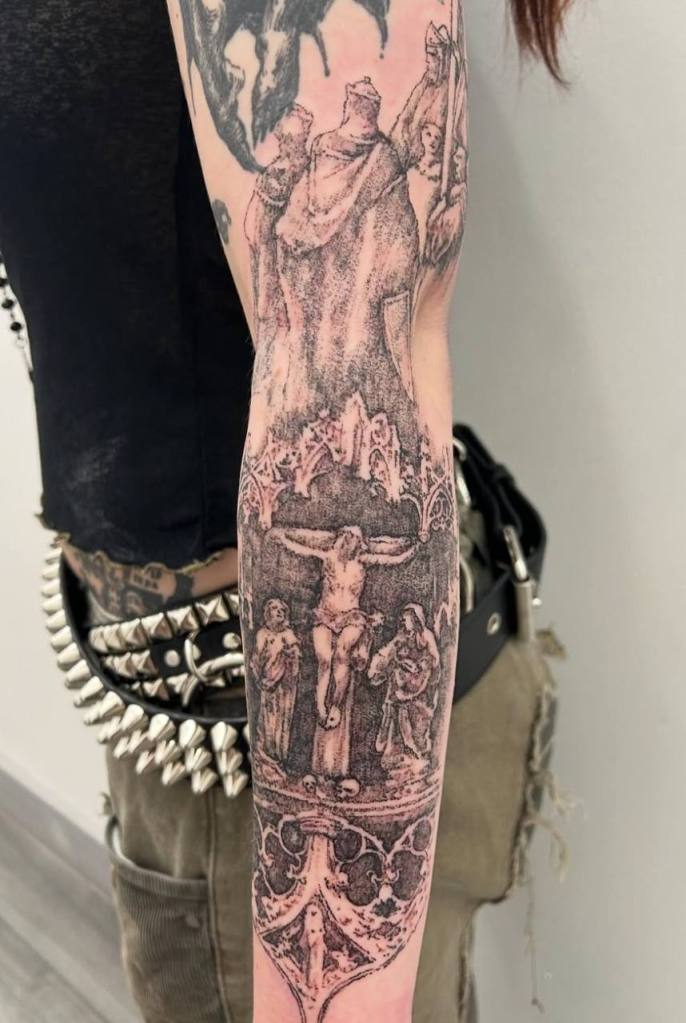
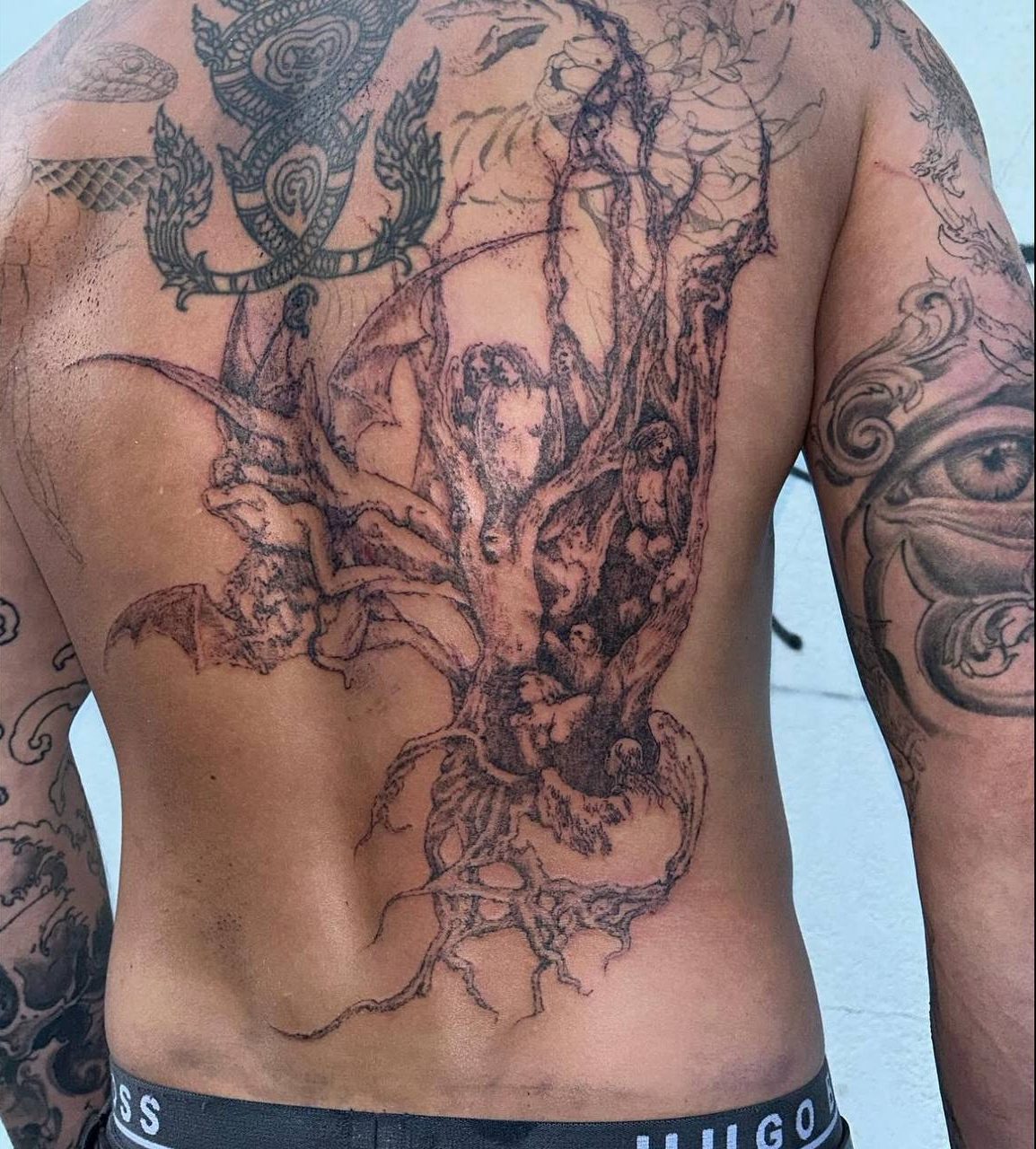
Cybersigilism screams it in-itself. It is a cybernetic reinterpretation of certain ‘esoteric’ sigils from various cultures. We could see the same pathways of ‘tribal’ tattoos just with different expressions, we could also notice the influence of black metal in the sharp spike-like lines, we can also notice a mixture of christian, gothic iconography that read Dante’s Inferno for the tattooee. The rather grim manifestation of the same bible as renaissance paintings. Thus, we are left with a revision of God. For the sake of cybersigilism, we understand a cybernetic Christian decentralized God that is barely noticeable among the cybernetic lines. Specifically here, eurotrash comes to distinguish itself from cybersigilism, it is no longer the fixation of cybernetic lines but the decentralization of icons and unawareness of the initiation and the ending of the tattoo. Eurotrash is indeed a structure, a structure that could be defined through Paul Claudel as a process of becoming imbalanced or in the process of coming apart. A eurotrash tattoo or a cybersigil tattoo is never fully aware of itself, neither is the tattooee aware of its ending. It could be expanded or even fully covered by yet another piece. Therefore, there is no fixed idea of what is cybersigilism and eurotrash, it could be the fading effect or the capacity that it has for becoming. All in all, we could say that these relational tattoos can never grasp themselves. There is a structure in the body art yet it is always not exactly there, then an anarchitecture perhaps; Or a post-anarcho-architecture. A rhizome arises and it cannot be pinpointed, the fact of it imbalancing itself automatically decentralizes both the artist’s intention and the subject. Even the Christian iconography is no longer centralized as it is in Renaissance paintings, for it is drowning in the scheme of ‘becoming’s.
How is it that this ‘culture’ finds its products in the rhizomatic shelter? As a safe-skin against a thing-centric tattoo, what remains?
Proto-Trash
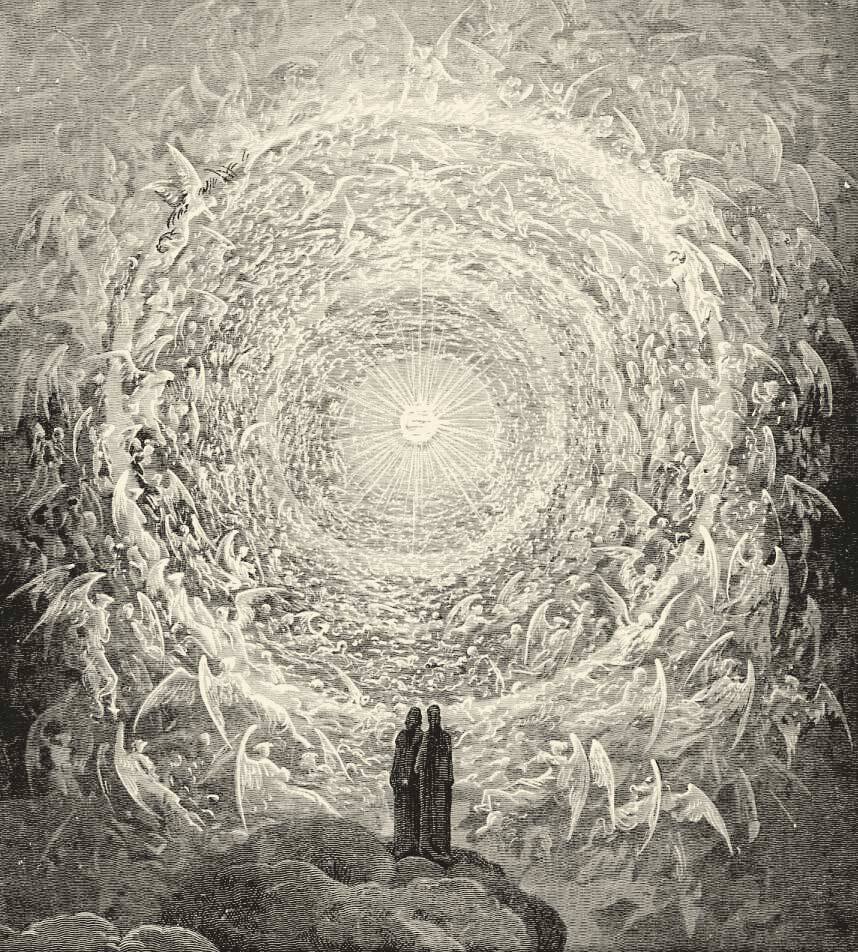
Gustave Doré’s maneuver regarding Satan’s immortal temporality, and a referral to it as a vivacious mutilation whose basic existential core is in jeopardy sees the same evidence of the Eurotrashic interpreting device: each symbol goes through a rhizomatic antistructural-structure. A non-hegemonic non-foundational foundation. God in the other circles, and the same industrial Christ flattened by the English proletarian struggle. Dore could be distinguished with himself, a Frenchman in London and also the witness of Dante’s God. Catastrophe! Dore smears Dante’s heroic theology. Dante and Beatrice are gazing upon the highest heaven, at Empyrean, occupying pure light, as a prerequisite for Dante’s final visit to the three circles, three colors, one circumference; “But already my desire and my will were being turned like a wheel, all at one speed, by the Love which moves the sun and the other stars.”[3] Dore procreates a catastrophic heaven (Fig 1), where the angels present themselves in line with the Celestial Rose. Cybersigilist, Eurotrashic, Dorean Sensation, in the Deleuzo-Claudelian lens, is a disequilibrium, the structure collapses unto itself. The angels represent both themselves and the lenticular clouds, as Dante and Beatrice bear witness to this breakdown, they give away their asymmetry to fulfill the triumph of the Divine symmetry. The heaven’s too high and the hell’s too low, the Frenchman in London performed a cosmoillological spectacle. Dante’s subject remains a subject, an assemblage, the human is not his master as the humanist Renaissance art, and neither is God’s image visible in the human being’s death. Dore is attempting to illustrate the virginity of God; that is, God before man, God as an outsider of the Human. The flesh looks fragile compared to the divine architecture, Dore’s God is posthuman. The human witnesses his ‘postness’ in the absurdity of the law, the demons, the angels, and the mountains, holy or not.
Colors do not emerge as they did with Paul Cézanne’s works, where his readings inspired a practice where the focal point is the merging effect of colors. As Deleuze reflects on colors and Cezanne, “The activity of painting consists of the moment of chaos followed by the subsequent moment of catastrophe, and from this, something emerges: once again, what emerges is color. That is, when color emerges at all..” a shoutout to possibilities too, “since there is still the possibility that nothing emerges. One is never certain; this process and activity of painting guarantee nothing in advance.”[4] And as Cézanne himself notes, “The landscape is reflected, becomes human, thinks in me. […] I climb with her to the roots of the world. we germinate A tender excitement seizes me and from the roots of this excitement then rises the juice, the colour. I was born in the real world. I see! […] In order to paint that, then, the craft must be used, but a humble craft that obeys and is ready to transmit unconsciously”[5] An artist in a recent invention, the figure of the artist is a recent invention. How did Dore himself read Dante to illustrate a Dante? We could then simply think that he forgot. He learned how to see again, fully ridding himself of the Renaissance and then proceeding with his homework., Yet, if one is materialist enough, and if one employs that, they can suggest that Dore’s work for Dante is reducible solely to the process of reproductive wood-engraved illustrations. Dore and his contemporaries copied their illustrations using electrotypes, which used rotary cylinder presses. Alas! No Dore exists then. We could then see Dore as a productive-production. His non-Reniassance vision is merely a result of the industrial processing of his time. Dore’s uncanny heaven is not uncanny because heaven is uncanny, for it is that due to the technical objectification; technical object: black ink, carved whiteness, industrial engraving, book-market reproduction, and theological spectacle. Comically, industrial capitalism dried all that is humanistic in Dante’s heavens and hells. Nothing stops the tattooee to choose a Eurotrashic design that has colors, that has ‘Cezanne’s catastrophe’. Yet they refuse to do so, as if the body art is also subjected to the power of the cylinder presses.
Gothic architecture served as an artistic manifestation of Deleuze’s struggle against representation. In reflecting on Francis Bacon, he notes “A powerful nonorganic life… …opposed in principle to the organic representation of classical art. Classical art can be figurative, insofar as it refers to something represented, but it can also be abstract, when it extricates a geometric form from the representation. But the pictorial line in Gothic painting is completely different, as is its geometry and figure… …It is a geometry no longer in the service of the essential and eternal, but a geometry in the service of “problems” or “accidents,” ablation, adjunction, projection, intersection.” The essential and the eternal even if they occur are simply secondary; the geometry of the Gothic do not presuppose a God or a Human, nothing is divine here. For it merely is later on interpreted as religious, yet the main cause remains an accident. He continues, “If it encounters the animal, if it becomes animalized, it is not by outlining a form, but on the contrary by imposing, through its clarity and nonorganic precision, a zone where forms become indiscernible. It also attests to a high spirituality, since what leads it to seek the elementary forces beyond the organic is a spiritual will. But this spirituality is a spirituality of the body; the spirit is the body itself, the body without organs”[6] Cybersigilism undoubtedly is anti-representation, no Line-Minister can represent all the lines, and the lines cannot be populated to a formalized form. And eurotrash similarly has Gothic lines, it could even read the Confessions of Augustine for us, but again, it is not there. If the lines take the shape of a face, it would still not be a ‘cybersigilist/eurotrashic face’, for it would still remain as cybersigilism/eurotrash.
Black metal, at least the aesthetics of black metal, is an immanent critique of Christianity. It almost entirely subscribes to certain Christian aesthetics, operating within the same metaphysicalized tones. Perhaps by some indications, one cannot imagine black metal existing without any Saint Paul. Its existence, being situated on an anti, has to be ensured with the existence of that which follows the anti. All the blackisms that black metal theory follows (rebellion, misanthropy, Satanism), are inversions of Christian self-desecration. Simultaneously, this inversion is not inevitable within black metal theory, whereas the exclusion is inevitable as Christian ‘universalism’ generates an ‘adjectant other’ such as the ‘pagan’ or the ‘Gnostic’.[7] Inversion would indeed flip the hierarchy and reproduce the Other as an authoritative figure, thus black metal identifies with the adjectant other as it plays with the nodes of Christianity. Perhaps, the influence that Black metal has on cybersigilism and eurotrash is not only on the aesthetical manner but extended to adopting the immanent critique; in which biblical iconography is placed on the body next to the adjacent other, where the nor the tattooer or the tattooee n can distinguish between the primary and the secondary.
There is a fragmentation of what remains of European body art. The body art reimagines the European as a spirit raving for a self that can only understand itself as a relation to the dancer. And even though the raver understands the value of the DJ, they conclude that they are inevitably the same piece as the DJ. Then perhaps, they dance for whatever comes in the room; a relational structure. Raving is another ambiguous term, for it was specifically the Berlin scene that did the reimagination of networks that I speak of. It was the Berlin scene that eurotrash and cybersigilism rested on. Compare the Berlin scene to house music raves. The raver in the house music scene has an urge to connect or to understand itself with the same lines as the DJ, the DJ as a central figure of the rave. However, in the rave scenes, the inaccessibility of photography (filming or selfies with the DJ), increased the capacity of the dancer to grasp the dance’s ego the same as the DJ’s ego. Rave culture, or at least that of Berlin, weakens the centrality of the individual in a shared unconscious acknowledgment of anonymity and temporality, which implodes into a mere appendage. An artistic organization, even a schizoid one, is at last a cultural product, inseparable from itself. If one were to see a cybersigilism/eurotrash tattoo on another, what may they think? That first, this figure, in their atomistic individuality, defines and understands their atomism based on an idea of a collective that nonetheless recognizes them. And here, cybersigilism tattoos and eurotrash tattoos are rarely repetitive, they rarely appear as a ‘flash’ tattoo, they rarely even appear as visualized thought. By some hints, individuality and nonconformity are not threatened here, as that has been the necessity for Western tattoos, and simultaneously this is dragged to a collective layer, where it signifies the assemblage that assembled them.
What is to be Drawn?
Subject-oriented tattoos are more often than not born in cultures that not only a rigid form of essence, but a hierarchy of essences as separate entities exist; that which the individuality of the subject is already explored and explained in-it-self. One can link the interconnection of essences and separation of essences to the predominant mode of theisms in the cultures, and at the same time, the degree of the rigidity in the organs of the organization. This is not simply to say that centralized societies produce subject-oriented tattoos and decentralized societies produce relational ones. But certain ‘leakages’ from the society itself, where the organs are deorganized and the body is, well, stripping itself from organs, are more likely to produce the decentralized tattoos.
This apparent decentralization cannot be romanticized as an attempt to free the subject from stability.. These forms are yet again produced by markets, platforms, technologies, and recognizable subcultural conventions. The body-art-without-organs is therefore not an outside organization. Still, it is an immanent critique.
[1] Gilles Deleuze, On Painting: Courses, March–June 1981, ed. David Lapoujade, trans. Charles J. Stivale (Minneapolis: University of Minnesota Press, 2025), 1.
[2] Paul Claudel, The Eye Listens, trans. Elsie Pell (New York: Philosophical Library, 1950), 169.
[3] Dante Alighieri, Paradiso, trans. C. H. Sisson, in The Divine Comedy (Oxford: Oxford University Press, 1993), 33.142–45.
[4] Gilles Deleuze, On Painting: Courses, March–June 1981, ed. David Lapoujade, trans. Charles J. Stivale (Minneapolis: University of Minnesota Press, 2025), 8.
[5] Cézanne, Paul; Doran, P.M. (2001). Conversations with Cézanne. Berkeley: University of California Press. pp. 137–141.
[6] Gilles Deleuze, Francis Bacon: The Logic of Sensation, trans. Daniel W. Smith (London: Continuum, 2003), 44.
[7] Steven Shakespeare and Niall Scott, “The Swarming Logic of Inversion and the Elevation of Satan,” Helvete: A Journal of Black Metal Theory, no. 2, With Head Downwards: Inversions in Black Metal (Winter 2015): 1–12.


Leave a comment