“At times they do indeed see something the others do not, but at other times that what they see only in degree and serves no purpose. Although they are collaborators with the most rigid and cruelest projects of control, how could they not feel sympathy for the subterranean activity revealed to them?”
Deleuze & Guattari
“A Scottish traveler testifies to the unique attraction to the power of fire, speaking after rebels had burned the Hôtel de Ville in Paris in May 1871: “Never could I have imagined anything so beautiful. It’s superb. I won’t deny that the people of the Commune are frightful rogues. But what artists!”… vitality has taken up quarters in the so-called “problem neighborhoods””.
The Invisible Committee
Any Western attempt to philosophize from the comparative safety of their desk or office about any ongoing genocide in Gaza is a task which can only be attempted with the utmost militant analysis, as said realities being faced by the Palestinian people can in no way shape or form be simply ‘conceptualized’ or ‘theorized’ as a simple element of political philosophy or critical theory, but only as an ongoing process of political-becomings… one which demands the attention of any collectivized praxeological effort formed against the globalized molar and molecular formulations of imperialism, capitalism, and fascism.
This essay seeks to use the ongoing struggle against the Israeli Occupation Force by the various elements which construct the Palestinian liberation front in terms of their collective subversions of political philosophy on both a strategic and aesthetic level through the lens of Deleuze & Guatarri’s positing of the “nomadic war-machine”.
While I am not alone in applying a contemporary liberatory potential to D&G’s project, it would be a mistake to first ignore the co-option and capture of their project by the forces of technocratic and 4th world-ist imperial projects, which have been long attributed to Deleuze and Guattari through their alleged application and education to the very occupational forces which are currently committing said genocide in Palestine. The intention of this essay is to first further analyze the ongoing development of the Zionist imperial project; its interaction or co-option of Deleuze & Guattari, the materialization of Foucault’s ‘biopolitics’, and the embodying (and un-bodying) of Mbemmbe’s ‘necropolitics’, through both a practice of maiming and remote death.
Critical to this discussion is not simply the understanding of contemporary Zionist strategy in Gaza, but an analysis of the October 7th Flood and its continued 4th world resistance to the most technologically advanced imperial states on earth. This – “Subterranean Deleuze” – acts as a sociopolitical force which adopts the nomadic war machine in an anarchitectural space by an embracing of the sub-soil of Gaza and the axiomatics of colonial settler sovereignty. By recognizing this force, we will have a better possibility to recognized the potentialities of the geopolitical Y-axis, of anarchitectural guerilla strategies and globalized aesthetics which manifest as horizontal nomadic war machines, and which puts in the mind of any colonizer or fascist occupier a fear of every stone, every street, and every wall which they so rely on for their campaigns of domination and genocide.
The essay will be organized as such: First I will briefly discuss the concept of the nomadic war machine as presented by Deleuze and Guattari, and by tracing its lineage through Clastres and prehistory, arrive at a better understanding of the relationship between the war machine and the state apparatus. This – albeit brief – preface to what is one of D&G’s most complex and intriguing concepts is necessary before covering the site specific co-option of their project by the IOF (Israeli Occupation Forces) in Gaza, as will be discussed in the second section. The third section will cover a transition from the weaponization of D&G’s project on the ground, to the skies through the surveillance targeting technologies of drone warfare, as well as a multifaceted development or mutation of Foucaultian concept of biopower and biopolitics in the ongoing campaign in Gaza, synthesized in the usage of technologies such as drones, clandestine explosive campaigns, and domestic military policy accumulate into an imperial and genocidal machine which is unique on the world stage today. Finally, working through the secondary literature of Andrew Culp’s positing of both a Dark Deleuze and A Guerilla Refusal, we can begin to formulate how the various forms and strategies employed the various Palestinian resistance groups posit both a growth out from – and challenge to – traditional forms of sociopolitical and militant resistance.
This essay by no means is meant to be read as celebratory… The continued resistance against the imperial project of the IOF continues to this day and will continue for the foreseeable future. The intention here is rather to operate as a diagnostic to a shared contemporary political domination. imperial and anti-imperial action, and socio-aesthetic strategies which have been deployed with varying results by both sides of the on-going genocide.
1. The Nomadic War Machine
Gilles Deleuze and Felix Guattari’s A Thousand Plateaus: Capitalism & Schizophrenia (ATP) (1987, Minnesota) pushes even further into a sociopolitical project than the a radical departure from traditional critical theory as was presented in the first edition of their collaborative project: Anti-Oedipus (AO) (1983, Minnesota). In a constant drive for mapping, lines of flight, and deterritorialization, the “withdrawal freaks” (AO, 277) of the war machine constitute nomadic assemblages, which interact and poach elements from the striated, codified, and demarcated space of the imperial state apparatuses. Refusing the wars of annihilation as those practices which define the warfare practices of the sovereign state, the primary function of the nomadic war machine is not war, but rather is creative… connected to the ‘outside’ of the apparatus, and yet still intertwined within it, constantly pulsing and mapping the space, rather than tracing. (ATP 26, 357)
In defining this function of the nomad and its war machine, D&G rely heavily on the social anthropology work of Pierre Clastres, whose diagnosis of the prehistoric and nomadic war as not that of biological or zoological evolution (Loroi-Gourham), nor the economic development and acculturation in which war developed as presented by Marxist Leninist and Maoist social theorists, or even the exchangist-discourse as presented by Levi-Strauss. Clastres (working through Mauss) diagnosed the war machine-function as the ‘engine’ behind the social machine, insomuch as forming what he defines as a ‘society-for-war’, rather than a war for – or with the intention of forming – a society.1 Deleuze and Guattari take this understanding or adoption of the prehistoric ‘chief’ – they who maintains not a dictorarial power in the assemblage of the nomadic group, or one of which holds any power per-say – but rather has a cult of personality and ability to – via the war machine – prevent the sedimentary foundations of the State apparatus to form as a striation of space. (ATP, 357) The war machine materializes thusly as a flattening force of the body-politic in response and refusal to attempted creation of hierarchical structures of the sovereign, forming temporary alliances and coalitions to cut down those tribes, or groups of nomads which might seek to consolidate or codify power via the co-option of the war machine. It is worth noting (especially in this case) that the state apparatus does function or interact with the war machine for its own purposes, but seeing that the war machine is purely an assemblage which is “external” to the models of the state “apparatus”, this exteriority causes fits and issues when the prior attempts to weaponize the latter. To quote D&G:
“The State has no war machine of its own; it can only appropriate one in the form of a military institution, one that will continue to cause it problems.” (ATP 354-355)
We will return to D&G’s nomadicism and the war machine as we continue this conversation in relationship to the occupation of Palestine and the co-option of their project by the IOF, as much of the very radical and revolutionary potentiality of the have been and continue to be deployed by the genocidal campaign in Gaza… but first lets turn to the fascistic weaponization of the nomadic war-machine, and how the IOF both uses and builds upon this in terms of militaristic strategy before returning to how we can re-apply the very same tactics to combat the occupation apparatuses in the post-10/7 epoch.
2. The IOF and D&G; Rhizomatic Warfare
In the 21st century, much has been written by critics of Deleuze & Guattari’s project, specifically its co-option and weaponization by the very same reactionary, capitalistic, and fascistic elements which coalesce into the contemporary apparatuses of control diagnosed by Deleuze in the last years of his life.2 This should come first and foremost as no shock to the readers of D&G, as the processes and procedures of “beoming-schizo”, the “Body without Organs”, “re” and “deterritorialization”, the inherent and immanent processes of “machinic desire”, all are easily adopted by the very forces of capital and technofascist control which they sought to diagnose and dismantle. While Deleuze and Guattari recognize the axiomatic functioning of capital, they were in their own lifetime inable to prevent its very problematic co-option by the very apparatuses they sought to understand and critique. As we will discuss, this co-option process is as diverse as the program which D&G attempted to present, ranging from Silicon Valley technofeudal barons, to continental philosophers who just happen to work for the IDF, to Landian e/acc acolytes who might have taken the closing passage of 3.9 in Anti-Oedipus a bit too seriously. While the first and last in said list will be discussed, the middle element – the State war machine becoming nomadic – will be central to this discussion and eventual positing of a “subterranean Deleuze”.
In Eyal Weizman’s Hollow Land: Israel’s Architecture of Occupation (HL) (2007), Weizman makes interconnections between the Deleuzian topographic and urban strategies employed by the IOF during the Second Intifada and its range of effects on the Palestinian liberation fighters, and civilian/refugee population alike. While published nearly two decades prior to the 10/7 attacks and the consequent Hamas-Israel War of 2023-?, Weizman makes direct comparisons to the contemporary theory being drilled to the IOF officer corp, and the tactile, geographic, and topographic results in the various territories, camps, and pockets of Palestinian life and resistance. While Weizman is quick to point out that the “military use of contemporary theory” is by no metric a new relationship, he continues to note that the reversal of intention behind an education in the humanities as the “most powerful weapon against capitalist imperialism” (HL: 210), could just as easily be used by said occupying forces as was proven (or at least attempted) by the IOF.
Thankfully in the case of further understanding to adoption or co-option of critical theory by reaction forces we have name to put to the action, Aviv Kochavi.
Known as the father of this contemporary move by the IOF to adopt the strategy, verbiage, and thought processes of these revolutionary critical thinkers into the military strategic space, Aviv Kochavi3 (who not surprisingly studied western philosophy closely) very much wears his influences very clearly on his sleeve. Using terms such as; “nomadic terrorist”, “Wahhabi war machine”,.” between difference and repetition”, “heterogeneous millieus”, “cybernetic-driven synthesis”, etc. (HL: 199). No matter the convoluted veneer of phrasing and terminology, Kochavi’s alleged pedagogical goal was quite simple: to create a new relationship between the state apparatus (the IOF), and the nomadic war machine (Palestinian resistance) via a co-option of theory for the ultimate goal of state control.
First put to the test immediately prior to “Operation Defensive Shield” in March of 2002, Kochavi ordered his paratroopers to first envelop the refugee camp at Balata in a stereotypical manner. Operating in day light. Forming a traditional perimeter around the area. Purposefully allowing for the liberation fighters to set up barricades, cross fires, and ambush points. This intention – to feint a traditional impending siege style operation with the regular usage of armored columns followed by infantry down preplanned and traced routes – was then suddenly thrown on its head, as the IOF troops applied a:
“(…) fractal manouever, swarming simultaneously from every direction… our movement through the buildings pushes [the insurgents] into the streets and alleys, where we hunt them down.” (HL:193).
Here during the Balata Camp action was the first foray into a rhizomatic swarm militancy. A weaponization of the nomadic strategies by the state apparatus’ war machine, intended to challenge the 4th world problem of targeting, in which the line between combatants, civilian, and refugee becomes increasingly blurred. As for Kochavi himself, he attested the ‘smooth’ and ‘striated’ understanding of space presented by D&G would have the most long-lasting impact on the IOFs urban strategy in occupied Palestine, in which the smoothing out of the physical topography of the camps of Gaza were gradually replaced by the striated spaces of “fences, walls, ditches, road blocks,” and other physical impediments. (HL:201) In this effort to ‘smooth the space’, via the utilization of armored bulldozers and the destruction of the internal walls of domestic spaces, allowed the IOF to “walk through walls”, circumnavigating the defense strategies of the Palestinian fighters.
Kochavi’s theoretical co-option wouldn’t halt with D&G, as he also cited the physical practices of dérive (wandering through the psychogeographic landscape of an urban area), and détournement (the re-appropriation of a space from its initial intention) both of which were developed and practiced by the post-Marxist radicals of Western European Situationists, as well as the anarchitectural (anarchic architecture) practice developed by artist Gordon Matta-Clark as quickly appropriate strategies to achieve the goal of ‘walking through walls’. (HL:209)
By the end of the Israeli 38-year occupation of Gaza on September 12th, 2005, Kochavi would be the last soldier to evacuate the Strip… leaving behind a flattened, disconfigured, and permanently changed topographic and geographic landscape. Seemingly, the co-option of critical theory employed by his units had been a success, as can be told from the testament of one Palestinian fighter who claimed that the Israelis seemed to be “everywhere: behind, on the sides, on the right, on the left… How can you fight that way?” (HL:195) This successful change in strategy was by no means without internal issues with the IOF (as we can recall D&G state that the war machine can merely be adopted by the state as a form of military institution, which is bound to “cause problems”). Yet, these internal problems were minor and minute when compared to the destruction of the landscape and infrastructure of occupied Palestine. What could be recognized is that by the time of departure of ‘boots-on-the-ground’, there was a complete and total domination of the surface psychogeographic topography of Gaza and the other occupied territories… and over the next two decades, the IOF would expand this domination to the skies using the most cutting age military hardware which would function as an armed (be that with live video feeds or Hellfire missiles) observing and partaking in a dark mutation of the biopolitical existence in Occupied Palestine.
3. 2005-2025; From the Land, to the Sky: a Mutation of Biopolitics
Leaving the burning husk of what once was the Gaza Strip after nearly four decades of armed occupation, the IOF settled back into the role of experimental proxy for many of the same high-tech weapons and surveillance systems being developed both domestically and abroad. It is worth emphasizing here, as we will begin to discuss many of the non-human weapons platforms which are continually being deployed, researched, improved, and sold by the Israeli occupying state, that this is in no way a new development. In fact, the usage of questionable, unethical, and violent weapons systems in the Zionist state of Israel can be traced decades before the on-the-ground weaponization of critical theory by Kochavi and his IOF paratroopers. This is not to say that the IOF, Israeli intelligence apparatus, and Israeli military industrial complex had long before the end of the occupation of Gaza in 2005 been at the cutting edge of unethical, advanced, and increasingly globalized weapons systems, all of which were tested in – to use the title of journalist Anthony Loewenstein’s book – The Palestine Laboratory [PL].
Before delving deeper into the manifestation of the aerial dominance and surveillance regime of the IOF in Palestine, it is worth briefly noting the history of weapons development in the prior 20th century which might lay an effective foundational understanding of the general modus operandi of the Zionist state.
Even at its sovereign infancy, from the mid 1950s onward Prime Minister Ben-Gurion made it clear that the various state and private weapons manufactures of Israel would sell their systems to any and all foreign military and paramilitary groups which the Foreign Ministry “ha[s] no objection” (PL:27)… With state manufactures like IWI (Israeli Weapons Industry), and private manufactures like Elbit (which would go on to be the largest in Israel) would expand its own small arms manufacturing well beyond its own domestic borders.
By the end middle of the Cold War, Israel was selling weapons to regimes which were embargoed or sanctioned by the United States, Soviet Union, or in some instances both simultaneously, such as the apartheid regime of South Africa, the breakaway white-nationalist ‘state’ of Rhodesia, as well as various other paramilitary and anti-communist military juntas in Latin America (Guatemala, El Salvador, and Costa Rica all as official state purchasers). After the successes of these lucrative arms deals globally landed the young country of less than four million citizens in the top ten weapons exporters on earth, it should come as no surprise that, to quote Lowenstein; “militarism became the country’s guiding principle and it’s lived with it ever since; ending the conflict with the Palestinians is bad for business”.
This focus on the domestic military industrial complex would not be floundered by the end of the Cold War in 1991, nor the Financial Crisis of 2008. In fact, the arms and surveillance industry would act as the backbone of the Zionist state to lean upon and weather the storm through both.. By 2021 the state earned an all-time high of $11.3 billion USD, up an astonishing 55% in two years, and taking in a mind-boggling 40% of the international funding for cyber companies generally, much of which surveillance and tracking focused. (PL:29)
As we will return to the discussion of the cyber-war elements of the IOF in the closing section of this text, it is worth returning back to the aerial elements of the campaigns against Palestine, which as we know or recognize as not only operating militarily but also as a lynchpin of the very economic of the state itself…
Throughout its entire – albeit short – existence, the Zionist state has been forced to answer this question: “If [we] cannot prove its weapon systems are working in the human testbed that is Gaza, then what would disparate states differing as widely from Azerbaijan to the streets of the United States care about buying said systems?”4
Even with decades of success selling or smuggling the iconic Uzi and Galil small arms to regimes varying from Sri Lanka to the Contras, as early as the 1980s Israel’s most consequential ally – the United States – had begun to take notice of its deployment and development of non-human weapon systems… namely “remote-piloted vehicles” or in today’s verbiage, drone weapons as early as the Israeli-Lebanon war in 1986. (PL: 39)

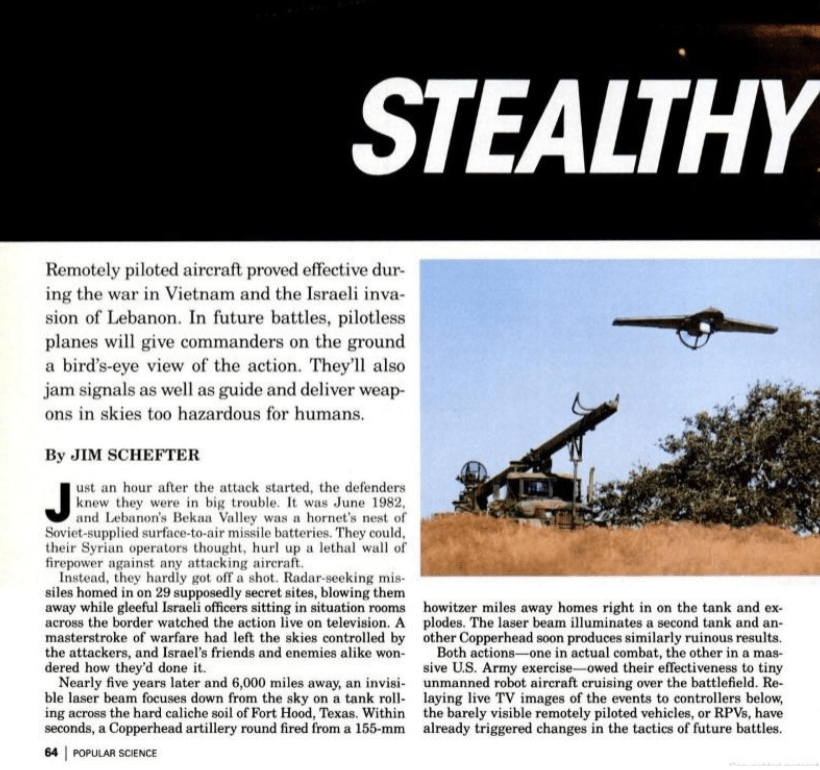
While the usage of RPV’s, (remote piloted vehicles or ‘drones’) again were by no means a revolutionary advancement in weaponry development and had in fact dated back to the First World War and was truly realized in the Second by the Nazi development of the V-series of automaton rockets. The Israeli state seemed to recognize – even in its sovereign infancy – that non-human weapon systems would play a critical role in future conflicts, and – crucially – that said weapons could also be both enhanced and enforced by an equally effective system of aerial surveillance in which drones today continue to pivotal role in.
This new technology would prove its capabilities to United States onlookers when On October 23rd, 1983 a truck bomb placed by the Islamic Jihad Organization5 exploded outside a Beirut barrack building where US and French soldiers were stationed. The explosion would kill 304 people and would set the stage for the re-deployment of the MEF (Marine Expeditionary Force) in an attempt to quell the violence.
Before the re-deployment of the MEF, Marine Commandant Gen. Kelley secretly flew into Beirut in order to investigate the scene of the attack first hand. Israeli reconnaissance drones were able to locate the Marine General, and watching via a live television feed, even zoomed in close enough to put a crosshair on the General’s head as he was led throughout the former barrack building. Al Ellis, the ’father’ of the Israeli drone program confessed that “all he did” was “take a model airplane, put a camera in it, and took photographs”,6 but when the United States command structure was shown this footage, they were – understandably – taken aback by the capabilities of the Israeli drone systems… if not rightfully taking said situation as an active (yet parapolitical and covert) threat.
As Israeli aerial weapon systems dominated the laboratory of Palestine and began to perforate the world, what can be observed is a crucial evolution in the biopolitics which were diagnosed by Michel Foucault. Whereas the rhizomatic swarming, walking-through-walls, on-the-ground strategy of smoothing the striated had proven the IOF’s ability to dominate the ground war via novel methods to achieve the traditional goal of a sovereign’s armed forces (arbiter between life and death7), what the advancements in non-human aerial weapons platforms displayed was the specter of the biopolitical which was inescapable for those below.8 The remote observation, surveillance, and occasional strike from above, at the decision of a soldier miles away behind a TV feed, embodied not only the sovereign’s ability to decide between life and death, but the biopolitical ability to: “incite, reinforce, control, monitor, optimize, and organize the forces under it”9. Foucault makes it clear that this shift from the traditional formula of ‘right to kill’ to the biopolitical ‘right to let live’, by no means implies a deceleration in violence which it constitutes, and in fact, rather than armed conflict being between two opposing sides in which the “sovereign who must be defended”, but rather through this shift conflicts are waged on “behalf of the existence of everyone; entire populations are mobilized for the purpose of wholesale slaughter in name of life necessity”
Foucault’s conceptualization of a biopolitical sovereign seems to operate most clearly on the molar level within the increasingly demarcated and shrinking space of – in this case – Gaza and Palestine. Foucault’s euro-centric positing a political in which human life (both the anatomic and biological) is centered as a subject of optimization through the various sites of disciplinary society (the school, clinic, barracks, etc.), is summarized by the rather than the sovereign’s ability to kill, but rather to let die by the removal of the structures of life which are at the at the center of said optimizations.
While the biopolitical can be understood as manifested by the usage of drones and aerial surveillance, Achille Mbembe pushes the Foucaultian biopolitics in the post-colonial space by introducing the concept of “necropolitics”10, which in the case of Palestine is a no longer simply understood as a laboratory for strategic military experimentation by the IOF (although that absolutely remains an in-flux element), but a mutation which synthesizes “late-modern colonial occupation”(NP:29) with the disciplinary, biopolitical, and necro-political. The critical development of the necropolitical from the bio-politic can be most closely compared to the life of the slave, that “death-in-life”(NP:21) and thus the site of the necropolitical is most easily found in the plantation or, in the case of Palestine, the refugee camp. In these spaces or sites, it is not that the human body is removed from the anatomic connections to the mechanisms of capitalism and labor, but the optimization of life which is centered by Foucault and the biopolitical is rather replaced by understanding the subjects of the plantation and the camp as “savage life” which denies and splinters any and every “common bond between the conqueror and the native”.(NP:24) This dehumanization process of the necropolitical is crucial, as Mbebbe presents racism as not a simple byproduct of the biopolitical (in which the racialized other demarcates which lines are allowed to live and which are allowed to let die), but rather functions as the social engine of the entire post-colonial system, which in itself are further stratified into spaces of exclusion (or in Fanonian or Schmittian terms) exception; the plantation, the refugee camps, the township. Within the mutation of the biopolitical into the racialized and compartmentalized camps of occupied Gaza, it is not only the aerial surveillance of the biopolitical or disciplinary societies in which the panopticonic eyes of the remote drone, nor is it simply the swarming rhizomatics of the state apparatus’ capture of the war machine on the ground of the camp, but another strategy which embodies (or, rather de-bodies) the biopolitical, and that would be the practice of intentional maiming by IOF ground troops.
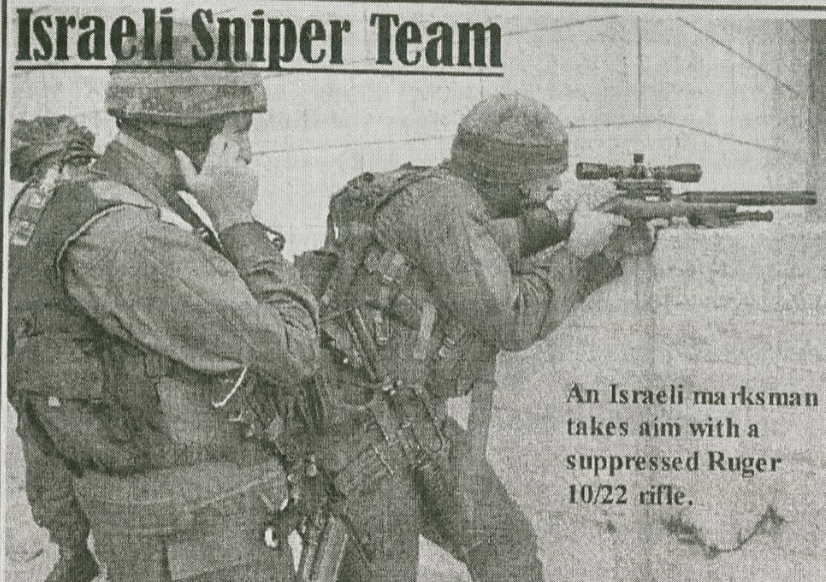
This shift, from the bio to the necropolitical, em-(or de-) bodied by the demarcation of the physical space is also accompanied by not only strategies of aerial surveillance, but with a host of tactical strategies on the ground. As presented by Jasbir Puar, maiming the population as an intentional strategy positions itself somewhere between the biopolitical and necropolitical, as it is not purely of the ‘right to death’, nor the ‘war on life’ itself, but rather the intentional wounding of the populace with the goal of permanent disability to achieve a two-fold strategy; the prevention or impossibility of healing, and the infrastructural destruction of any facilities or resources which might aid in said healing. This strategy was not simply or solely applied to the targeted but manifested in the very weapons procurement of the IOF, who by the mid 1980s began equipping snipers with Ruger 10/22 internally suppressed rifles in order to “wound a specific target without killing them”11. These “tactical aims of settler colonialism”, can (and for the occupational settler colonial forces must) be achieved in this two-part strategy, the maiming of “infrastructure in order to stunt or decay” as well as of the “able-bodied into debilitation through the control of calories, water, electricity, health care supplies, and fuel.”12 Not as easily demarcated as necro or a complete mutation from Foucaultian biopolitics, the strategy of maiming (on both the anatomic and infrastructural levels), finds some sort of middle ground between the two, perhaps being closest related to the Deleuzian ‘control societies’ discussed prior, in which networks replace the ‘disciplinary forms’ of the biopolitical, yet are still not as easily demarcated by the strict striations of space which are central to Mbabbe’s reworking of the biopolitical. Whereas the spread of diseases would mark the biopolitical death of the subject in regimes of the past, insomuch as the body would be allowed to die, the use of maiming forces the subjected Palestinian body into a constant state of necessary healing which the equally maimed infrastructure of the camp cannot maintain… the intention of this strategy is clear, and rather dark, to quote Puar: “It is as if with withholding death – will not let or make die – becomes an act of dehumanization: the Palestinians are not even human enough for death”, truly a sick and stark mutation and synthesization of the bio, and necro political.
Before moving on to one final example of truly unique (and horrifying) example of the Israeli state sovereign, I would be remiss to not mention how this move – from the traditional strategies of the colonial occupying force to the biopolitical aerial hyper-surveillance state dominated and embodied by the weaponization of the drone – was not without its own specific aberration.
During 2002’s “Operation Defensive Shield” spearheaded by Kochavi’s rhizomatically swarming paratroopers, a standoff took place at Bethlehem’s Church of the Nativity (believed by both Orthodox and Catholic Christians to be the birth place of Jesus Christ) after militants fleeing the swarming IOF took refuge in the oldest basilica in the Levant. The BBC would report that over 200 monks were in the Church when 39 Palestinians would seek refuge within the historic walls. Over a month (April 2nd – May 10th) the suspected militants would be forced to eat grass and weeds from the Church courtyard as the IOF would not allow for the delivery of food to anyone in the Church. Now, this could be understood as simply one in a countless number of violent circumstances undertaken by Kochavi’s soldiers during Operation Defensive Shield, but one strategy employed by the IOF stands out to me as an exemplification of this brutal synthesis of both the on-the-ground and in-the-air weaponization of biopolitics in occupied Palestine.
By early April, faced with a high-stake sociopolitical military situation, the IOF (always one to innovate) decided to give their snipers optimal positional superiority overlooking the Church by hoisting an armored storage container via an industrial crane above the tactical area.
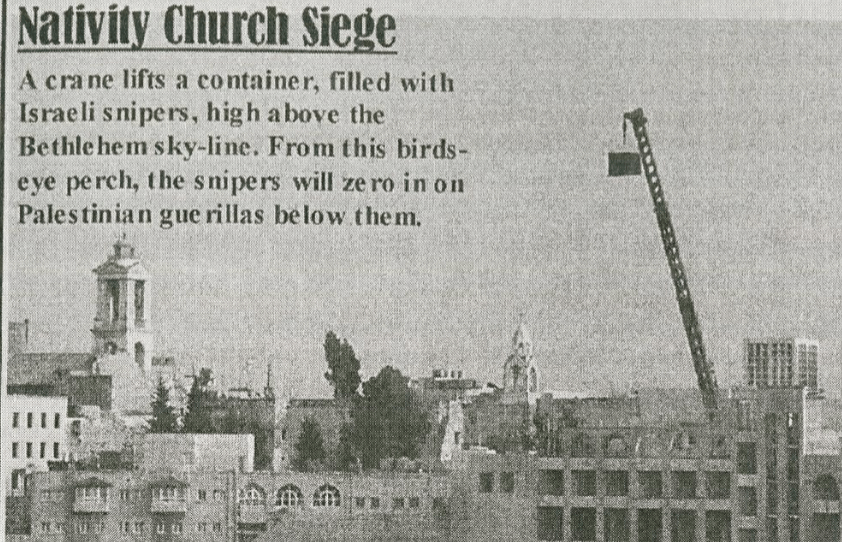
This peculiar weaponization of the aerial space would prove effective. During the duration of the siege Israeli snipers would kill 8 Palestinians in the Church and wounded an Armenian monk. In this situation, the Israeli forces didn’t find the maiming capabilities of the Ruger 10/22 rifle necessary, as 5.56, 7.62, and allegedly .50 caliber small arms were all deployed in overlook duty during the Siege. For the IOF, this was a tactical and propaganda boon. The pure oddity and tactical tenacity of the Israelis perching their own snipers floors above the holy site only speaks to the unique weaponization of colonial strategy which was being experimented with by the IOF in the early years of the 21st century.13 The Siege of the Church of the Nativity would mark a turning point in IOF domination of Palestinian resistance. The IOF had not only dominated the ground via the tactical ‘smoothing the striated’ and through the rhizomatic ‘walking-through walls’, nor had they ceased in developing a surveillance network of drone systems to enforce biopolitical dominance of the increasingly demarcated and shrunken space of occupied Palestine… Now, we see on display here a synthesis of both, whereas the terrestrial sniper is literally lifted into the sky to spread lethal domination from an armored storage container.
Before discussing the most recent events in occupied Palestine and the strategic counter-measures implemented by Hamas and various other armed liberation groups in combatting the Zionist state apparatus, it is worth noting another ‘unique’ aspect of the IOF strategy, and one of which we will return to when discussing the October 7th Flood, that being the controversial and seemingly counterintuitive “Hannibal Directive”.
The strategy of hostage taking had become a hallmark of Palestinian resistance in the latter half of the 20th century. Varying from entire airliners, to Olympic athletes, and from Israeli civilians to IOF officers… the fighters of the Fatah, PLO, PLA, Hamas, and various other resistance organizations would use the captive bodies of the Israeli as a bartering chip to combat the mass carceral strategy enforced by the settler colonists. It is worth noting that the judicial system (if it could be called that) in the state of Israel is bipartite, insomuch that it has been called “One Law: Two Systems” by the ACRI,14 and a “Stain on International Justice” by the Guardian.15 The Palestinians who are incarcerated range from teenagers to the elderly, are often held in perpetual limbo by a system of military courts and tribunals. Recognizing the successes in the strategy of ‘kidnapping’ Israeli soldiers and the propagandistic boon which was gained by the Palestinian liberation movement, by 1986 the “Hannibal Directive” was put into immediate effect, first through highly classified releases to the top brass of the IOF, and later being exposed in the early 2000s as a real directive. The content of the directive was rather stark and straightforward: “the kidnapping must be stopped by all means, even at the price of striking and harming our own forces”,16 this meant, in plain language that the IOF would be ordered to kill its own soldiers if the potential for a captive-swap circumstance was to manifest and the target (being their own soldier) could be located and determined to be difficult if not impossible to free without an overwhelming loss of manpower and material. In Eyal Weizman’s Forensic Architecture: Violence at the Threshold of Detectability (2017) which attempts to connect the topographical challenges and strategic elements which made this Directive both complicated and controversial. Weizman notes that while the said Directive is illegal both under Israeli and International Law, it could understood as attempt (much like the strategy of maiming and the dehumanization of the Palestinian) to remove the very term of ‘kidnapped’ from the strategic vocabulary of the IOF. 17
While the Hannibal Directive will be discussed further in the next section, it is worth circling back to the complicated sovereignty which the Zionist colonial-settlers are attempting to enforce. On the one hand, we have potentially emblematic biopolitical, disciplinary, and even necropolitical system in regards to the Palestinian population. Through the weaponization of critical theory (swarming, rhizomatic, war machine, Deleuze & Guattari, Foucault, etc.) on the ground, a world-leading surveillance state of the necropolitical spaces of the refugee camps via the automaton remote drone in the air, and the strategy of maiming which seeks to blend the dehumanizing elements of both… we are now faced with an attempt to completely nullify the “economy of exchange” symbolized by the kidnapped hostage as barter rather than say for the “videographic spectacle of their executions”18 which had in the early 21st century been popularized by other Islamic militant groups such as the Taliban and ISIS/ISIL. It seems as though Deleuze and Guattari were correct in their understanding that the co-option of the war machine by the State apparatus was destined to complicate things, and here with the Hannibal Directive we have that complication physically manifested. Is there on the one hand a return to classical sovereignty, in which the ‘right to kill’ (of both soldiers and civilians) those individuals which make up the very regime itself has re-manifested, and then on the other a bio and necropolitical sovereignty, in which the Palestinian is de-humanized by both ‘right to let die’ is reduced to ‘savage life’ and forced into an increasingly ‘smoothed’, demarcated, and consolidated space of tighter and more desperate conditions of the camp and ghetto?
This convoluted and complex settler colonial sovereign regime presents any sort of resistance with an equally complicated and difficulty in challenging the hyper-modern biopolitical and necropolitical forces of the IOF. In the closing section, we will discuss the strategies and re-application of Deleuze and various other critical theoretical approaches which proved to be incredibly effective and successful in the Hamas/Israel War of 2023-?.
4. Subterranean Deleuze: Becoming-Imperceptible and Becoming-Undeniable
“There has to become an art to becoming visible as well as an art to disappearing. Disappearing cannot be a factual coincidence; it has to be an art.”19
Before discussing the two-pronged strategy employed by the Palestinian resistance in combatting the IOF, it is worth making a handful of points painstakingly clear: First, the goal of freeing Palestine is by no means complete, and must be on the forefront of any person who seeks for global liberation today, as it was yesterday, as it will be until the day it is complete. Second, while the global consensus has given the armed struggle in occupied Palestine of 2023-2025 the title the “Hamas-Israel War” or “Gaza War”, it is worth noting that even Wikipedia refers to this as an ongoing conflict, in the present sense, not the past sense… and that even with a ceasefire in place, the struggle does not cease for total liberation of the Palestinian people. Third, and most importantly for our conversation, we must recognize the local and global successes of the Palestinian resistance in combatting one of the most technologically and strategically advanced military apparatuses on the planet.
The successes of this conflict will be the focus of this closing section and manifested on hyper localized (molecular) level, and global (molar) levels.
What was the response to the prior discussed strategies (biopolitical, necropolitical, etc.) of the IOF by the various Palestinian liberation movements? In which the walls can be walked through, the skies constantly surveilled, and the infrastructure, professional classes, and general populace maimed in an increasingly walled, categorized, and smoothed out space?
The response was to go underground.
This, of course, is not to assume that the various Palestinian resistance groups had not already used the strategy of or utilization of tunnel systems in the past. As we discussed prior one of the first publicly documented implementation of the Hannibal Doctrine was in 2014 was in fact a response to the usage of this subterranean strategy after an Israeli officer – Hadir Goldin – was captured (or “kidnapped” if we are to use the Israeli verbiage) and taken into the tunnel systems dug out by Hamas. This was a circumstance so dire that rather than risk the lives (or the threat of further capture) of the IOF personnel, the Israelis determined that striking the area to avoid the economic exchange value of the officer as a hostage. As we can see, the fear of the tunnel is very evident from the colonial settler’s point of view. It is unknowable, the convoluted network or nest of the subterranean specter which can burst forth at any moment with radical militants strapped with explosives and welding Kalashnikovs.
Through this most recent strategic subterranean developments in Gaza and throughout occupied Palestine, are the militaristic, propagandistic (aesthetic), and global successes which I think can be understood as the foundations of a coming “suberranean-Deleuze”, which seeks to recuperate the nomadic war machine for its liberatory and radical potential.
Beginning with the militaristic, we can look to Andrew Culp’s A Guerilla Guide to Refusal (GGR) in which he first recognizes the war machine functioning at every plateau of D&G’s conceptualization as various elements or moments of creating and forming in-flux assemblages which counter the state apparatuses. Culp has a long track record of combatting the co-option of D&G’s project by what he calls the ‘lava-lamp’ philosophy of Silicon Valley technocrats, and military functionaries such as the IOF presenting or posting a necessary move away from the ‘productive’ or ‘positive’ aspects of Deleuze’s which are nearly the always the ‘Deleuze’ which is discussed or applied.20
Now, this should come as no shock to any reader of D&G’s project, which is so groundbreaking on so many levels; socially, psychologically, politically, etc. it is quite easy to plug Deleuze’s project into the repressive, capitalist, or fascist projects which seek out revolutionary tactical and practical changes for their own which are, in fact, antithetical to D&G’s own position. To combat this co-optive tendency of D&G, Culp presents Dark Deleuze, that which embraces “disconnection”, “removal”, “fleeing”, rather than the interconnectivity, positive, and productive which – as we have discussed – have been used for violent repression in Palestine and elsewhere. Here we can recognize the strategy of disconnection of Dark Deleuze being in play in the tunnels of Gaza. Hamas and various other groups, disconnected themselves from the visual surveillance tools of the biopolitical, removed themselves from the Israeli ability and aim to maim, nullified the prior forced subjugation to ‘walking through walls’ strategies, and the traps of the smoothed-out spaces. It could be understood that what Hamas modified during this conflict is a “politics of subtraction” or the “politics of the underground” (GGR: 26-27), insomuch as an axiomatic was found – in this case the ground level or anarchitecture of Gaza deliberately destroyed by the IOF – and by a subtractive adjacent method, via a subterranean burying or concealment, waged a campaign on their own terms. By militarizing the negative Y-axis of the geopolitical space of Gaza, what must be recognized is an effective campaign and active becoming of what Culp defines as “imperceptible”(GGR: 6-12, 27-29), not solely as a military strategy but furthermore as an towards effective political means through the tripartite means of saturation, elimination, and by ‘putting-everything in’. (GRR 9).
The Y-axis strategy of the Palestinian is not limited to combatting the IOF through tactical usage of non-battle, but in many ways has taken on as a battle for Israeli survival as well. While the IOF has admitted to ‘accidentally’ killing its own citizen hostages,21 scrutiny has also been applied to the Nova Music Festival deaths many critics alleging that after ordering the Hannibal Directive, Apache helicopters open fired with Hellfire missiles and 20mm cannons on its own civilians to avoid them being taken hostage by Hamas.22 As we have discussed before, this would be nothing new for the IOF, and seemingly positions the Palestinian resistance fighter as not only fighting for their own survival, but against the IOF to keep their own hostages alive.
While the subterranean strategies employed in Gaza and throughout occupied Palestine have seemed effective on a militaristic and localized political level, there is a unique element to the October 7th resistance which while not overlooked by Culp, is perhaps a mutation of his positing of philosophy for the guerrilla fighter, and that is victory on the aesthetic front.
Beginning on 10/7 and continuing to this day has been a relentless and successful propaganda campaign by the various resistance groups throughout Palestine which both on the one hand globalize their anti-Imperial struggle, but also emphasize the very barbaric nature of the Israeli occupiers simultaneously. Whereas there is always a stress for the guerrilla fighter to succeed in undertaking the ‘propaganda-of-the-deed’, what Hamas and various other groups have achieved on a previously unseen level is making propaganda-from-the propaganda-of-the-deed. This manifested articulately via means of networked virality online, through the now iconic usage of the red-triangle emoji which quickly and still remains as a semiotic unit of resistance and solidarity, but also demonstrated the raw effectiveness and bravery of the imperceptible Palestinian fighter.
In many ways, these strategy can find its roots in what Weizman described prior, as a unique style of warfare in which the goal is not sacrificial violence at any means necessary as often the case throughout guerrilla struggles, but in fact to document and find success in the ‘nonbattle’ in which the guerrilla fighter used the terrain (be it above or below the ground), to force a conflict on their own terms.23 The effectiveness of this campaign was (and remains)undeniable… forcing the occupying IOF soldiers into a seemingly endless battle against an even increasingly invisible and effective opponent, and yet one other strategy would prove even as effective against the Israeli forces, and that would be the documentation of their own occupation from the very cell phones of the IOF soldiers.
While it is needless to note that all occupying forces on one level or another commit brazen and disgusting crimes against the subjugated colonized, perhaps never on a level seen before has the attitude and activities of the violent armed colonizer been on such international display as it has been in Gaza over the past two years. Soldiers have been recorded wearing the underwear of Gazan women taken from their abandoned homes,24 use images of themselves on carpet-bombed streets as their profile pictures on dating apps,25 and have been recorded committing hundreds of war crimes which would be impossible to fully list here. Again, the perpetration of war crimes by any occupying force should come as no shock, but it is here in Gaza that the documentation and subsequent virality of these crimes have challenged the global narrative against the Zionist regime. Through26 the aesthetics of resistance, which stresses and perfects the urban guerrillas practice of ‘becoming-imperceptible’, there has been an equally effective aesthetic/propagandistic campaign which has led to monumental shifts in the global perception of the occupying Israeli forces.
Conclusion
The sociopolitical reality and manifestations of resistance currently ongoing in Palestine are nearly as complex as the various elements and strategies of the Israeli state apparatus itself. As Mbabbe, Puar, Weizman, and the Israeli state itself have detailed, many of the strategies implemented by the captured Deleuzian war machine of the IOF challenge the notion of how we understand the very concept of state sovereignty itself. While it is a biopolitical experiment insomuch as all Western capitalist nation-states are, the post-colonial geopolitical demarcations and violence of intentional wounding or maiming clearly differentiate the Israeli state from even the most violent of its western counterparts. Yet, even with the movement from the biopolitical to the necro, Israel also weaponizes mandated violence against its own population through the Hannibal Mandate, which only complicates our contemporary understanding of political philosophy further. This – Israel – is a colonial-imperial project consisting of not only a population historically displaced ethnic group, many of which only a handful of generations from removed from the most horrific genocidal violence, but one of which is committed (and abetted by most of the capitalist West) in creating an ethnostate in the Middle East. The Israeli sovereign project is, arguably from its conception, one with inherent contradictions. Willing to experiment in the laboratory of Palestine the most terrifying weapons of biopolitical control and surveillance, but at the same time revert to a sense of classical sovereignty in which it will without hesitation murder its own citizens via artillery and air strikes. Somehow there is seemingly an odd and evil synthesis on display here, between the cruelty of the feudal Hobbesian Leviathan, and the technocapitalist or rather technofascist weaponization of Foucault, Deleuze, and Mbabbe.
And yet over the last two plus years we have seen incredible revolutionary successes in the Palestinian resistance to this very much hypocritical and advanced sort of 21st century capitalist sovereign, in which the reversal or rather reapplication of the very theories which have been so bastardized by the forces of control, power, and domination have – once again – been utilized for the intended liberatory purposes. The knowledge the Palestinian revolutionaries have displayed must not be understood as simply the leadership reading and teaching a certain text, theory, or strategy, but rather one of blood-shedding experience and history of resistance. While it is easy for us here sitting comfortably in the West to apply these overarching liberatory concepts of varying thinkers to the ongoing resistance, it must be made clear that there is a necessity to see this the other way around. Rather than assuming that, they are fighting them through this particular thinker, theory, or method… rather we can use their resistance, through the lens of other thinkers, to equally challenge and combat our own sociopolitical domination.
- Clastres, Pierre “Archeology of Violence” (Semiotext(e), 1980). 277. ↩︎
- Deleuze, Gilles. “Postscript on the Societies of Control” (1990) ↩︎
- Weizman uses the spelling “Kochavi”, whereas other sources use “Kohavi”, I will be using Kochavi here for consistency with Weizman’s research, writing, and reference.
↩︎ - Dr. Eado Hecht (researcher at Israel Command College) mentions that the Israeli supplied suicide drones in the recent Azerbaijan/Armenia conflict provided the prior not with a tactical advantage, but rather a strategic one, and mentions that this advantage could easily be employed by non-state / paramilitary elements. Perhaps prophetically, he pointed out that this could cause changes in the IOF’s strategy, as they are used to decades of “fighting without looking up to see whose aircraft was flying above.” (Military Strategy Magazine, Vol. 7, Ed. 4) ↩︎
- Journalist Adam Shatz claims that the “Islamic Jihad Organization” which claimed responsibility for the barrack attack “did not exist” before the attack. It is also worth to note that Israeli military intelligence has been well known for parapolitical and paramilitary operations, and has a history of inciting violence within the region on its own allies in order to ratchet up violence and provoke a military response from Western imperial powers. (See: USS Liberty “incident” or the more recent Hezbollah “pager bomb” war crime) : https://www.nybooks.com/articles/2004/04/29/in-search-of-hezbollah/
↩︎ - Chamayou, Gregoire. “A Theory of the Drone” (New Press, 2013) 28. ↩︎
- Michel, Foucault “The History of Sexuality” (Pantheon Press, 1978) 135. ↩︎
- This term: “swarming” was also developed by Deleuzian scholar Steve Goodman in reference to the postmodern condition of rhizomatic warfare in his PhD dissertation “Turbulence a Catrography of Postmodern Violence” (Warwick 1999), but it is well beyond me to assume that Kochavi has ever read anything beyond the cliff-notes of ATP, let alone anything else even as directly connected to D&G’s project as Goodman’s work very much is. ↩︎
- Idib. 136 ↩︎
- Mbembe, Achille. “Necropolitics” (NP) (Duke Press 2003) ↩︎
- West, John. “Fry the Brain: the Art of Urban Sniping and its Role in Modern Guerrilla Warfare” (SSI, 2008) 231 ↩︎
- Puar, Jasbir. “The Right to Maim: Disablement and Inhumanist Biopolitics in Palestine” (Borderlands Journal, Vol. 14, No. 1, 2015) 11 ↩︎
- This is an incredibly difficult event to tie down, which should come as no surprise when you have any history in tracking down colonial war crimes… The image (without any photographer cited) was found in West’s “Fry the Brain…” (235), and the sparse other sources mention that the crane hoisted container was also used to blast the site with “high pitch sounds”, which again (much like drones) are strategies which have since been adopted by American law enforcement apparatuses.
(https://electronicintifada.net/content/israeli-distortions-during-siege-church-nativity/3984) ↩︎ - https://www.english.acri.org.il/post/__401 ↩︎
- https://www.theguardian.com/commentisfree/2021/mar/06/israel-military-courts-palestinians-law-uk ↩︎
- Weizman, Eyal “Forensic Architecture: Violence at the Threshold of Detectability” (Zone Books, 2017) 176
↩︎ - Idib. 177 ↩︎
- Idib ↩︎
- Baudrillard, Jean (Interview with Truls Lie for Euromzine) 2007. ↩︎
- Culp, Andrew “Dark Deleuze” (Minnesota, 2016) 3, 7. ↩︎
- https://www.timesofisrael.com/liveblog_entry/idf-reportedly-tells-families-it-accidentally-killed-three-hostages-last-year/ ↩︎
- https://www.haaretz.com/israel-news/2024-07-07/ty-article-magazine/.premium/idf-ordered-hannibal-directive-on-october-7-to-prevent-hamas-taking-soldiers-captive/00000190-89a2-d776-a3b1-fdbe45520000 ↩︎
- Deleuze, Gilles, Guattari, Felix “A Thousand Plateaus” (485) ↩︎
- https://www.reuters.com/world/middle-east/israeli-soldiers-play-with-gaza-womens-underwear-online-posts-2024-03-28/ ↩︎
- https://www.newarab.com/analysis/israeli-soldiers-are-posting-gaza-war-photos-dating-apps
See the popular artist @500bc on Instagram who has been compiling images of said IOF soldier’s dating profiles in an ongoing photo series.
↩︎ - For a recent example see the execution of two Palestinian men in Jenin who were attempting to surrender. https://www.aljazeera.com/news/2025/11/27/israeli-troops-kill-two-palestinians-in-jenin-as-they-try-to-surrender ↩︎


Leave a Reply