Wilfrid Sellars’s diagnosis of contemporary philosophy continues to delineate its current state. Within it, two rival “images” of being-in-the-world are opposed: on the one hand, the manifest image—the present self-conception through philosophical reflection; on the other, the scientific image—the formulation of the human as a complex physical system1. For Sellars, the contrast between manifest and scientific image should not be interpreted as a conflict between the naivety of common sense and the sophistication of theoretical reason. In his influential essay Empiricism and the Philosophy of Mind, Sellars explains—through the now celebrated myth of Jones—that the importance of the manifest image is normative rather than ontological2. Against the instrumentalization of the scientific image, Sellars stresses that one must resist every attempt to subsume it into the manifest image.
In this essay I argue that ‘noise’, understood as an unbounded form of empiricism within the scientific image, finds in the manifest image its obverse in noise, conceived as the paradox of a genre founded on the negation of itself. This ambivalence, in turn, helps to unfold Sellars’s concept of isomorphism or “picturing”, through which it seems plausible to connect the three phases of British philosopher Ray Brassier’s thought so far, namely, the nihilist phase (focused on Badiou and Laruelle, up to 2007), the naturalist phase (centered on the reading of Sellars and Brandom, between 2008 and 2013), and the normative phase (oriented toward Hegelianism and Marxism, since 2014).
This connection is made possible by what we call the dialectic of neo-Sellarsianism in Brassier, according to which, when considering Sellars’s metaphysical square, the philosopher has positioned himself both to the right and to the left3: before the second phase, he aligned decisively with eliminativism and scientific naturalism, whereas later he delved into inferentialism and marxism. What changed, in author’s own words, was his interpretation of the space of reasons. We quote Ray in an interview:
“My earlier work, specifically my 2007 book, misstated the nature of the tension between the normative dimension of “folk psychological” discourse and developments in cognitive neuroscience. “Folk psychology” is not a term used by Sellars, although it was taken up by philosophers he influenced, such as Daniel Dennett and Paul Churchland, eventually becoming the critical target of “eliminative materialism.” For eliminative materialists, “folk-psychology” names the pre-scientific, commonsense understanding of the mind which will be replaced by cognitive neuroscience, from whence categories such as “belief” and “desire” will have been eliminated. I admire eliminative materialism’s revisionary stance and I believe our understanding of the mind should be rendered compatible with our best science. But I now think it’s a mistake to identify the normative core of the Manifest Image with folk-psychology understood as a theory committed to the existence of entities such as beliefs and desires. One of Sellars’s deepest insights is the idea that to characterize someone as thinking is not to give an empirical description of them but to situate them in the logical space of “giving and asking for reasons.” To appreciate the import of this distinction involves understanding the difference between empirical-descriptive discourse and normative discourse. This is what I failed to appreciate in my book and I now think my support for the attempt to eliminate the manifest understanding of mind rested on precisely this confusion. By distinguishing between the normative and descriptive dimensions of discourse, one can distinguish between the inherently normative (i.e. rule-governed) character of “giving and asking for reasons” and the psychological categories invoked in attempts to describe and explain this practice. These attempts are fallible and corrigible. So while the normative dimension of discourse is irreducible, its descriptive categories are not”4.
Ray, in his iconoclastic 2007 article “Genre is Obsolete,”5 provides the starting point for arguing that, through the metaphysical concept of the totality of the incompossible, it is possible to build a bridge, via ‘noise’, between the two images6. This kind of anchoring between logical immanence (intentionality) and causal realm (nature) is made possible by the fact that the transitions from perception to thought and from thought to action form behavioral circuits. Consistent with his interpretation of Sellars, Brassier also resists replacing the manifest image with the scientific image, a task that radicalizes eliminative materialism. This is why the analysis of noise is carried out in the generic terms of our manifest self-image, that is, in the normative value that allows us to understand ourselves as rational agents. Here Sellars draws upon Kant: we must understand the critique of reason as tied to normativity, that is, to the formal and logical—never ethical or juridical—character of norms. For inferentialism, as a naturalistic theory of mind and meaning, the question that structures the formal infrastructure of thought is: what is implicit and explicit in conceptual practice?
To merge Black radical thought and post-Landian accelerationism into a blaccelerationism, the artist Aria Dean brings forth masterpieces of Afrofuturist art and culture, which often partake in an acceleration toward the end of the world7. She exemplifies this with Busta Rhymes’s series of apocalyptic albums (The Coming, When Disaster Strikes…, E.L.E. (Extinction Level Event): The Final World Front, and Anarchy). For our purposes, we wish to emulate Dean’s staging, precisely because it highlights the main component of the manifest image: the idea of people as sites of intentional agency. Aaron Dilloway’s album Modern Jester makes explicit the obsolescence conceptualized by Brassier, influenced by Tom Smith’s dictum from To Live and Shave in L.A. However, the philosopher’s examples in his 2007 article—Smith and the enigmatic Swiss deviant and ‘evil Kung-Fu troll’ Rudolf Eb.er—seem valid only for his right-Sellarsian approach; therefore, in the final section we will argue that Dilloway better satisfies his left-Sellarsian approach.
Dilloway, who was one of the original members of the legendary group Wolf Eyes8, underscores the obsolescence of genre. The result of being, at the same time, “a specific sub-genre of musical vanguardism and a name for what refuses to be subsumed by genre,” is that “the functioning of the term ‘noise’ oscillates between that of a proper name and that of a concept; it equivocates between nominal anomaly and conceptual interference” (Brassier, 2007: 167). Yet the practitioners of this pseudo-genre do not allow themselves to be blocked by the paradox, transforming indeterminacy into a condition of possibility for work. In his work, Dilloway acknowledges “the debilitating stereotypy engendered by the failure to recognize the paradoxes attendant upon the existence of a genre predicated upon the negation of genre” (Brassier, 2007: 168).
1. The Totality of Incompossibles
What is Dilloway’s response to the dilemma of musical innovation? To answer this question, we must understand how the imperative of innovation generates an antinomy for any specific genre. Brassier states: “Either one keeps repeating the form of innovation; in which case it becomes formulaic and retroactively negates its own novelty. Or one seeks constantly new types of innovation; in which case the challenge consists in identifying novel forms which will not merely reiterate the old” (2007: 169). This seems an even greater challenge for someone like Dilloway, who works with the manipulation of 8-track tape loops. The metaphysical proposal is that Modern Jester, composed in the manner of sonic essays, by forcibly short-circuiting incommensurable genres, enables an infinite set of non-materializable forms, each unrepeatable.
For this occasion, I delve into the revision of the manifest image through a normative enabling of the paradox of innovation. We presume that Modern Jester is compatible with the alternative paradigm of the totality of incompossibilities. Since the totality of possibilities is synonymous with God, we must secularly renounce its set. Brassier continues: “If all possibilities are extant, this can only be a totality of incompossibles, which harbours as yet unactualized and incommensurable genres” (2007: 170).
Refining the notion of incompossibility, it becomes evident that its photographic negative is compossibility, a concept developed by Gottfried Wilhelm Leibniz. In his Discourse on Metaphysics, Leibniz stipulates that a complete individual thing—a person in the manifest image, or an organism in the scientific image—is defined by all its properties, while these in turn determine its relations with other individuals. The existence of one individual can negate the possibility of another’s existence. This conception of compossibility is closely tied to the theory of possible worlds. Put simply, Leibniz suggests that a world is a set of compossible things; that is, its composition is a kind of collection of things that God could bring into existence. In this sense, if for Leibniz there is an infinite number of possible worlds that remain unactualized, for Brassier there is an infinite number of impossible worlds that remain unrealized.
The imperative to make the incompossibles real leads to what Brassier calls “an ascesis of perpetual invention which strives to ward off pastiche by forging previously unimaginable links between inexistent genres” (2007: 170). What prevents regression from turning into generic repetition is the demand to generate the necessary conditions for the actualization of the incompossible. Considering Modern Jester as an album structured around cause and effect, it does not accelerate to the limit but instead suspends itself, refusing climax; within its strange becomings and bizarre transformations, one can discern a liberating visceral force. From this perspective, loops9 are the elements that inscribe iterability into the sonic sensation10. Although some are unbalanced drones and others emulate ambient textures, Dilloway is perpetually exhausting sounds through iteration, whether minimal or massive.
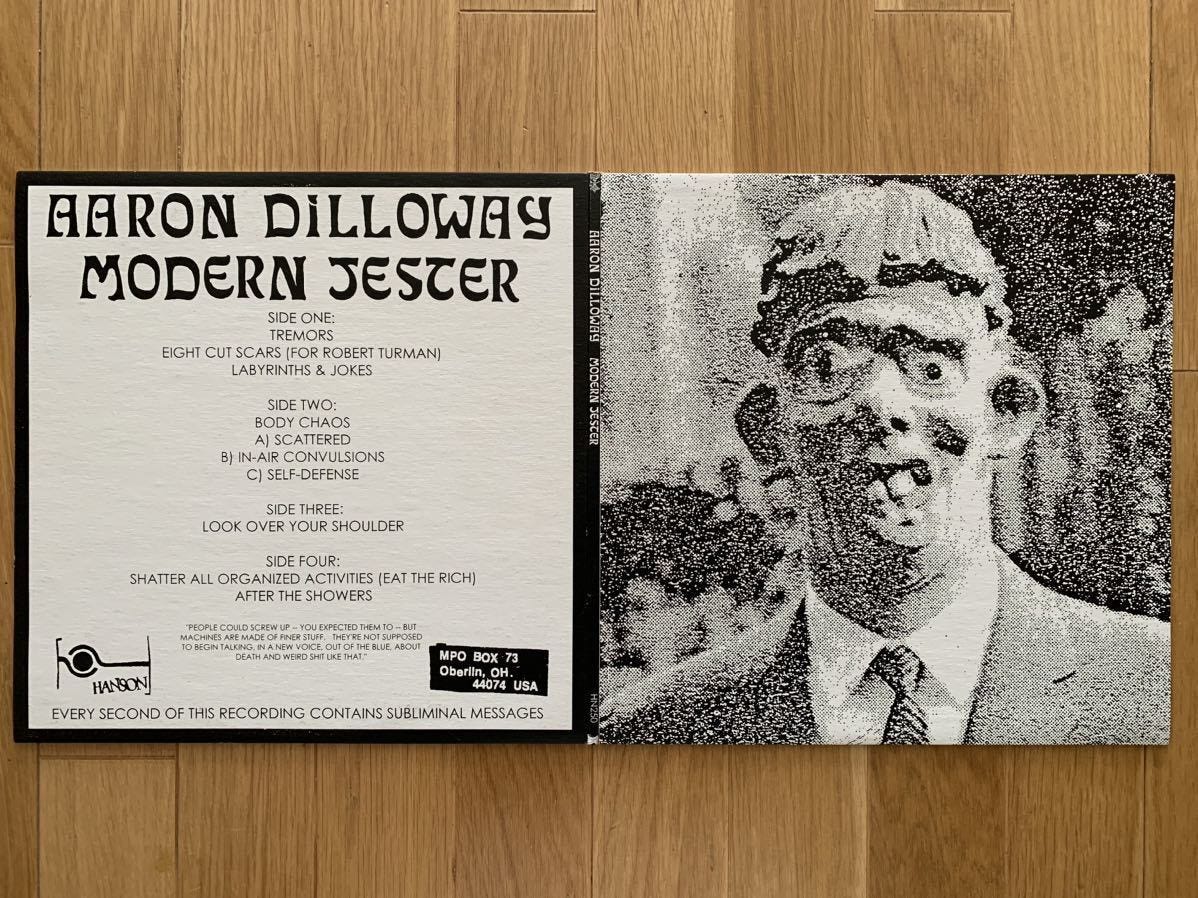
To lay bare the pure pragmatics of Modern Jester, it is not enough to link it with the meaningless sign which, with Meillassoux’s aid, is associated with pure noise11. Dilloway’s naturalism also reflects the obsolescence of genre, insofar as his field recordings are a decisive component of his work. After leaving Wolf Eyes to live in Kathmandu—the capital of Nepal in India—six years later this unclassifiable album emerges, one that nonetheless offers an auditory account of the routines characteristic of the manifest image. I will now build a bridge between the author’s earliest and latest phases in order to argue that “Genre is Obsolete” is especially useful for analyzing Brassier’s transition toward a more attentive reading of the manifest image in Sellars, bringing together different forms of naturalism within a shared set of norms and practices.
2. Sellars and the Transcendental Analysis of Intentionality
The dominant register in Nihil Unbound was that of a transcendental realism of the end of meaning as extinction of meaning, where this latter concept marks the conceptual reinscription of the world’s indifference to thought. However, in his 3:16 interview, Brassier admits that his support for the project of eliminating the manifest understanding of the mind was based on a mistake: the misidentification of the normative core of the manifest image with the entities of folk psychology. One of Sellars’s most fruitful ideas, Ray points out, is that to characterize someone as a thinker is to place them within the logical space of “giving and asking for reasons,” rather than to provide an empirical description of their behavior. Hence the need to grasp the distinction between empirical-descriptive discourse and normative discourse.
Explaining the staggering scope of the space of reasons exceeds the limits of this essay, whose original purpose was to examine its relation to the ascetics of perpetual innovation, which requires attending both to the metaphysics of incompossibility in generic obsolescence and to the pragmatist conception of normative intentionality. In his recent lecture “Norms, Facts, and Forms: Capital as Third Thing,”1213 Brassier focuses on the relationship between Marx and the Pittsburgh School (Sellars, Brandom, McDowell). He begins his analysis by recapitulating the hypothesis of Luz Seiberth’s book on the concept of intentionality in Sellars, the aspect of his reading that interests us in order to understand the domain of intentional agency in Dilloway. According to Seiberth, Sellars recodes the Kantian distinction between transcendental immanence and metaphysical immanence, distinguishing between horizontal and vertical intentionality13. Instead of conceiving intentionality in the traditional sense, as a vertical relation connecting thoughts with things (a word–world relation), Sellars reconceives it as a relation between thoughts (a word–word relation).
In the space of reasons, inference constitutes the basic transition from thought to thought. For this motif, for Sellars, the logical dimension in which perception grounds judgment—and vice versa—represents the intersection between the horizontal dimension of logical justification and the vertical dimension of efficient causation14. Paraphrasing Brassier, identifying the point of origin at which logical immanence and causal transcendence diverge is the aim of Sellars’s transcendental analysis of intentionality. In line with our staging, Dilloway materializes intentionality in nature, as his loops appear to demonstrate the fact that transitions from perception to thought and from thought to action form behavioral circuits that can be situated within the causal realm. These behavioral circuits, which bear some affinity with the accelerationist concept of hyperstition, should be understood more accurately as a corollary of Kant and Sellars’s normative thesis, according to which the notions of accepting and inferring are inextricably linked—meaning that every autonomous discursive practice, such as noise, must incorporate the practices of giving and asking for reasons1516.
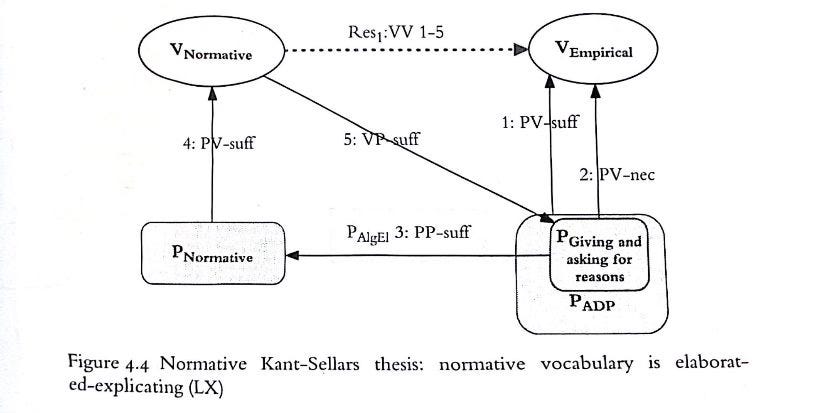
What is realized in Dilloway is what James O’Shea calls Sellars’s “norm/nature meta-principle,” that is, the fusion between rational activity governed by rules and behavioral regularity governed by rules. Sellars elaborates: “espousal of principles is reflected in uniformities of performance” (1991: 216). We must understand the significance of Sellars’s distinction between logical form and empirical form to explain his transcendental domain: concepts have logical form by virtue of their inferential roles, and since these are justificatory, logical form is equivalent to epistemic potential. As the materialization of an incompossibility, empirical form consists in its factual properties, such as the shape, texture, frequency, amplitude, and format employed by Dilloway. In this way, linguistic performance reflects principles at the level of empirical form, and simultaneously, linguistic performance is related to the objects by which it is elicited: cassette recorders and looped tapes, contact and throat microphones, analog effect pedals, feedback between microphones and speakers, as well as amplified everyday objects such as metals, tubes, or plastics.
For Brassier and Sellars, the correspondence between the empirical form of objects and that of the utterances they elicit is not a first-order correspondence between empirical properties and causal objects, but rather a second-order isomorphism between relations among object properties and relations among properties of the utterances they cause16. This isomorphism is what we understand as picturing. In the words of Richard Rorty, who dismisses this concept as metaphysical: “Picturing is for Sellars what disclosedness is for Heidegger” (1988: 216)1718. That is, an appeal to the transcendental dimension of truth. Although Rorty’s rejection of this concept resonates with Brandom and McDowell, for Sellars and Brassier it signifies both the condition and the consequence of normative activity within the transcendental dimension of their naturalism. We suggested that contact with normality in Nepal paved the way for Dilloway’s naturalism of the obsolete, since there can be no adoption of principles without uniformities of performance.
Seiberth states: “The isomorphism is at once a result of linguistic activity and its transcendental precondition” (2022: 124). In other words, logical form depends on empirical form, since “the empirical form, allowing a function to be realized or reflected in a uniformity of behaviour, sustains the logical form” (2022: 125). To the extent that logical form must be empirically realized, truth—reflected in the adoption of principles within uniformities of performance—is a sign that something needs to be done. Hence, we can affirm that truth, more than correspondence, is interference.
3. The Myth of Experience: Capitalism and the Space of Reasons
The conclusion of “Norms, Facts, and Forms” prompts a reevaluation of the ending of “Genre Is Obsolete.” In his 2007 article, Brassier closes his analysis with debates concerning the subversive potential of these genreless practices. Critiques usually come from a cultural sphere whose relationship with the capitalist economy is at once transparent and opaque. Although pseudo-genre is also a commodity, its practitioners do not aim to be more or less subversive than those of any other marketable genre. For this reason, his alignment with right-Sellarsianism leads him to identify much of contemporary critical theory with a vaguely Marxist tone as responsible for glorifying neo-Romantic clichés regarding the transformative power of aesthetic experience: “The invocation of somatic and psychological factors in accounts of the (supposedly) viscerally liberating properties of ‘noise’ reiterates the privileging of subjective (or inter-subjective) experience in attempts to justify the edificatory virtues of making and listening to experimental music. But neither playing nor listening can continue to be privileged in this way as loci of political subjectivation. The myth of ‘experience,’ whether subjectively or inter-subjectively construed, whether individual or collective, was consecrated by the culture of early bourgeois modernity and continues to loom large in cultural theory” (2007: 172).
His prior inclination toward scientific naturalism, visualized in Churchland’s eliminative materialism and Metzinger’s SMT approach, leads Brassier to postulate the dissolution of genre in line with the dissolution of the structure of social existence: “In this regard, the negation of generic categories exemplified by Shave and Runzelstirn bears a cognitive import which invites us to embrace the eradication of experience as an opportunity to re-fashion the relationship between the social, psychological, and neurobiological factors in the determination of culture” (2007: 173). Through noise, Brassier’s intention was to eradicate experience both in the sociological determination of neurobiology and in the neurobiological determination of culture.
However, in his 2024 lecture for The New Centre for Research and Practice, Brassier’s current left-Sellarsianism leads him to consider the space of reasons as split by capitalist class relations. Moreover, his interest in social consciousness proves incompatible with the remodeling of pre-established culture. Interestingly, his inferentialist mixture of Sellars and Marx, as well as his neurobiological linkage between Shave and Runzelstirn, share the same idea. For Sellars, discursive activity fuses logical form with empirical form. For Marx, social forms—the wage labor, commodification, and money—fuse normative authority with empirical form. For Brassier, in sum, the radicality of formal and structural resources (logic form) must fuse with the cognitive and cultural form of sonic experimentation (empirical form). Dilloway, with his inconmensurable generic short-circuits, generates the noise of anomaly in the manifest image, implicitly committed to the Sellarsian idea that rule-governed behavior is the flip side of rule-governed activity at the level of social consciousness, and not merely reducible to a concrete neurophysiological reality.
- Wilfrid Sellars, “Philosophy and the Scientific Image of Man”, in Science, Percepción and Reality (1963). ↩︎
- Reprinted in 1997 as a book, with an introduction by Richard Rorty and a supplement by Robert Brandom. In his analysis of human self-understanding, Sellars introduces the myth of Jones as a narrative that explains the origin of our conception of the mental. The myth of Jones suggests that we did not always conceive of ourselves as mental beings motivated by thoughts and sensations; it had to be learned, and the acquisition of such resources constituted a transcendental step in our cognitive evolution. ↩︎
- Cfr. Jaroslav Peregrin, “Should One Be A Left or A Right Sellarsian?”, in Metaphilosophy, 2016; Mark Lance, “The Word Made Flesh: Toward a Neo-Sellarsian View of Concepts, Analysis, and Understanding”, in Acta Analytica, 2000. Thanks to Federico Nieto from The New Centre for these valuable references. ↩︎
- https://www.3-16am.co.uk/articles/nihil-unbound ↩︎
- https://www.multitudes.net/genre-is-obsolete ↩︎
- “It is the noise that is not ‘noise’, the noise of the sui generis, that actualizes the disorientating potencies long claimed for ‘noise’.” (Brassier, 2007: 173). This idea of reestablishing a bridge between epistemology and metaphysics is in line with Ray’s intention in “Concepts and Objects”. ↩︎
- Aria Dean, “Notes on Blaccerelation”, E-flux #87: http://worker01.e-flux.com/pdf/article_169402.pdf. ↩︎
- We follow Brassier in holding that the best interpretation of the emerging ‘noise’ scene in the late 1980s and early 1990s appears in Bananafish magazine, edited by Seymour Glass. ↩︎
- Retrocausality of loops is a central element in the hyperstitional practices of the CCRU and, more broadly, in Nick Land’s writing. ↩︎
- In Meillassoux’s ontology of the empty sign, we find the following terminology: repetition is a differential and finite recurrence, in space and time, always measurable; iteration is a non-differential and unlimited recurrence, producing pure identity anew by capturing the identical of the same kind. The meaning of the kenotype is to be an iterable mark, linked in Meillassoux’s epistemology of ancestrality with contingency. Cf. Quentin Meillassoux, “Iteration, Reiteration, Repetition: A Speculative Analysis of the Meaningless Sign”, 2016. ↩︎
- Paul Hegarty, referring to Dilloway’s quarantine video concert, in which he showed chickens eating on amplified floors, identifies this act with ‘pure noise’ (2022: 81). ↩︎
- Full lecture available here.
↩︎ - Luz Seiberth, Intentionality in Sellars: A Trascendental Account of Finite Knowledge, 2022. ↩︎
- Wilfrid Sellars, Empiricism and the Philosophy of Mind, §38. ↩︎
- Robert Brandom, “Modality and Normativity: From Hume and Quine to Kant and Sellars”, in Between Saying & Doing. Towards an Analytic Pragmatism, 2008. ↩︎
- Cfr. Luz Seiberth, “Sellars’ Metaontology”, in Reading Kant with Sellars. Reconceiving Kantian Themes, 2025. ↩︎
- Richard Rorty, “Representation, Social Practise, and Truth”, in Philosophical Studies: An International Journal for Philosophy in the Analytic Tradition. Colloquium on Sellarsian Philosophy, 2000. ↩︎
 Hyperspekulation
Leave a comment